
The most difficult part of conceptual agreement for most consultants is establishing value. That’s because they believe that the objectives constitute the value— and they probably will, if we left it at that.
But what I’ve learned is that there is a multiplicity of value emerging from most individual objectives. The more we cajole the buyer into agreeing as to what they are and the impact on the buyer personally and the organizations professionally, the higher fees we can justify in terms of return on investment (ROI).
Here’s a single, stereotypical objective that most people would also say is the value derived: Increase profit.
However, potential value from reaching the objective of increased profit includes:
- Pay higher dividends to investors.
- Invest in business expansion.
- Increase bonuses to retain top talent.
- Be more competitive in hiring.
- Pay down debt.
- Improve stock price.
You get the idea. By prompting and provoking the buyer, you can derive a great deal of value from each objective. And it’s the value that will be used to justify the fees you charge, not the objectives.
Questions to ask to generate value statements include:
- What will these results mean for your organization?
- How would you assess the actual return (ROI, ROA, ROS, ROE, etc.)?
- What would be the extent of the improvement (or correction)?
- How will these results impact the bottom line?
- What are the annualized savings (first year might be deceptive)?
- What is the intangible impact (on repute, safety, comfort, etc.)?
- How would you, personally, be better off or better supported?
- What is the scope of the impact (on customers, employees, vendors)?
- How important is this compared to your overall responsibilities?
- What if this fails?
The proposal’s ultimate fees will be based on these relationships, if understood by the buyer in this preparation stage:
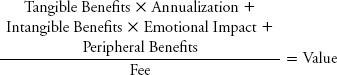
The tangible benefits (increased profit, decreased downtime) times the years the benefits will accrue and grow; plus the intangible benefits (be seen as a leader, dis- card unpleasant work) times their emotional impact; plus the peripheral benefits (easier to attract talent, better media treatment); over your fee, equals the value or ROI for the client.
A relatively few objectives can yield dozens of value statements, especially when you consider professional, personal, and peripheral, the three Ps of value. The higher these are in the buyer’s eyes and with the buyer’s concurrence, the higher your fee can be while still generating significant value.
Glossary
Value is the degree of positive impact personally, professionally, and peripherally that objectives that are met generate. It is the soul of the project, the reason that major investments can be readily justified.
Commodities, such as training programs or coaching days, don’t afford as much value because they are about time and materials and are easily compared to others’ prices. But true projects are never commodities and never comparable (which is why you should generally avoid RFPs, as discussed earlier).
Buyers, especially highly assertive and fast-moving senior people, tend to think in terms of tasks being accomplished and goals being reached. You have to “slow them down” a bit so that you can remind them and gain agreement on the results of those tasks that help to reach those goals. The intangible benefits are especially important, because circumstances such as increased safety, reduced stress, greater comfort, and increased aesthetics can be highly powerful drivers and highly regarded value. (This is why architects undercharge—they focus on the building extension rather than the improved quality of life for the family.)
Value, like beauty, may be in the eye of the beholder, but it’s nonetheless discussable and mutually appreciated. This final step in conceptual agreement is an integral part in preparing the client for an acceptable proposal and is absolutely vital, yet often rushed through or completely ignored.
Here is a summary of the key elements before we move on to ensuing that these approaches reach the right eyes and ears:
- Never provide a proposal for a gatekeeper or intermediary, even if that person promises to “sell” it for you. That person won’t have your passion and will fold under pressure. He or she has more to lose than you do.
- Forge a trusting relationship first, so that the buyer is comfortable sharing facts, opinions, needs, and desires. Invest as much time as needed to develop that bond.
- Clearly understand and differentiate among objectives, metrics, and value. Focus on the multiple value and impact that any one objective may represent.
- Reaffirm each item in these three areas with the buyer. Ensure that you have true conceptual agreement prior to creating any proposal.
- Never discuss fees at this point. The key is what the buyer’s improved conditions will be. The fees and subsequent ROI will come later. If you are talking about fees or price at this point, you’ve lost control of the discussion.
Notes
1. Along with failing to build a trusting relationship; failing to provide options; failing to establish definitive next steps; and failing to charge high enough fees. All can be remedied with this book!
2. For details on this highest quality of all trusting mechanisms and referrals, see my book Million Dollar Referrals (McGraw-Hill, 2011).
3. With apologies to Jim Collins and his fine book, too many companies blindly want to embrace the mantra and not the meaning.
4. Returns on investment, assets, sales, equity.