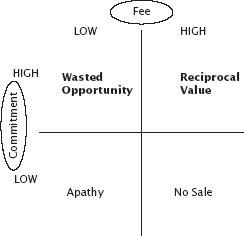
There are times when the buyer will respond with the request for a delay. The requests are usually about time and money, in that it’s not the right time, or there’s another budget cycle approaching, or that there may be too much disruption at the moment. If you simply accept these requests in good faith, you will be doomed.
Here are my tricks of the trade for counteracting these not-infrequent requests:
1. Find out what’s changed.
If nothing has changed, then the buyer wouldn’t be asking for the delay. After all, you probably (should have) already asked if there were any obstacles not discussed after conceptual agreement but prior to writing the proposal.
So something had to have changed, or the buyer wasn’t being candid with you before. Find out if it’s a legitimate obstacle, such as a budget abruptly reduced or a new responsibility added, or if it’s a chimera. If nothing has changed, then it’s just an excuse.
If there is new information or concern, work with the buyer to overcome it. Any delay in your project will probably doom it. My estimation is that 90 percent of proposals that are delayed after submission are never accepted at all. Make these arguments:
- There is no time like the present. The project’s advantages and value will be even more important in a tougher environment or with the threat of disruption.
- You’ve seen this before. You can adapt and you can help the buyer to adapt to the new circumstances as the project goes forward.
- The budget will be lost if it’s not used. The buyer clearly had funds he or she was willing to invest. Those funds might well be removed or redirected if not invested in this project now.
- Offer to meet the buyer’s boss if that would be helpful and is possible.
- Offer to reorient your efforts and the project to incorporate and/or address the new priority and new issues. You’re a valued resource, the buyer has a new need, money has been allocated—you can get a running start.
2. Find out if it’s an excuse.
The buyer will sometimes offer a lack of money or time as an excuse. Here is what might have transpired and what you can do about it:
- Subordinates have learned of the project and are terrified. In this case, tell the buyer that lower level people are always discomfited when there is a threat to the “nest,” but that you’ll be happy to place a few of them on a steering committee to give them formal input.
- Someone else has learned of the cost and has objected, without under- standing the value or ROI. Offer to explain to the offended party or to provide the buyer with the language and rationale to handle the objective.
- As in my case study, your buyer may be “big hat, no cattle” and be intimidated about actually approving the work. In this case, don’t throw good money after bad. Some people are just afraid.
3. There is a legitimate cause for pause.
The buyer may be undergoing a personal setback in terms of a family problem, illness, or finances; the organization may have added responsibilities to the buyer, demanding that the buyer travel somewhere, or actually frozen all budgets. These events happen all too often.
Try to establish the best time to pick up the discussion again. If the matter is personal and you know that, provide some breathing space and simply keep in touch with the buyer’s assistants until you’re told that things have stabilized and he or she is attending to work again. If it’s organizational, work with the buyer to choose definitive review dates and times to assess next steps.
Legitimate delays aren’t always fatal, though they are most of the time. Try to “stay in the game” with frequent contact and review of status. Remind the buyer that the terms in the proposal are not eternal, and that your availability and your fees may change abruptly.
Case Study: The Hospital CEO
I was introduced to the CEO of a major hospital group who needed coaching, because he wasn’t getting along with a key subordinate and also had problems with his boss, the board chair. We agreed to meet in person, and he flew in on the company’s private jet. I picked him up in my Bentley convertible, and he told me he had a similar model.
We spent two hours at my house and, as a result, I FedExed a proposal after taking him back to the airport and the private jet.
My top option was a $45,000-a-month coaching relationship, with less expensive Options 1 and 2. After a week, he finally returned my messages, and said that Option 3 was clearly the only one that made sense, but he could never justify the cost. He was afraid of what his disruptive subordinate might say to his prickly chairman of the board.
“But your jet trip to see me cost you that much,” I pointed out.
“Yes, but no one really knows the purpose of that trip.”
So the Bentley-driving, million-dollar CEO had to opt out because he was afraid of what others might think. Of course, he could have funded this himself, but that was apparently unthinkable. You can’t win them all.
But most of all, remember that time and money are not resources, but are rather priorities. So don’t fall victim to a wait until resources are forthcoming. Instead, build a case that you and your project represent a larger priority than those to which money and time are currently being invested. This is what can dramatically shorten your process and best overcome this objection.
If you’re a large enough priority, resources will flow to you nonetheless. Continually demonstrate your importance to your buyer, the organization, and the results that were specified in the proposal. All good things do not come to people who wait.
They come to people who make their case.