Determining the Economic Buyer

The economic buyer is the linchpin to any proposal because only he or she can say yes (or no). You want to avoid those people who can say no but can’t say yes—the gatekeepers. (Later on, we discuss techniques that provide for a choice of yeses, thereby improving your odds hugely.)

I actually had someone (on Twitter, where else?) attempt to argue with me that he is a buyer in his company and has his own budget, yet must get permission from his boss to spend it! No matter what he chooses to call himself or how he prefers to delude himself, he’s not a buyer. True, economic buyers have the power to spend money on their own authority.

Now, buyers may change roles as the money changes. Someone with a maximum spending grant of $300,000 is not going to be your buyer for a $2 million project. Some consultants actually “outgrow” their buyers as their services become more comprehensive and sophisticated. That’s quite fine. 

Whenever you receive or generate a lead, don’t simply do back flips because someone is interested in your services. Use the interest to quickly determine whether the person involved is a buyer. If they are, we discuss how to develop a trusting relationship in the next segment. But if they’re not, then your sole course of action is to explore how that person can lead you to the true buyer. 

That may sound mercenary at first blush, but I’ll remind you that this is a business, not an avocation. Here are some questions to pursue to test whether someone is a buyer: 

1. Whose budget will support this initiative?
2. Who can immediately approve this project?
3. To whom will people look for support, approval, and credibility?
4. Who controls the resources required to make this happen?
5. Who has initiated this request?
6. Who will claim responsibility for the results?
7. Who will be seen as the main sponsor and/or champion?
8. Do you have to seek anyone else’s approval?
9. Who will accept or reject proposals?
10. If you and I were to shake hands, could I begin tomorrow?
11. What is the decision-making process for this type of approval?

You don’t have to interrogate someone under a bare light bulb, but you do need to use several of these questions to ascertain who is going to approve your eventual proposal. Normally, human resources people and training people are never economic buyers in any major organization. They are usually acting on behalf of a line entity that has requested help in finding resources. The only exceptions are occasionally the executive vice president (or similar title) of HR, but that isn’t terribly common, either. (These people are sometimes buyers for commodities, such as training materials, seminars, and so forth.) 

Key Point: The larger the organization, the more the number of economic buyers. They need not be the CEO or owner, but must be able to authorize and produce payment. Committees are never economic buyers. 

As painful or awkward as it may seem (no doubt some of you reading this are refugees from HR), you cannot afford to establish relationships with non buyers. You will be seen as their peer, which will completely undermine you with executives, or they will consume your time and never introduce you to anyone who can buy out of fear of being left out. Ironically, many HR people “tasked” with finding consultants (whom they inevitably regard as vendors) are offended that they, them- selves, haven’t been asked to complete the project seeking external resources. Finally, these folks seldom understand the larger picture, strategy, or sophisticated results. 

In other words, it’s the La Brea Tar Pits of approval.
You’ll also find that committees are next to useless.

First, when someone says, “The committee will have to hear this,” you know immediately that that person is not a buyer! Second, few committees have budgets. They are usually recommending agents to the person who does have a budget. Third, there is almost always someone on the committee who is the actual decision maker or a key recommender (KR). These key recommenders can be highly useful because, unlike other gatekeepers, they see their role as introducing high-quality re- sources to important buyers.

So either find the decision maker or KR on the committee, or find the person to whom the committee is reporting its recommendations. 

In small companies, the buyer is the owner, founder, or president, with rare exception. That’s also true in medium-sized companies, but here you might also find a general manager or a similar position. In large companies, you might find buyers all over the place, and their status seldom is reflected on their business card. For example, in banks everyone is a vice president, even if they merely keep the lines orderly, but virtually no one has any real authority (try to get a small business loan). However, in Merck, a Fortune 50 company, I had dozens of buyers in a dozen years, and one who approved $250,000 in projects three years in a row had the modest title of “director of international development.” 

Although you may assume that in large organizations the heads of business units and large staff areas are always buyers, you can add to that hundreds of people who happen to have significant budget latitude. So you have to do some groundwork, using the questions above and asking others whom you meet. 

Keep this in mind: You have value that can significantly improve the client’s condition. It’s incumbent on you to try to implement that value to achieve that end. The sole manner in which to do so efficaciously is through someone who can completely agree to, approve, and fund a project. If you lose sight of that goal, then no amount of speed or enthusiasm will compensate for your ending up in the wrong port. Of the five ways in which most consultants fail to sustain themselves, the inability to find the true buyer is one.

Developing Trusting Relationships

A trusting relationship in this context is one in which the economic buyer and the consultant interact as peers, exploring whether a project makes sense and, if so, how to proceed as partners. Such a relationship is required prior to successful proposals because the linchpin of the proposal and the basis for your fees— conceptual agreement—cannot be thoroughly obtained without trust. 

If I am to share my objectives, agree on metrics, stipulate value, raise honest objections, cite probably risks, and so on, I must trust you. These are not issues that are plastered on the walls or broadcast on the elevators. 

Here are the hallmarks of a trusting relationship: 

  • Volunteering information, for example, “We’ve had a hard time recruiting minority candidates for key positions, and it’s a thorn in our side.” 

  • Sharing background, for example, “I never would have come here myself, except the COO changed and the new one had worked with me prior and I respect him enormously.” 

  • Allowing and entertaining push back, for example, “Your idea that we need to take ‘heroic measures’ outside of our own compensation criteria is risky but perhaps inevitable.” 

  • Agreements are met, for example, meetings are uninterrupted, calls are returned, promised documentation is provided, and so on. 

  • Advice is sought, for example, “How would you organize such a search effort if you had carte blanche?” 

  • Value is admitted, for example, “We’ve never looked at it that way before, and you’ve just provided a significant new route for us.” 

Sometimes trusting relationships are built in 20 minutes, and sometimes it requires three meetings. (If it takes months, it was not meant to be.) One of the great- est mistakes consultants make is to hurry through what they believe to be the “preliminaries” in order to get to the “deal” and the proposal. Any proposal that is not the result of conceptual agreement based on a trusting relationship is inauthentic, and the odds of it being successful are a fraction as high as when done the right way.

Sometimes you can generate “instant trust.” This has probably happened to you in the past on occasion, and here are three underlying principles in a business setting:

1. Platinum reference.

A peer of the buyer recommends you to the buyer. Their relationship is so strong that your prospective buyer is prepared to instantly respect you and trust you. Think of the conditions under which you make purchases and instantly trust others—these are often due to a trusted colleague or friend’s recommendations.

2. Commercially published book.

This is the “gold standard,” and many buyers will swoon and gladly form immediate bonds with a commercially published (not self-published) author, especially if the work is well known. Many of my clients rapidly entered into the proposal phase with me even though they hadn’t actually read my book! That was fine with me, and I certainly didn’t test them on the contents of Chapter 8.

Glossary

Trusting relationships are those wherein either party trusts the other with their “wallet”—ideas, information, insights, innovation.

3. Well-known intellectual property (IP) and/or visibility.

Sometimes you may be featured in the media as an expert, or you may be responsible for a model or methodology that is highly popular. Someone I mentor is usually called for media interviews on his specialty—crisis management, for example.

These are three methods for instant credibility. They don’t always work, and in any case most of us will be faced with trudging up a steeper hill. Here are five tips that will help you create trusting relationships when you don’t have access to the express lanes:

1. Offer value from the outset.

Those who tell you to refrain from “giving away” your intellectual property are either paranoid or don’t have any IP that others would find valuable in any case. Why else would I write more than 40 books, encouraging people to learn, apply, and benefit from my techniques? Because they want more. Many of you reading this book will purchase others, or attend a speech I’m giving, or join my Mentor Program, listen to a teleconference, and so forth. What you want to create is the belief that, “If I’m getting this much from an initial meeting, how much more would I derive from partnering on a project?”

2. Listen and ask provocative questions.

Never give a “pitch.” Throw “elevator pitches” down the shaft. Never enter any buyer’s office with a PowerPoint presentation or a “card deck.” One buyer, who spoke to me for 45 minutes straight with only a brief “Really?” or “Hmmmm” from me (to prove I wasn’t asleep with my eyes open) finally told me that he believed I was “the first consultant who ever sat in his office who really understood his business.” (He became a $565,000 client over the course of five years.)

3. Look and act like a success.

Wear an expensive suit. Don’t take out a dollar pen to write notes in a battered notebook. Your shoes should be shined, you hair well styled, and your accessories intelligent. If you’re driving to the client and don’t have a nice car, then rent one. Lest this seem superficial to you, permit me to remind you that successful people want to be around successful people, and they will more readily trust people who are manifestly successful. Wouldn’t you? I’m not taking skiing lessons from the instructor with battered equipment who can’t afford a lift ticket.

4. Never dumb down your language.

This is among the worst advice in the history of sales and marketing, and it’s usually espoused by those who seek to bring others down to their level of inarticulateness. Use metaphor, example, metonymy, analogy, and “war stories.” Study enough to be conversant in the buyer’s business (e.g., in a bank know what a loan defalcation means), but you don’t have to be the content expert (because the client already is).

5. Stay in the moment and don’t think about “selling.”

Have a conversation. Focus on the fact that you are evaluating whether you want to work with this buyer just as the buyer is evaluating whether to work with you. Don’t put undue pressure on yourself or the circumstances. Patience trumps pressure. You want to be seen as a calm resource, not a vendor desperate for a sale.

Now let’s look at the next step in our leap.

Establishing Outcome-Based Business Objectives

Most objectives that govern projects really aren’t objectives. They tend to be deliverable, especially if they are created by the training or human resources functions. They are also often metrics, rather than results.

Here are examples of some truly lousy project objectives that nonetheless often stick their ugly heads above the water: 

  • Run a three-day leadership conference.
  • Provide coaching for one day per week.
  • Create a customer call processing of 15 people per hour.
  • Counsel Mike on how to better manage his time.
  • Develop more staff confidence.
  • Take us from “good to great.”

Now I’ll turn them into true business outcomes that mean something in terms of eventual value, which we cover later in this chapter: 

  • Leaders will voluntarily share resources and information and cease creating duplication and client confusion. 

  • Enable Mary to present corporate results to the media without reading a prepared script and to answer spontaneous questions rapidly and to the satisfaction of the questioner. 

  • Improve the speed of customer processing without diminishing quality. 

  • Enable Mike to get his job completed to his boss’s satisfaction in less than 45 hours per week. 

  • Push decision making down to front line levels so that there are fewer approvals, faster response time, and less failure work. 

  • Maximize our ability to ___________ (fill in the blank). 

You might disagree with some of my wording, which is fine, but I think you’ll agree that we’re not talking about results that have an impact on the business and not simply tasks. 

About 99.99 percent of all RFPs (requests for proposals) you’ll ever receive are really arbitrary alternatives packaged as if they are projects. They specify how much time, duration, how many people, how many sites, and so on. They are invariably created by a cohort of low level people who evaluate all the wrong things—tasks versus outcomes. (Will you eat lunch on-site? Will you cut your bread horizontally or diagonally?) This is why it’s rarely sensible to respond to RFPs, because you’re never dealing with a buyer and the source is always looking for how much you’ll charge by the hour. 

These 11 questions best elicit true business objectives: 

A few of these questions honestly answered in a trusting relationship will provide your project objectives (which is why an economic buyer’s attention is all you need—no needs analysis, endless interviews, and so on). Ironically, lower level people and gatekeepers usually can’t give you the proper answers because they don’t know them! 

Most projects have a handful of objectives, from two to six. A single objective is usually too narrowly focused on an alternative (e.g., place an interview in publication X), and too many are usually a gallimaufry of vague intentions (e.g., expand in Europe while developing our domestic management team and improving quality). 

Each objective can provide a variety of values to the client, so even a few can result in substantial impact, which in turn justifies significant fees.

The best way to rapidly move a buyer from tasks and arbitrary alternatives to genuine business outcomes is to ask, “Why?”   

“We want someone to run a weekend strategy retreat in October.”

“Why?”

“Our strategy isn’t being universally implemented uniformly.”

Glossary 

Objectives are business outcomes and results that have substantial impact on the products, services, and relationships of the enterprise, and which can be measured. They may be new opportunities reached or problems solved.

“So your need is to accelerate your ability to meet your strategic goals on a global basis?” 

“That’s the reason.” 

Note how much more value is inherent in that restated objective, and how much more latitude exists for meeting it than a simple weekend of moving items from one easel sheet to another! 

Establishing Metrics for Progress and Success

The basic question to ask ourselves here is, “How would you know it if you tripped over it?” 

There is far too much going on in terms of “feeling confident” or “clarifying” or “believing.” But you don’t know that those are not proper indicators. You wouldn’t know them if you tripped over them. (The only way you know that I’m more confident is that I ask you fewer questions, confront buyers with better rebuttals, speak up forcefully at meetings, and so forth.) 

The measures of success will underscore the direct role that your contributions have played in reaching the objectives.

There can be more than one metric for a given objective:

  • Objective: Increase repute in the community.
  • Measures:
  • Increased, positive coverage in local media.
  • Local service club bestows accolades and awards.
  • Higher levels of local, highly qualified job candidates.

Glossary 

Metrics are indicators of progress or success, which anyone can use to determine that key goals have been reached. They reside in observed behavior and/or evidence in the environment.

Some of the questions you can ask include: 

  • How will you know we’ve accomplished your intent?
  • How, specifically, will the operation be different when we’re done?
  • How will you measure this?
  • What indicators will you use to assess our progress?
  • Who or what will report on our results (against the objectives)?
  • Do you already have measures in place that you intend to apply?
  • What is the rate of return (on sales, investment, etc.) that you seek?
  • How will we know how the public, employees, and/or customers perceive it?
  • Each time we talk, what standard will tell us we’re progressing?
  • How would you know it if you tripped over it?

Some metrics are anecdotal, not scientific. That’s okay, as long as you and the buyer agree on who is doing the measuring and how. For example, a divisional general manager sought greater team collaboration with fewer turf battles. When I asked how he’d know this was accomplished, he told me, “I won’t be seeing warring factions every day in my office for whom I have to serve as referee.” 

That was good enough for me and for him. 

Metrics are vital during the project so that there are early indications of anyone falling behind. That way you can alert your buyer, who has the real clout and authority, that some attitudes and behaviors require changing. “You and I agreed that a key metric was that all five service areas embraced the new technology by April 1, but as of March 15, the call center has not had one person attend any meetings and the manager has not returned calls. You need to change his attitude about this.” 

A professor at the University of Wisconsin posited four levels of measurement in 1959: 

1. Reactions of learners.
2. Increased knowledge of learners.
3. Behavioral change of learners.
4. Results of the behavioral changes.

HR people still speak about this as if it’s the Holy Grail more than a half-century later, and training magazines quote it as scripture. Unfortunately, it was superficial and academic in 1959, and it still is today. The only measure that matters is improved results—an improved client condition, in this case represented by objectives met and validated by key metrics. Those metrics are, in turn, based on empirical evidence in the environment that can be readily identified.

Here’s another way to view the evidence you need: 

Beliefs—Enlightened self-interest
Attitudes—Normative pressure
Behaviors—Coercion

We tend to “whack” bad behaviors, but that only lasts as long as the whacker has a larger stick and is present. We tend to try to sway attitudes through normative pressure (“be one of the in crowd”), but such entreaties are inconsistent and opinion is fickle. 

Only through addressing enlightened self-interest can we prompt belief and attitude changes that will be reflected in behavior changes, which produce new results. Therefore, most projects will include elements on achieving commitment, and not merely compliance (whack), and will be measured by an improved resultant client condition. 

Try not to choose metrics (or objectives) that specify a level of performance, for example, a 3 percent margin improvement or six new customers per month. In- stead, create movement in the right direction: Maximize the margins as measured by the profit per customer improving, and maximize new customers per sales- person as measured by additional signed contracts monthly. 

Note that metrics and objectives may sometimes overlap and resemble each other. You may have an objective of “12 new accounts,” but I’d rather see “improvement in number of new accounts” as measured by monthly registrations. There are too many variables outside of your control to commit to specific numbers. The key is to arrive at a range in the objectives step that pleases the buyer (conceptual agreement) and to take the conservative end of that range. 

Sometimes, “success” is years away, for example, “create a European operation within the next five years.” Your contribution may only be for a portion of that time. But your metrics will cover the elements essential during your tenure—hiring five European account managers, translating materials into the six major languages, and so forth. 

Establishing Value and Impact

The most difficult part of conceptual agreement for most consultants is establishing value. That’s because they believe that the objectives constitute the value— and they probably will, if we left it at that. 

But what I’ve learned is that there is a multiplicity of value emerging from most individual objectives. The more we cajole the buyer into agreeing as to what they are and the impact on the buyer personally and the organizations professionally, the higher fees we can justify in terms of return on investment (ROI).

Here’s a single, stereotypical objective that most people would also say is the value derived: Increase profit. 

However, potential value from reaching the objective of increased profit includes: 

  • Pay higher dividends to investors.
  • Invest in business expansion.
  • Increase bonuses to retain top talent.
  • Be more competitive in hiring.
  • Pay down debt.
  • Improve stock price.

You get the idea. By prompting and provoking the buyer, you can derive a great deal of value from each objective. And it’s the value that will be used to justify the fees you charge, not the objectives. 

Questions to ask to generate value statements include: 

  • What will these results mean for your organization?
  • How would you assess the actual return (ROI, ROA, ROS, ROE, etc.)?
  • What would be the extent of the improvement (or correction)?
  • How will these results impact the bottom line?
  • What are the annualized savings (first year might be deceptive)?
  • What is the intangible impact (on repute, safety, comfort, etc.)?
  • How would you, personally, be better off or better supported?
  • What is the scope of the impact (on customers, employees, vendors)?
  • How important is this compared to your overall responsibilities?
  • What if this fails?

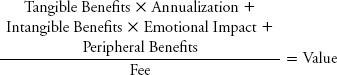
The proposal’s ultimate fees will be based on these relationships, if understood by the buyer in this preparation stage: 

The tangible benefits (increased profit, decreased downtime) times the years the benefits will accrue and grow; plus the intangible benefits (be seen as a leader, dis- card unpleasant work) times their emotional impact; plus the peripheral benefits (easier to attract talent, better media treatment); over your fee, equals the value or ROI for the client. 

A relatively few objectives can yield dozens of value statements, especially when you consider professional, personal, and peripheral, the three Ps of value. The higher these are in the buyer’s eyes and with the buyer’s concurrence, the higher your fee can be while still generating significant value.

Glossary 

Value is the degree of positive impact personally, professionally, and peripherally that objectives that are met generate. It is the soul of the project, the reason that major investments can be readily justified.

Commodities, such as training programs or coaching days, don’t afford as much value because they are about time and materials and are easily compared to others’ prices. But true projects are never commodities and never comparable (which is why you should generally avoid RFPs, as discussed earlier). 

Buyers, especially highly assertive and fast-moving senior people, tend to think in terms of tasks being accomplished and goals being reached. You have to “slow them down” a bit so that you can remind them and gain agreement on the results of those tasks that help to reach those goals. The intangible benefits are especially important, because circumstances such as increased safety, reduced stress, greater comfort, and increased aesthetics can be highly powerful drivers and highly regarded value. (This is why architects undercharge—they focus on the building extension rather than the improved quality of life for the family.) 

Value, like beauty, may be in the eye of the beholder, but it’s nonetheless discussable and mutually appreciated. This final step in conceptual agreement is an integral part in preparing the client for an acceptable proposal and is absolutely vital, yet often rushed through or completely ignored. 

Here is a summary of the key elements before we move on to ensuing that these approaches reach the right eyes and ears: 

  • Never provide a proposal for a gatekeeper or intermediary, even if that person promises to “sell” it for you. That person won’t have your passion and will fold under pressure. He or she has more to lose than you do.   

  • Forge a trusting relationship first, so that the buyer is comfortable sharing facts, opinions, needs, and desires. Invest as much time as needed to develop that bond. 

  • Clearly understand and differentiate among objectives, metrics, and value. Focus on the multiple value and impact that any one objective may represent. 

  • Reaffirm each item in these three areas with the buyer. Ensure that you have true conceptual agreement prior to creating any proposal. 

  • Never discuss fees at this point. The key is what the buyer’s improved conditions will be. The fees and subsequent ROI will come later. If you are talking about fees or price at this point, you’ve lost control of the discussion.

Notes 

1. Along with failing to build a trusting relationship; failing to provide options; failing to establish definitive next steps; and failing to charge high enough fees. All can be remedied with this book!

2. For details on this highest quality of all trusting mechanisms and referrals, see my book Million Dollar Referrals (McGraw-Hill, 2011).

3. With apologies to Jim Collins and his fine book, too many companies blindly want to embrace the mantra and not the meaning.

4. Returns on investment, assets, sales, equity.