Speed and Responsiveness

I promise my proposals within 24 hours in almost all cases. (Taking an international flight might prohibit this, but not always.) I can write it on the flight then e- mail it from my laptop or iPad on landing. Since I’d rarely schedule a flight like that the same day as a major meeting, it’s rarely ever been a problem, and it’s the kind of problem I love if I do have it! 

Speed is of the essence. Too many bad things can happen the longer you wait to submit your proposal: 

  • A client priority radically shifts.
  • Unexpected internal and external events intervene.
  • The buyer becomes ill or is reassigned or has personal problems.
  • A subordinate decides to resist because it’s threatening.
  • Legal and finance and HR get wind of it, and stick their noses in.
  • Across-the-board cuts are made.

You get the idea. Absence does not make the heart grow fonder; it makes people forget. You want to ride the wave of the positives you’ve created: trust, conceptual agreement, value, excitement. Consequently, you want to instantiate the discussions, ideas, concepts, agreements, and related matters in a formalized way as soon as you possibly can. 

I’m suggesting that as soon as you possibly can is the next business day. 

Since my proposal “architecture” is really a template, I suggest that you modify it within reason for your needs (e.g., you may want to include something about intellectual property if it worries you, but never include resumes for you and your staff), and then simply “plug in” the appropriate content in each of the nine areas.

Once you do that, you can read it through for flow and logic, and then finalize it. As I mentioned in the prior chapter, send two executed copies by FedEx to your buyer’s personal attention, and send an electronic copy only if requested. 

Glossary 

Instantiate: To convert intangibles into pragmatic, clear examples for action and next steps. Digression: Electronic Proposals I realize some people request and prefer these, and I’m no Luddite. I’m working as a coauthor right now on a book tentatively titled Web Dreams. Having said that, here are my reservations about electronically submitted proposals:

Digression: Electronic Proposals 

I realize some people request and prefer these, and I’m no Luddite. I’m working as a coauthor right now on a book tentatively titled Web Dreams. Having said that, here are my reservations about electronically submitted proposals:

  • The formatting is easily scrambled, and small errors can make major differences, as with decimal points, months, and so on. 

  • They are unsecure, and a secretary or assistant may regularly intercept e-mail (they are less likely to open a personal FedEx), and they may talk to friends in legal or HR. 

  • E-mail with attachments is often blocked or redirected for security reasons.

  • It’s far too easy to include someone else’s e-mail by accident, either at your end or the client’s end. 

  • You lose the richness of your letterhead, presentation folder, and so forth. 

For those reasons, I’ll send hard copy no matter what. I’m not using FedEx as a generic here, either. I use Federal Express because it has by far the best service, highest reliability, and easiest tracking. (I remember the DHL guy who would appear in a little van, smoking a cigarette to deliver to me. I don’t want his cousin delivering to my clients.) 

The proper sequence then, looks something like this: 

1. Conclude your conceptual agreement meeting in person with a summary and definitive next steps (see the final segment in this chapter).

2. Write the proposal immediately—if you’re back in the office that day, fine, otherwise write it in your travels. Consider allowing time to write it in the city you’re visiting before taking the first flight home. Treat yourself to a good meal and celebrate.

3. Review it for accuracy (it helps to have someone else read it for typos) and send it via FedEx. Track the progress. E-mail the client that it’s en route, and include the client’s e-mail address in the FedEx options for notification for “sent,” “exceptions,”¹ and “received.” This way, if the buyer should tell you later that it wasn’t received, you can specify exactly who signed for it and when. (This has happened to me because internal mail operations don’t necessarily assign the best and the brightest there.)

4. Contact the client as established in the next two days. 

Three golden rules: 

1. Write the proposal rapidly and completely at your first opportunity. 

2. Get it to the client by the fastest means, which may include FedEx and electronics. 

3. Enable the client and yourself to follow up on its progress. Before we move on, consider this: The speed and responsiveness demonstrated by your proposal submission is a clear and vivid indication of the speed and responsiveness the client can expect of you during the ensuing project. That is no small matter, no small example to set, and is seldom unnoticed. If you can provide a substantial proposal succinctly and rapidly, the chances are you can fulfill your project obligations in the same manner. 

The proposal is the curtain being raised on the project. It’s an opportunity for the “audience” to understand what’s to follow, and become engaged and absorbed early. In the theater, they often talk about “the front of the house,” so that people have a positive experience arriving and the curtain can go up on time. 

This is your “front of the house.” The important thing is for you to arrive on time! Get the place cleaned up, usher your buyer into the right seat, adjust the lighting, create the right mood, and sell the popcorn! 

 

Accurate Re-creations

The word above is “re-creation,” as in formulating again, not what goes on in a rec room! By “re-creation” I mean that you should be faithfully recreating the conceptual agreement reached with the economic buyer. 

This means that you shouldn’t be including everything that happens to be stored and accessible on your computer. You should be providing the “bare-bones” essential to keep the buyer on the straight and narrow trail. 

Case Study: Heft versus Gravitas 

I had received a call from a buyer at a previous client, now at a new firm, to meet with him and submit a proposal for a project. It was a different kind of firm from his prior one, so I believed that I should convince him of my qualifications for that type of business, despite our previous relationship and conceptual agreement achieved during our meeting. 

When I called as promised a few days after the proposal submission, he said, “Alan, I’m sorry, but that ‘core dump’ you did of every visual you’ve ever created was distracting and leads me to believe you may not be comfortable with this particular type of intervention. Maybe next time.” There never was a “next time.” 

Here’s what you don’t want to include in the proposal package and why. Don’t even think about it, assuming, of course, that you have conceptual agreement with a buyer in place. If not, then don’t just refrain from what’s below, refrain from sending a proposal altogether. 

  • Resumes: These are used to get jobs, not to supply credentials for proposals, especially when you’ve already met with the buyer. And resumes for your staff are pointless. If the buyer trusts you, shouldn’t the buyer trust your judgment about your associates and colleagues? 

  • Promotional materials: That horse left the barn just before the cows came home. Why on earth attempt to support your credibility now, after successful buyer interactions? 

  • Deliverables: HR is famous for requesting “deliverables” because HR people seem incapable of thinking about outcomes. Whatever tasks or interventions you’ll be performing can be lightly covered in the “options and methodology” section of the proposal. 

  • Charts and graphs: These are seldom useful at this juncture because you already have agreement, and they can tend to cause reservations if they are misunderstood or are shared with others who have not been privy to the prior conversations.   

  • Gifts or incentives: Don’t even suggest that there is some lagniappe involved, even a brochure to a college the buyer’s daughter is considering. The only incentive should be the early payment discount, which profits the entire organization. 

Glossary 

Cover letter: The introduction to the proposal that contains certain promises, agreements, and expectations that accompany and are inherent in the proposal.

If those are items that should not be included—which is why 2.5 pages is usually totally sufficient—what else should be included? 

Put the proposal in your best presentation folder along with a cover letter. Here is a sample cover letter.

March 3, 2012
Wile E. Coyote
Vice President, Predation
Acme Co., Inc.
85 Canyon Dr.
Notsocarefree, AZ 88901

Dear Wile, 

As promised, I’ve enclosed two copies of the proposal reflecting our agreements reached yesterday in your office. I’ve forwarded an electronic version as well this morning. 

Please choose the option you prefer, the payment terms you prefer, and return one of the copies I’ve already signed via the FedEx envelope enclosed. I’ve also enclosed an invoice in different varieties in case this helps in the process. 

I’m prepared to begin within a week of your acceptance, as discussed.

Please note that this proposal is copyrighted and contains my intellectual property. It may not be shared with anyone outside of your organization for any reason without my express approval.   

I’ll call you Friday at 10 a.m. as agreed, if I don’t hear from you prior, to see which choices you’ve made. If you’d like to begin immediately with a telephone “handshake,” I’m happy to accommodate you. 

Thanks for the opportunity to work with you on this important project. 

Sincerely,
Alan Weiss, PhD P
resident

Note that you’re stressing that this may not be shown to competitors, the exact date and time of your follow-up, there is a FedEx envelope with your account number enclosed, and there are invoices to expedite the initial payments. 

You’ve also allowed for an immediate start on the basis of a phone call. When the client does accept, either with a signature or a call, try to begin right away, on- site. This “pours cement” on the agreement. Even if you have other client engagements, you can always work in a brief visit to make some observations and con- duct some interviews. 

Let’s explore why you don’t need more pitch and promotion, just to ensure that you’re comfortable. So forget all the resumes and jive. But make sure that cover letter is firmly attached and writ large! 

Three golden rules: 

4. Leave out as much as you can.
5. Ensure that the hard copy looks great.
6. Don’t mistake the proposal for promotion.

Counterintuitive: No Pitch or Promotion

I’m a devotee of the television phenomenon American Idol. One of the most hackneyed and trite critiques of the singers offered by the judges—especially Randy Jackson, who’s become known for it—is “pitchy.” In singing, this means that one is out of the proper tonal range, which can be caused by not hearing yourself, or by nerves, or simply by singing too loudly (which often results from the first two conditions).

You can also be too “pitchy” in your proposal, and it may seem counterintuitive to many of you that this is such a “low key,” explanatory document. So first I’ll reiterate: A proposal is a summation, not an exploration, and not a negotiation. This is not a debating document, thus it needn’t make points about why the buyer should pursue this. We already know that from prior discussions. This is rather about how the buyer should do this (hence, the options I insist upon presenting).

The more you provide a “take it or leave it” approach, the more you’re faced with a “hard sell.” An auto showroom with a single model is going to have some hard- pressed salespeople, but one with 20 models has salespeople who say, “If you’re looking for better mileage, just step over here,” or “If it’s something sportier that makes sense, let’s walk out onto the lot.” 

Under the best of conditions, a binary decision (do it or don’t do it) will give you a 50/50 chance. I’m not commenting on how well you’ve set it up, merely that there are two possible outcomes (despite the fact that the decision may be made immediately or delayed). With three options, however, you have no, yes, yes, and yes. You now have four possible outcomes, of which three are favorable, even though they differ in degree. (A project with the lowest option is far superior to no project at all.) 

As options increase, however, the advantage disappears. Again, this may sound counterintuitive, but consider this: With the advent of the proliferation of invest- ment and retirement vehicles in an increasingly turbulent and unpredictable global economy, fewer people actually decide on even attractive alternatives and simply allow their money to sit in low (e.g., 1 percent or less) savings accounts. People walking into television stores find themselves faced with flat-screen, different sizes, 3-D, projection, home theater, surround sound, digital light processing, liquid crystal display, rear projection, and so on. And as a result, they often leave the store without deciding, whereas a decade ago the choice was simple and immediately made. 

What’s needed isn’t a “pitch” but a set of optimal choices all focused on a yes of some kind. My experience concludes that this is three, but you may deem four or two your preference. My analysis looks like this:

Option  Percentage of Times Chosen 
¹  ¹⁵% 
²  ⁶⁰% 
³  ²⁵% 

As they say in the TV ads, “under actual conditions your results may vary”! How- ever, these are the results of my own work and thousands of people who have mentored with me. This means that when a proposal is accepted, a quarter of the time the top and most expensive option is selected, and 85 percent of the time one of the top two is selected. That is a huge increase in your annual income because, if you don’t provide options but rather a single choice, that fee is usually somewhere between Options 1 and 2.

You’d be leaving (and maybe have already left) a great deal of money on the table. 

In my experience, about 80 percent of value-based proposals—following a trusting relationship and conceptual agreement with an economic buyer—are accepted. Some of my mentees have reported acceptance consistently in the 90 percent range. But let’s remain conservative. 

If your average proposal options are for $50,000, $70,000, and $90,000 and you submit two per month, that’s 24 proposals a year, of which 19 would be accepted. Of the 19, three would produce $150,000 (Option 1); 11 would produce $770,000 (Option 2); and five would produce $450,000 (Option 3). That’s a total of $1,370,000 without a single proposal’s option in six figures, yet many of you do and should be bidding six figures for a great deal of your work. 

If you were providing the single option, between the points I mentioned is usu- ally the case (between Options 1 and 2), that amount would have been $60,000 times 19 projects, or $1,140,000, which represents a quarter million dollars left on the table. However, what’s not included in my calculations is that the single-option, take-it-or-leave-it proposal would not close at a rate of 80 percent. Let’s be kind and say that your closing rate is better than 50/50—call it 65 percent. That means 16 proposals close at $60,000 each, which is $960,000, or $410,000 less than the approach with three options and a higher close rate, which is a 30 percent decline in potential income.

Over the course of five years, that grows to about $2 million. If your proposals tend to be less than the average or more than the average above, simply adjust the figures accordingly. But the fact is that you are leaving money on the table each year, which you will never be able to recover. It’s gone. And it was all bottom-line profit. Over a decade that’s the difference between comfortable retirement and forced work; between being able to take prudent risk and having to be archly conservative; between philanthropy and penuriousness.

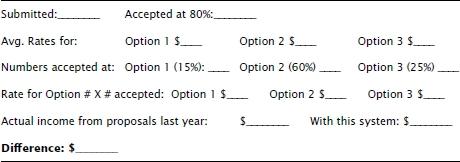
Try this out, just to personalize the impact, by using your last full year’s results: 

Now apply my averages, assuming that you had an option 15 percent below your average fee (1), 15 percent above it (2), and 25 percent above it (3). Apply the percentages above to your close rate and the options that would have been accepted: 

What differences do you see? Is it worth thinking about following the simple, disciplined system, and worrying less about pitch and more about process? How much money did you leave on the table last year? 

Three golden rules: 

7. Options escalate business dramatically.
8. If you don’t ask, you don’t get.
9. You are past the point of return in terms of negotiating.

To Be or Not to Be (In Person)

It’s a bad idea to deliver a completed proposal in person. 

I know that flies in the face of what you’ve been told, what you do, and even a positive experience or two you’ve had, but it’s an overwhelmingly bad idea. 

Now I guess you’re going to want to know why. 

  • Timing: This delays receipt and acceptance. You have to produce a convenient date for you and the buyer, which could take a week or a month. If something emerges in the interim or during that meeting requiring an adjustment, then the delay becomes even longer.

  • Temperature: You allow the process to cool down considerably. The next day (which is why I’ve advocated speed and FedEx or electronics) the buyer is still enthused, very conversant, and convinced. As the days grow long you reach the December of the (northern hemisphere) year: cool and icy conditions.

  • Intermezzo: Restaurants often provide an intermezzo, or palate cleaner, between courses, to remove prior tastes. You don’t want that course served here. Too many interferences can surface that neither you nor the buyer had anticipated (or had anticipated as much less of an issue) the longer you take to get there. 

  • Crowds: There is at least an odds-on chance that, because you’re coming back to present the proposal, the buyer will invite in (or others will inveigle in) random colleagues and subordinates, who may well pose objections and resistance the buyer had underestimated. It’s unlikely that the buyer would invite this cabal to review a written proposal received the next day after your meeting.

  • Production: It’s often assumed that the presentation of a proposal requires PowerPoint, handouts, models, and at least three trained seals. Why are you there with merely a 2.5-page proposal that is totally clear and crisp?

  • Questions: As long as you’re there, the buyer is going to utilize the time to explore every nook and cranny. There will be minor questions that become major pains, semicolons that require more than a short pause, and suggestions for amendments and redaction. 

  • Negotiation: It’s much tougher in person than on the phone for most consultants to steel themselves to reject requests for fee compromise. When the buyer says, “I love Option 3, but the price is a tad high,” on the phone you can reply, “That’s why we have Option two!” But sitting on a couch, drinking coffee, with the buyer smiling and winking, how steeled are you going to be? After all, if this isn’t a negotiating document, then why have you returned in person to discuss it at all?

And there is the rub. 

Once you show up, especially after more than a couple of days—and it’s often more than a month in many instances, given travel and other priorities for both parties—the dynamics have changed. There are new priorities, views from precincts not reporting in previously, less intimate familiarity with the details, less fervor about and belief in the ROI. 

Your proposal is copyrighted, and you’ve stipulated within it that it’s not to be shown to anyone outside of the organization—thereby preventing, one hopes, the sharing of contents with competing consultants. But on top of all of that, you have a trusting relationship with the buyer. 

Therefore, your written proposal should be sufficient for you to place before the buyer without the potential negatives of setting up and conducting a personal meeting for discussion and acceptance. And don’t forget this: 

  • Returns: Any changes, additions, or deletions agreed on in a personal meeting must be changed, usually through more than a hand notation but rather with a new, altered proposal, which will take more of your time to create and return and have accepted. And the buyer just may suggest that you return in person for a “final” discussion with the amendments.

Digression About Trust 

When a buyer says, “Great proposal, it’s made it to the short list,” or “We’re now looking only at you and one other firm,” or “Someone else is 25 percent less expensive making it a harder choice for me,” you do not have a trusting relationship with the buyer. 

The relationship you develop, coupled with conceptual agreement with its inherent ROI, should place you in a completely different category from competitors. Hence, the time required to develop that relationship actually results in faster, higher quality business. 

If I—as an economic buyer—trust you and believe in the goals we’ve mutually established, then someone else’s lower price isn’t going to be even a vague issue. Don’t rush the proposal creation, but do rush its delivery. 

  • Expense: The client isn’t going to be paying your expenses in 98 percent of these excursions, so that you may be spending thousands, which reduce the margin of the project by increasing acquisition costs considerably. The idea is to reduce acquisitions costs! (And if you aren’t successful in obtaining the project—which in best cases will be at least 20 percent of the time—you’re incurring tens of thousands in unnecessary reductions to your bottom line annually.)

So, to be or not to be?
Not.

Near the end of this famous Shakespearean soliloquy, Hamlet observes:

With this regard their currents turn awry,
And lose the name of action.

You don’t want to “lose the name of action.” You’re going to accelerate the process (or at least maintain the current velocity) ironically by staying away. Educate the client about this near the end of your conceptual agreement meeting. “If we’re agreed, I’ll summarize this in a brief proposal, get it to you tomorrow, and call you Friday at 10 for your choice of options and terms. There’s no need to take up any more of your time until then.” 

So let’s turn to Friday at 10, when you do need to “show up.” 

Two golden rules: 

10. You’re most influential when you’re not there with the proposal.
11. Don’t fix things that are working just fine.

Definitive Dates and Times

A discipline that’s key to our professional lives is especially salient in terms of proposals. I call them “sedulous next steps,” or SNS. 

Nowhere is a definitive future, agreed-upon action more important than in developing, documenting, and delivering proposals. It’s rather useless to promise a proposal quickly and then take your time following up. Speed and milestones are as important as detail and description. 

Before you leave the buyer and after the conceptual agreement, you should use language such as this: 

I’ll have this on your desk before 10:30 on Thursday. Are you available Friday after- noon at 2 to chat by phone so that I can find out your choices? 

If not, what time is best on Monday? Would you prefer I call your cell phone or office number? 

If you have a conceptual agreement based on a trusting relationship, you should not receive a response such as: 

  • I’ll get back to you when I can next week.
  • Call me in about two weeks.
  • I’ll need to have some of my people review what you send.
  • Take your time, there is no rush here.
  • Why don’t you schedule another meeting and bring it by?

All of these are “stop” signs requiring that you return, like Groundhog Day, to an earlier part of the conversation and reestablish (or establish for the first time) a trusting relationship, value, a sense of urgency, and definitive next steps. A failure to do this is why so many consultants complain to me that, “I can’t understand it, the buyer won’t return my calls despite our productive meeting.” 

Productive for whom? 

Here is a typical schedule you can follow and even place in your briefcase to refer to during your visit: 

Step  When 
¹. Establish conceptual agreement  During meeting with economic buyer after trust is established ³ 
². Reconfirm conceptual agreement  Prior to end of meeting 
³. Set time and date for buyer to expect proposal  Prior to end of meeting 
⁴. Set time and date for follow-up after  proposal is received  Prior to end of meeting

⁵. Set contingency time and date in case follow-up is missed  Prior to end of meeting 

Thus: 

I’ll have this on your desk before 10:30 on Thursday. Are you available Friday after- noon at 2 to chat by phone so that I can find out your choices? 

If not, what time is best on Monday? Would you prefer I call your cell phone or office number? In case something occurs that we don’t anticipate and we miss that call, how is Monday morning before the day begins, say at 8:45? how is Monday morning before the day begins, say at 8:45? 

We’ve covered why the buyer might not be responsive when you don’t create SNS (e.g., the buyer just wants you to be gone and really hasn’t felt a trusting relationship grow). But why would the buyer not respond if you do have a trusting relationship and tight conceptual agreement?

Glossary 

SNS: Sedulous next steps are those vital connections between you and the buyer, which maintain momentum and minimize time duration. They are important throughout the marketing and delivery relationships, but absolutely critical in the proposal stage. 

Personal concerns have arisen that trump all else •Illness •Emergency assignment •Company emergency (e.g., lawsuit) •Interference and interruption by others/shifting priorities •“Cools off” to the value after you leave •Learns new, pertinent information that’s discouraging •Misses or misplaces your call/forgets 

For these and allied reasons, I’ve been suggesting the following preventive and contingent actions: 

•Take your time to gain trust and test that trust, for example, is the buyer sharing with you and seeking advice? •Reconfirm everything on the spot, while you’re there. •Set definitive next times and dates. •Set contingency times and dates. •Request a cell phone number and/or personal e-mail. •Ask while together, “Are there any obstacles you can conceive which might delay your acceptance of my proposal that we haven’t yet  discussed?”⁴ •Move quickly—as quickly as you can. This is enhanced by our very brief and pithy proposal format. •Ask the buyer’s secretary or assistant if anything is preventing a return call if the original and contingency aren’t made. •Don’t assume the buyer is damaged or dishonest or uninterested. •These judgments will adversely affect your behavior. •Make three calls, and then write a hard copy letter. We’ll talk about this contingency more a bit later. 

Understand for now that time is money in the sense that the faster you are, the more you’ll make. But let’s look at adverse events that occur despite your best plans. 

One golden rule: 

12. Get there firstest with the mostest and measure it with your calendar.

Notes 

1. This enables the buyer and you to be told that FedEx had a mechanical problem or a storm cancelled the flight. 

2. Which is not in person, and which I discuss later in the chapter. 

3. This may take more than one meeting in certain circumstances, so be sure to schedule the next meeting while you’re there.

4. If the buyer says, “Yes, I haven’t seen your fees!” respond, “That’s true, and you’ll see fees, options, and ROI in detail tomorrow!”