A consulting retainer is vastly different from the typical “retainer” you might hear about from an attorney, just as Beethoven’s Fifth Symphony inspires something other than the feelings you might derive from the hokey pokey.
Legal retainers are merely deposits, against which future hourly fees (in six minute intervals) and expenses are deducted, right down to the cost of a stamp. But consulting retainers are payments that allow a client to have access to your “smarts.”
Glossary
Retainer: A fee paid for a given time period allowing members of a client organization to access you as an advisor in a reactive mode.
Retainers are usually for a minimum term of a month, though I recommend a quarter (90 days) as the minimum (which I explain later in the chapter). They may involve one or a few people, but never dozens. They may involve frequent access or limited access or situational access. They are always reactive, in that the client calls you, you don’t instigate the discussions. Think of being on retainer as being a mentor to the client, not a coach (the latter of which actively intervenes).
Retainers are “insurance policies” in some respects. They constitute a safety valve, or sounding board, or contingency for the client. People hope to never have to use their fire extinguishers, but they’re comforted that they are present and that they work. You can find yourself providing one phone call a month and being held in extremely high esteem by your client. And always remember that you can maintain quite a few retainers concurrently, so that they are of high value and low labor intensity, the very definition of differentiated and successful consulting.
They also require a different type of proposal, because there is no discrete project involved, with a beginning, middle, end; there are not objectives, metrics, or value, per se.
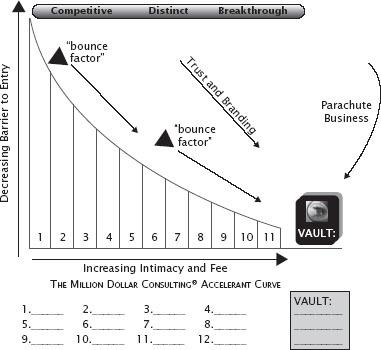
Retainers are most common after a project or series of projects, because the client trusts you, you’ve performed as promised, the results are evident, and it makes sense to continue the relationship even in the absence of a specific project. Too many consultants simply disengage without having suggested a retainer to the client.
Think of yourself in an advisory role. Think of yourself as Yoda, from Star Wars! You’re a wise person who doesn’t assertively intervene, but who is there when needed, though probably somewhat less abstruse and metaphysical than the little guy. Presidents have had “kitchen cabinets,” executives often use colleagues from their social and civic networks, and all of us usually have certain people we turn to when we need advice, even though we may otherwise not speak often. In police departments, they are often called “rabbis,” and in business it’s usually someone not in your direct hierarchical chain.
There are three elements that must be considered in a retainer relationship.
1. Who? (Number of people.)
It’s important to specify in the retainer proposal how many people have access. The more people, the more valuable the proposal. It may be your buyer solely, or someone your buyer designates. Or it may be your buyer and three of the buyer’s direct reports.
Retainers are never time- or activity-based, so it’s important to keep this number small (e.g., six or fewer), and to reflect the value of allowing more people rather than fewer people. The criteria for “admitting” people would be:
- Who is vital to have access to your smarts for the buyer?
- Who will share the confidential nature of the discussions?
- Who deserves to be in a deliberately small group?
These people must be of the proper level and understanding that you’re being accessed for advice, not for interaction in a project or for “hands-on” work.
2. How? (Scope of the retainer.)
The second variable is the nature of the interaction. For example, will it be strictly by phone and e-mail, or also by Skype, or sometimes in person and, if the latter, at scheduled intervals or adhoc? A retainer is unlimited access—that is, without restriction as to number of interactions, but it can restrict the type of interactions.
For example, does the client have access during Eastern U.S. business hours, where you live, or also during Western business hours, where the client is head- quartered? What about weekends and evenings? What is the response time—within three hours, or a day, or 48 hours? (My personal response time is generally 90 minutes during U.S. Eastern business hours, if we don’t agree to exceptions.) The more flexible you are, the more valuable.
If the client has a board meeting on the first Tuesday of every month, can the buyer access you on Monday evenings to review the next day’s agenda?
Are you expected to meet in person (expenses would be separately billed) at given times. (It’s fine to meet in person as long as the meeting remains simply advisory and not otherwise involved, e.g., conducting interviews, observing operations.)
3. When? (The term of the arrangement.)
As mentioned, I believe that a retainer must be in effect for a minimum of 90 days because it’s too tough to see the benefits in a mere few weeks, since you’re dependent on the client contacting you. Nor do you want monthly billing, which is too easy to simply abrogate at every hiccough that the client may suffer.
However, in 90 days, the likelihood is such that the client would have contacted you and found worth in the agreement. Remember, it’s not the frequency but the comfort in knowing you are there as a trusted advisor, and the immediacy of your expertise and advice when a relevant issue arises, prompting the client to seek your help.
This basic Who/How/When approach is all you need to create a retainer proposal, a sample of which appears later in this chapter, quite different from a traditional proposal. It’s unusual to begin with a new client in a retainer relationship (unless you have profound intellectual property and thought leadership), but it should be fairly common to create retainers with successful current and past clients, so you should become adept at these differing approaches to a highly lucrative business.