
I’ve been stressing that retainers are more likely as a result of top-flight project work with existing clients, but they may also arise from direct business with a new client because you have a position of thought leadership, outstanding intellectual property, high visibility, commercially published books, and so on.
I’ve represented this in the Million Dollar Consulting® Accelerant Curve in Figure 9.1
FIGURE 9.1 The accelerant curve
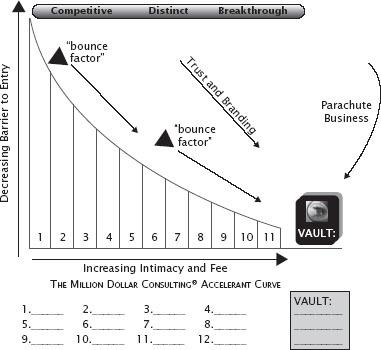
You can see that a progression of work with clients can help speed them down the curve, from areas of low barrier to entry (business with you), aided by “bounce factors” (e.g., models specially created for the client), that end up in your “vault,” which comprises such things as licensing and retainers. Counterintuitively, perhaps, as fees increase and the intimacy of the relationship increases (bottom axis) labor intensity decreases.
That “vault” contains breakthrough work and singular value that only you can provide to certain clients. Although it attracts people who have come down the accelerant curve, it also attracts what I’ve chosen to call “parachute business,” which is new business from non clients, which can go directly to retainers.
If you observe people who are the acknowledged leaders in their field—Marshall Goldsmith in coaching, Jeff Gitomer in sales, Walt Mossberg in technology, Marcus Buckingham in personal development, me in solo consulting—you’ll find that people are quite prepared to initiate a retainer relationship to have access to those respected “smarts.”
Thus, achieving that type of “star status” no matter how small or grand your field will greatly encourage direct retainer business from new sources.
But what if you’ve not yet attained those heights?
Here are other ways to try to stimulate more retainers:
1. Let the prospects know the option is available.
Too often you’re focused solely on your project work. If you look at the Accelerant Curve, you’re featuring or speaking about only a few options in the middle. Make sure that your prospective buyers understand you offer retainers and the utility and value of them by:
- Stating in your casual conversation with prospects that “While I was on retainer with . . .” as a part of your language.
- Insert the same kind of statements in your formal speaking events, such as, “Here’s why I love retainer work—I found myself being called at midnight. . . .”
- Write some white papers, newsletter articles, and blog postings that mention your retainer exploits.
2. Suggest it as an immediate option.
Remember the bank executive in the case study who told me he needs smart people hanging around? I was lucky he felt that way at the time. You should try to mention that there are several options for working together, one of which is a retainer.
3. Acquire specific testimonials.
Among your video and print testimonials should be clients who expressly mention the power of having you on retainer and how that relationship created tremendous value.
4. Use a retainer as an extension of value in proposals.
In your top option in the proposal, add a retainer to the project, with the hope that this aspect would be continued as a pure retainer in the future.
I thought this would be a good place to provide a sample proposal specifically for retainer work only.
Sample Retainer Proposal Proposal for Marlin Perkins, CEO, the Acme Company
Situation Appraisal
You’ve asked me to serve as a resource on retainer to help in an advisory capacity by phone, e-mail, and an occasional meeting with your board preparation, retention issues, difficult customer situations, and related matters.
People Involved
I will be the sole resource from Summit Consulting Group, Inc. providing the responses and advice to you and your COO, Jim Perkins. Any additions to the two of you will require an amended proposal.
Scope
The two of you have unlimited access to me from 9 to 5 U.S. Central Time during the week by e-mail and phone. If not immediately available, I will re- turn all phone calls within 90 minutes or, if at the end of the day, first thing the following morning. All e-mail will be responded to within 24 hours and usually much faster. We may have regularly scheduled calls at times we both agree on for whatever duration is needed. You may also contact me in emergency or critical situations beyond these provisions. Finally, we will personally meet if and when we both determine that such meetings would be critical to the resolution of high-priority company issues. Any additions to this scope will require an amended proposal.
Duration and Timing
This proposal covers the 12-month period from March 1, 2012, to February 28, 2013. We will discuss an extension in December 2012 if warranted.
Terms and Conditions
The fee for this retainer is $10,000 per month, payable by quarters at the beginning of each 90-day period (e.g., $30,000 due March 1, 2012). It is noncancelable for any reason, including your not contacting me for given periods, and payments are to be made on all due dates as scheduled. The retainer may not be postponed, delayed, or otherwise rescheduled.
We offer you a courtesy discount of 10 percent if the entire retainer is paid at commencement: $118,000 due on March 1, 2012.
Expenses will include only travel expenses should both be decided that a meeting is required, and will be billed as actually incurred. Expense reimbursement is due on presentation of our invoice.
Joint Accountabilities
Your accountabilities will include:
- Providing me with access to you and your COO, including per- sonal contact information.
- Sharing financial details of costs of turnover, loss of customers, acquisition costs, and so forth, as needed.
- Responding quickly to my requests for information.
- Reasonable lead time when discussing urgent matters whenever possible.
My accountabilities will include:
- Signing nondisclosure and confidentiality documents.
- Responding to your questions and requests as stipulated above. We both will be accountable for:
- Immediately informing the other of any new developments, which might materially affect the success of this project.
For example, the buyer finds out that divestiture is in the works, or I find out that three vice presidents have their resumes on the street.
Objectives, measures, and value are not included. You should include Joint Accountabilities as in our earlier example, and finally acceptance.
I don’t allow postponements with retainers because you might be in a position of an eternal retainer in such a case. Here, you must hold fast to the agreed on duration.
These retainer proposals are more like signed agreements—short, to the point, and easy. They simply stipulate the Who?/What?/When? dimensions and clarify that any alterations will result in an amended proposal.
Note that I don’t usually include options here. My feeling is that a retainer is a retainer is a retainer, and providing differing durations or activities during it is simply distracting.
You may find yourself simultaneously delivering projects during the retainer. That’s fine, it happens, and you simply create the traditional proposal for the project work (and there, of course, you can and should have options). But be careful: If you agree to a retainer and then agree to or suggest project work within it, you are going to lose your shirt as well as your house. There is no retainer large enough to cover the appropriate fees from the value of multiple projects.
So let me conclude this chapter by reemphasizing:
1. Project work involves a clear intervention, with a beginning, middle, and end, oriented to produce certain results, the value of which provide a dramatic return on your fee. You are the interventionist, even if you’re using client resources, to ensure that the project moves forward. You actively intervene with as many client resources as are required for the objectives to be met. You are highly proactive with the client.
2. Retainer work is a relationship in which the buyer purchases the right to have access to your smarts under limited conditions, which include people who have access, the degree of your responsiveness, and the duration of the arrangement. You are reactive to the client’s needs. Almost all of the work is by phone and e-mail—remote.
If you keep these fundamental and significant differences in mind at all times, you’ll have a great career—and submit successful proposals—for both project and retainer work with existing and new clients.
Finally, let’s look at what to do when bad things happen to good proposals.