
The point of all this planning and preparation is to get a signature on the bottom line of the proposal (my ninth category, “Acceptance”), because my proposal for- mat includes the buyer’s acceptance and there is no legal contract beyond this document (we’ll talk about legal documents and departments in the next chapter).
So how will that happen?
The most basic and fastest route is for the buyer to choose the desired option, sign and date one copy of the proposal, and return it. This is why the two copies I send are both executed by me. I don’t want the buyer to sign, then return it for me to sign, then return it to the buyer again. Too much time, too much potential for bad things to happen to good people who wait. I also include a FedEx letter envelope already addressed to me by using my account, and an invoice that can be used for any of the options and/or for full payment discount and “normal” 50 per- cent deposit.
The invoice would look like the one shown in Figure 6.1. You’ll note that this can be hard copy or electronic, and I send them in both forms. My federal ID numberis on the invoice because many company payment departments demand it, and I don’t want them to have to contact me (usually in 30 days!). Also, it’s called “Invoice and Statement” because some firms demand one or the other, so I’m covering all bets with a single document.
FIGURE 6.1 Invoice and Statement
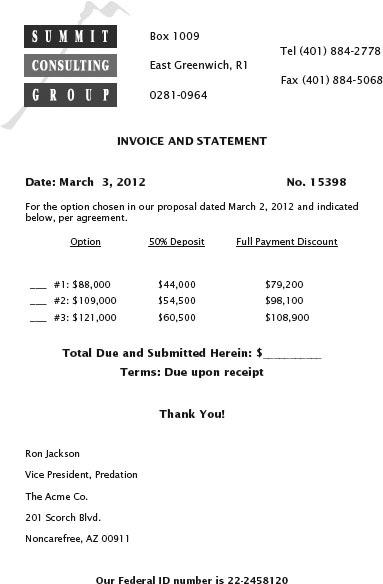
Specify the funds if you’re billing a nondomestic firm or wire instructions. You may also provide directions for wire transfer or credit card payments, depending on the situation. I tend not to provide these unless the client has re- quested them, because credit card payments entail interest charges on your part (3 percent on $121,000 is $3,640, for example, and wire transfers also result in a bank charge to you; both modes require up to a week before the deposit clears). If the client needs these alternative payment devices I’ll do it, but I’d rather not. As it is, checks take a few days to clear and checks not drawn on a domestic bank involve long delays and exchange charges.
Thus, ideally, the buyer signs the proposal copy that will be returned, chooses the option and payment terms, fills in the invoice, has a check issued, inserts the three items in your FedEx envelope, and you have it all the next day.
Sometimes, however, it’s not so easy.
If the buyer says, as often happens, “I want to begin, but the check cycle here is 60 days,” you don’t have an inconvenience, you have a problem. First, any buyer can have a “manual check” drawn, which is simply a computer check that pops out immediately. That’s because “60 days” means that your invoice is sitting on some- one’s desk in procurement or accounts payable for 59 days.
So you reply, “If that’s the best we can do, I’ll plan to start in two months.” A deal is a deal, and if you’ve managed to “consultant up” and be a peer of the buyer to this point, don’t cave now. You’re partners, not buyer/seller. The buyer will usu- ally say, “Let me make a call.”
Attack any issues like this as partners: How do we resolve this?
Having said that, there are times when you want to begin immediately so the hastening of a signature or reasonable facsimile is important.
For example, the buyer may well call you or respond when you call the buyer a day or so later, “I love this, Option 2 it is, and we have a rare chance to involve all of my country managers at once because they’re here this Friday for a conference. Can you come in to meet them and get acquainted? It will help tremendously when you have to talk across long distances later.”
The answer to this is, “Of course,” as long as your schedule actually permits it. I call this “pouring cement on the sale,” because once you’re on-site working there is virtually never a retreat on the buyer’s part. You simply add, “The proposal calls for payment on commencement, and this is quicker than either of us anticipated, but I’m happy to help. Can you expedite the payment?”
A “telephone handshake” is always good enough for me. If the buyer says, “Go,” I start moving. Don’t forget that the Acceptance aspect of the proposal says, in effect, “your payment is as good as your signature.” So if you get the check, simply ascertain which option, which you should readily tell by the amount, and get cracking.
The beauty of a true economic buyer with a trusting relationship is that his or her word is golden. So start mining. Otherwise, you’re going to meet the lawyers.
Notes
1. You don’t negotiate terms if you can help it, but there is the option for full pay- ment on acceptance and a 10 percent discount.
2. For those interested, of the 80 percent accepted, Option 1 is taken 25 percent of the time, Option 2 about 25 percent, and Option 3 about 50 percent.
3. If you can’t make it, ask about Thursday or even Saturday. These people wouldn’t be brought together for a single day, and your buyer may have simply chosen the best time for his or her schedule, but it probably could be altered.