
The transactions discussed here are based on a strong and trusting relationship, so it’s safe to make some assumptions based on the sequence shown in Figure 7.1.
FIGURE 7.1 A simple business sequence
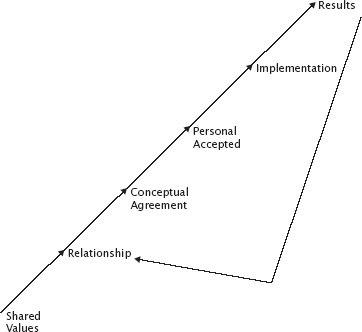
Shared values about business (e.g., whether downsizing is proper, the role of outsourcing, honesty with investors) can lead to trusting relationships. On that basis, conceptual agreement about objectives, measures, and value is possible, after which a proposal with options can be submitted with high probabilities of acceptance. Once a project is implemented, the results serve to reinforce the original relationship.
Succeeding steps are built on original trust and the increased trust that ensues from working together as partners and peers. This is why I emphasize here (and in all of my work) that positioning yourself as a peer, partner, and trusted advisor is so critical to success. Once your own demeanor, response, insecurity, language, and other factors place you in a subordinated position, as they say in Vegas at the craps tables, “all bets are off.”
With that basis established, the “golden handshake” is the potential to begin a client based on the buyer’s word and nothing more. That handshake may be physical, but it’s just as likely to be by phone or even e-mail. I talked earlier about “pouring cement on the sale,” meaning to show up as soon as possible after the proposal is accepted to demonstrate work has begun, and/or to do so even earlier. This is the result of the golden handshake.
When you have a trusting relationship and the buyer says something like, “It will take me a week to sign and return your proposal and generate a check, but there’s an ideal opportunity this week to meet with my entire team in one place, can you do that?” it’s time to spring into action. That’s a highly responsive, reactive action that will help to “guarantee” the buyer’s acceptance—you’ll be on-site, visible, involved, representing your partner, and so forth. It’s not impossible, but highly unlikely you’ll be told that you can’t go forward after that debut performance.
However, there are also proactive means to enforce the handshake. The buyer may say, “We’re a ‘go,’ I just have to physically sign the documents when I return from London next week, but I wanted to alert you that we’re accepting Option 2 and want you to put aside the time.”
To which you should respond, “That’s wonderful, why don’t I begin some of the initial interviews now to hit the ground running? May I call your assistant and obtain some of the contact information, and let’s you and I schedule a meeting for the day after you return.”
In this case, you’re suggesting the opening act, which is hard to say no to because it’s basically noninvasive. Note the options. The buyer could say, “I need to talk to my people first, so hold off on the interviews, but let’s schedule that day together.” Or conversely, “I’ll be submerged for a few days, but do start the inter- views and let’s schedule the meeting for a week later, when I can also give you the signed proposal and check.” The more options you provide to begin, the more likely the handshake will be accepted.
In all of my experience, I’ve never had a contract reneged on or even changed once the buyer and I have agreed to initial actions even before the proposal is signed and a check generated. That’s why I call this “golden.” Pragmatically, you need to show up and begin.
Not only haven’t I ever lost such work, but I’ve “saved” the contracts when intervening elements would have undone them. Natural disasters, deaths, terminations, competitive moves, market plunges, and other uncontrollable events would have at the least forestalled several of my contracts if I hadn’t shown up and begun work.
You can’t beat being present. This can taper off as your project moves forward and your labor intensity declines as planned, but it helps to be there early and often if you can, prior to the formalization of the contract. The longer you wait for any- thing, the more bad things can happen.
I’ve tried to illustrate in this chapter that it’s wise to try to avoid the legal department altogether. That means not provoking the legal hornet’s nest by poking it with your own lawyers and/or legalese. Once it becomes inevitable, work with them or your buyer to minimize concerns and conservative frenzy. Under certain conditions, do consult your own attorney, but ensure that the resource you use is well versed in your type of business and concerns.
You’ll have to compromise at times, but if you are clear about and prepared to protect your individual “musts” and trade away “wants” (maintain the fee, change the terms slightly if you need to) you’ll still have a great project and the client will feel that you’ve met halfway—even if it’s really your side of the field.
Let’s move now to a not uncommon but nonetheless dreadful aspect of proposals—when they’re actually requested, which can be the worst thing in the world for your business interests.
Notes
1. These principles work well with procurement and accounts payable, as well. For example, with this question, the buyer might point out that payments cannot be made in two different fiscal years, and you’ll want to know that at this point.
2. Which leads to more business and referral business, the “second sale” made at the time of the first sale. For a detailed explanation, see my book Million Dollar Referrals from McGraw-Hill (2011).