
You’ll learn from your victories and defeats what you can do better the next time. My proposals have become stronger, not by changing the format—which I’ve found to be consistently effective for my purposes—but from the content I insert into the template. ‘
By way of both summary and best practices, here are 12 keys for continual improvement:
- Ensure that you are talking only to an economic buyer.
- Establish a trusting relationship, no matter how long that takes.¹
- Gain conceptual agreement on objectives—results to be achieved.
- Gain conceptual agreement on metrics—progress indicators.
- Gain conceptual agreement on value—impact of the results.
- Review and ascertain if there are any obstacles to proceeding.
- Create a proposal with options or increasing value and fee.
- Ensure that you demonstrate an impressive ROI.
- Get the proposal in front of the buyer quickly.
- Establish definitive next steps, times, dates.
- Follow up as agreed on to find buyer’s decision.
- Implement as rapidly as you can to “pour cement.”
Like a golfer who has to perfect tee shots, bunker shots, putts, course management, and so forth, you need to improve in each area until you are unconsciously competent in each. If these are the 12 steps to proposal acceptance, and you can master each and handle objections at a point in the sequence, then your success ratio will probably be well above 80 percent.
You may need to adjust your proposals and their format in view of:
•RFPs
•Retainers
•Legal departments
•Client requests and requirements
One of the greatest “threats” is in proposals that have insufficient fees in terms of the value being offered.
When your fees are high and the buyer’s commitment is low, you have no sale. When the buyer’s commitment is low and your fees are low, you have apathy. When fees are low but commitment is high you have a wasted opportunity. Only when both commitment and fees are high do you create reciprocal value. (See Figure 10.1.)
FIGURE 10.1 Fee and commitment relationship
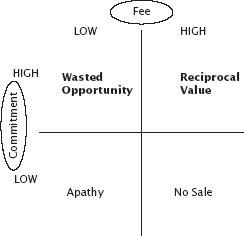
The upper left shows where consultants frequently and habitually leave money on the table. They have a committed buyer and the potential to provide great value, but their fees are too low. That is money that is never recoverable. The entire point of the proposal process is to try to place yourself in a position of providing value in options that represent appropriate fees for the value in any given option.
You may find that in your markets your proposals need extra dimensions. Clients might want to know how many people will be used on the project. Or they might need to know who owns “work product.” I wouldn’t normally include such issues but I would be happy to include them for a particular client who has a good reason for asking.
When your proposals are rejected, make it a top priority to find out why. It’s seldom the luck of the draw or the result of some committee. There’s something you could have done a better job with, and it’s usually involving the buyer. Too many consultants don’t “run through the tape” but rather let up at the finish line. That is, they ask the buyer a few questions but not enough questions. They get information but not the most important information. They unearth some value but not the maximum value that the buyer would derive. There’s a tendency to say, “Whew!” after the buyer answers a question that prompts the consultants to want to get it over with, rather than seeing an opportunity for further questioning and mining still more value.
The format is easy; it’s the content that makes the difference.
Thus, the constant improvement of your proposals will be based on your ability to secure the highest possible content from your buyer. The time you spend in the buyer’s office, asking questions and pursuing potential value, constitutes the most crucial aspect of creating a winning proposal.