
Before we enter the architecture of the proposal, let’s focus for a bit on ensuring that we garner and maintain the support we need. To this point, we’ve avoided or circumvented gatekeepers and achieved conceptual agreement with the economic buyer, based on the trusting relationship we’ve created.
Prior to creating the proposal, discuss with the buyer these five issues:
1. What are the accountabilities and roles the buyer accepts?
There must be a key person within the client who can shake loose bottle- necks and champion the right behavior. That should be the buyer (and can also be additional people). Does the buyer understand and commit to those duties, particularly at the outset of the project? The buyer has to walk the talk (demonstrate desired behaviors) as well as talk the walk (communicate progress and accomplishment).
2. Are there any barriers that haven’t been discussed yet?
Sometimes the normal course of discussion does not include potentially formidable barriers, such as entrenched department heads, competing projects, technology change, and so forth. What can the buyer foresee that the two of you should be planning to prevent or mitigate at the outset?
3. Who are the key influencers?
There are people who can informally lend weight and momentum to projects and who should be co-opted early. These may be sales leaders, union officials, popular managers, and so forth. Identify who they are with the buyer, and make plans to involve them in steering committees, important meetings, and so on. Show them how their self-interest will be served and how they’ll get credit for progress.
4. Where are the likely early victories?
Where are the likely best places to consider success? These might be tied in to the key influencers, but they might involve high-performing groups, the top-selling products and services, or particularly attractive markets and geographies. Start with small victories whenever possible to build the momentum.
5. What’s on the radar?
You’ll see a line in Proposal I in the next chapter that talks about you and the buyer informing each other of any events or issues that arise that may materially affect success. Now is the time to make the initial request. I’ve worked on projects where the buyer knew a divestiture was coming but didn’t tell anyone, including me!
Case Study in Resistance
When Hewlett-Packard was still making most of its profit from, of all things, printer ink, the head of the printer operation was a law unto himself. No matter what his peers agreed to, he would often choose to go his own way, confident that he wouldn’t be discomfited because he was providing most of the company’s bottom line.
Similar dynamics exist in many organizations, albeit to smaller extents. You can just acknowledge them, you have to figure out how the buyer intends to deal with them.
These final questions and checkpoints are an important transition to the proposal itself. The responses and discussion enable you to determine what the buy- er’s and your accountabilities should be, what time frames make the most sense, what options may be most appealing, and so forth.
In every organization there is a layer—I call it the “thermal zone” (Figure 3.2)—which refracts and redirects things, just as happens in water. That layer com- prises key middle managers who really run the day-to-day operation, and whose commitment, not mere compliance, is needed for the success of any project.
FIGURE 3.2 The thermal zone
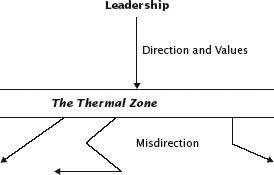
Therefore, it’s best to recognize both them and the circumstances in which they work so that your project isn’t refracted out of existence.
Note 1. One of HR’s and training’s favorite non verbs.