
There are nine key components in the proposal “architecture” that I’ve introduced and supported globally over the past 25 years. In this chapter are the latest iterations and examples.
1. Situation Appraisal
What: The situation appraisal is a one- or two-paragraph description of why you and the buyer are discussing the project.
Why: The intent is to begin on familiar ground with the premise of the project clear and for the buyer to being nodding “Yes, that’s correct.”
How: State what the improvement desired is and why it’s important to the buyer and/or the organization.
Example Here’s a poor situation appraisal, yet it exemplifies so many of the openings to poor proposals:
The Acme Company is a provider of financial services located in Cheyenne, which has been in business for 30 years and has a capitalized market value of $800 million. The Acme buyer knows this! It’s nothing novel or new or related to the project. It’s irrelevant.
Here’s an excellent situation statement:
The Acme Company has traditionally attracted the best and brightest talent because of its excellent brand and relationships with top schools. However, recent bad publicity over poor financial decisions, the removal of the CEO, and loss of key contacts in top schools have made it imperative to launch an aggressive plan to acquire the best talent in the industry, both at entry and senior levels.
That situation appraisal explains exactly why you’ve been talking, why the project is urgent, and what the general goals are.
Take a project you’re considering, have under way, or have completed, and try writing your own situation appraisal below:

2. Objectives
The next three elements—objectives, metrics, and value—are taken directly from the conceptual agreement elements achieved with the buyer. I prefer to state them as bullet points and not narrative, because they are clearer and more concise.
What: An objective is a business outcome or result that is to be achieved.
Why: These are the “improved client conditions” that generate value and, ultimately, ROI.
How: State the objectives gained during the conceptual agreement phase, trying not to use specific numbers (e.g., “five new hires,” but rather direction, e.g. “maximum new hires”).
Example
(continuing with our current example)
The objectives for this project include:
- Reconstruct positive relationships so that we are endorsed by top schools.
- Attract seasoned veterans who see our firm as a “step-up” in prestige.
- Avoid disrupting or threatening current staff.
- Reassure clients and prospects that top talent is present at Acme.
- You will be the leading edge and leader in financial recruitment.
Take a project you’re considering, have under way, or have completed, and try writing your own objectives below:
3. Metrics
What: These are the measures of success indicating progress and/or completion.
Why: You and the buyer will use these to guide decisions during the project and to validate your involvement in making the difference.
How: These are taken from conceptual agreement and stated with bullet points, making sure that there is manifest evidence (indicators) for the objectives.
Example
The measures of success for the project will include:
- A minimum of six schools on the top 24 list invite you to recruit on campus.
- Unsolicited resumes are received from top people at competi- tors.
- Unsolicited contacts are made by search firms to provide top tal- ent.
- Your involuntary attrition rate falls below industry averages.
- Clients renew at pre-incident rates and new clients are acquired above industry averages.
- The media create positive stories about your talent success.
Take a project you’re considering, have under way, or have completed, and try writing your own metrics below:
4. Value
What: This is the impact on the organization and the buyer for meeting the objectives, as measured by the metrics.
Why: These statements justify the fee by enumerating the ROI and impact.
How: Again in bullet point form, noting that there can be several value statements for any single objective.
Example
The value and impact of achieving the above objectives include:
- Less cost of attracting talent, estimated by you at about 15–25 percent.
- Less current turnover, estimated now at about $400,000 per year.
- Less client turnover, estimated now at $3 million in lost commis- sions annually.
- New business that should add a minimum of $3 million in com- missions.
- Word-of-mouth goodwill for both the company’s products and its jobs.
- You being seen as a leading-edge figure in financial recruiting.
- Enhanced media and community relationships.
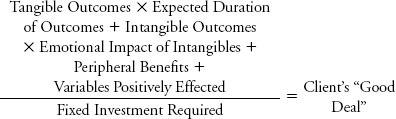
Note that value is both organizational and professional, and both tangible and intangible, as well as peripheral. Again, the formula we are using is:
Take a project you’re considering, have under way, or have completed, and try writing your own value statements below:
5. Methodology and Options
Always try to provide options for clients. This changes the psychology from “Should I do this?” to “How should I do this?”, which increases your chances for success at least fourfold. Don’t go too deeply into methodology (e.g., “focus groups,” not “six focus groups in four locations”).
What: These are the alternatives that the buyer may select from to reach the objectives, the various roads to the destination. However, some routes provide more value than others, even though the least of them will fulfill the objectives.
Why: To escalate the buyer’s decision to add more value and consequently higher fees because of higher ROI. You are adding to the value “above the line” in Figure 3.1, allowing you to increase the fee “below the line,” which still in- creases resultant value.
How: Meet the objectives with the first option, then provide even more value and differentiation in ensuing options.
Example
Option 1, Strategic: We will interview top administrators at your top 24 schools and develop a plan for creating new and strong ties. We will run focus groups comprising current clients to establish the best of your existing services and determine which new ones would be most desirable. We will launch a media campaign of delighted clients, new services, and feature existing top talent. We will create an advisory board of top search firm leadership.
Option 2, Tactical: In addition to Option 1, we will create a monthly, electronic client and prospect newsletter. We will create speaking engagements for the new CEO in front of campus and search audiences. We will monitor current employees for any signs of disaffection of top talent, including observations and personal interviews.
Option 3, Execution: In addition to Options 1 and 2, we will work with your senior management team to develop them in perpetuating this work themselves after our departure. We will create an annual conference of “best practices in talent management in the financial services industry” hosted by your firm. We will revisit once a quarter for the ensuing year to fine-tune and to help you to manage the results.
Note that you can call these options anything you like, including simply “Options 1, 2, and 3.” You can also mix and match my particular interventions to suit, as your client and your own taste will differ from my example. But, in theory at least, the differences applicable to any alternative should make sense in the context of that alternative, understanding that prior alternatives are already inclusive. Options are not “add-ons,” nor are they based on more volume (e.g., interview at 40 schools instead of 24). They are qualitatively better, not merely quantitatively larger.
You want to avoid a “take it or leave it” single alternative whenever possible, which should be always.
Take a project you’re considering, have under way, or have completed, and try writing your own methodology and options below:
6. Timing
What: This is an estimate and preferably a range of the duration of each of the options barring unforeseen circumstances.
Why: The client deserves to know the extent of your presences and possible disruptions, and you deserve to have a disengagement date set to avoid any possibility of “scope creep” (the buyer requesting that you stick around beyond the objectives being accomplished at no extra fee).
How: State in duration of days, not calendar dates, the estimated time required.
Example
For Option 1, we estimate a 45- to 60-day time frame.
For Option 2, we estimate 60 to 90 days.
For Option 3, we estimate 90 to 120 days, with four quarterly visits in the following 12 months.
These time frames assume that you and we experience no unforeseen delays or postponements. I’m prepared to begin within one week of your acceptance of this proposal.
7. Joint Accountabilities
This is one of the most overlooked elements in a proposal. If you concur that you’re entering into a partnership with your buyer, then it’s only logical that you should each have (and share) accountabilities for success. The project is not something you “do” to the buyer. It’s a joint undertaking.
What: These are the responsibilities that you are each in the best position to support individually or that you can best do jointly, and constitute the key areas underlying the success of the project.
Why: By specifying these in the proposal, the buyer is also signing off on his or her personal responsibility and committing to acting in a certain manner, while also being clear on your commitment to critical areas.
How: List those that are unique to the buyer, those that are unique to you, and those that you’ll share.
Example
Your accountabilities will include:
- Providing me with access to all key people internally, in colleges, and among your media access.
- Sharing financial details of costs of turnover, loss of customers, acquisition costs, and so forth.
- Free access for me to roam the offices, including security passes, access cards, a private office, and intranet access.
- Providing your personal contact numbers and addresses, weekly debriefs by phone or in person, and responding to my inquiries and requests within 24 hours.
- Honoring the intellectual property and trademarked material I provide for your use.
My accountabilities will include:
- Signing nondisclosure and confidentiality documents.
- Responding to your questions and requests within 90 minutes during Eastern U.S. business hours (put your own service standard in this space).
- Conducting all interviews, focus groups, observations, external interactions personally and with respect for minimizing disruption and concern.
- Meeting all deadlines agreed on and immediately reporting any threats to our progress.
We both will be accountable for:
- Immediately informing the other of any new developments that might materially affect the success of this project.
Take a project you’re considering, have under way, or have completed, and try writing equivalent accountabilities for you and the buyer below:

8. Terms and Conditions
This is my favorite part of the proposal! This is the first time—the first time—that the buyer will see the fees. That may be contrary to everything you’ve ever heard, learned, or practiced, but hear me out. You want the buyer to be nodding assertively and positively throughout this proposal that these are the issues dis- cussed (in conceptual agreement), the options that are valuable and make sense, and that it’s time to get started. You want that positive sentiment and momentum to carry right into the fees section.
What: These are the fees, reimbursements, and terms of payment for the project described herein.
Why: The buyer has now understood the value of the options and can make a reasoned judgment about ROI (return on investment—see Figure 3.1). With value-based fees, there is never a time-based element or meter running, simply a project fee with substantial return.
How: Simply state the fees, reimbursements, and terms, without too much narrative and without confusion. Take into account in your fees the elements in Figure 3.1 from conceptual agreement and the value stated herein.
Example
The fee for Option 1, Strategic, is $176,000.
The fee for Option 2, Tactical, is $211,000.
The fee for Option 3, Execution, is $267,000.
Terms: 50 percent on acceptance of this proposal, and 50 percent 60 days after commencement of work. Alternatively, you may avail yourself of a 10 percent discount with payment in full on acceptance. (NOTE! Some organizations have internal policies stipulating that all discounts must be accepted.)
Expense Reimbursements: We charge expenses as actually accrued and bill at the conclusion of each month. Payment is due upon presentation of our invoice. We charge for reasonable travel, living, and related expenses. We do not charge for administrative support, courier, postage, phone, and so forth.
This project is noncancelable for any reason. You may postpone and reschedule with our approval without penalty so long as you maintain the existing payment schedule. The quality of our work is guaranteed, and if our work is not consistent with the quality expressed in the accountabilities section, we will refund your full fee.
Important Notes:
- The terms are aggressive and I suggest that you always request 50 percent as a deposit, with the balance due in short order, not over the course of the project.
- This is as good a time as any to point out that you never want this proposal to go to the legal department, hence, avoid legalese and “boiler- plate” such as “third parties shall hold harmless. . .”
- Specify what your expense policy is and never “nickel and dime” (like lawyers do when they charge you for photocopies).
- Never cite “10 days net” or “30 days net,” but rather, “due on presentation” or “on receipt.” In worst case, they’ll take 30 days but not 60.
- Try to provide a minimum 10:1 return on the client’s fee in terms of the value expressed. At these levels, it doesn’t matter if Option 1 is $164,000 or $181,000. It doesn’t matter. However, ensure that there is sufficient “distance” among options.
Take a project you’re considering, have under way, or have completed, and try writing your terms and conditions below:
Case Study: The Insurance Merger
I was hired for the cultural aspects of a huge insurance merger in New York City. The fee was $250,000. I received $125,000 promptly and began work, though my buyer, the executive vice president, never returned a signed copy of the proposal. Sixty days later, I received my second $125,000 on schedule. I completed the project well ahead of deadline in four months, and still had no signed contract.
When I asked the delighted buyer, he told me, “I have authority to sign checks up to $150,000, but I can’t sign legal contracts over $100,000 without legal’s review. So I took the path of least resistance, figuring you’d be happier with the money and no signed contract than the other way around.” That explains a sentence you’ll see in the final segment of the proposal architecture, further on!
9. Acceptance
To steer clear of the legal minefields my proposals are also acceptance vehicles. Thus, after the buyer has read through, agreed to most of what he or she has previously agreed to, and seen attractive options, an immediate decision can be made.
What: The formal and contractual decision is indicated to go forward with the desired option.
Why: Proposals are summations, not explorations. It’s important to allow the buyer the opportunity to make an immediate commitment.
How: Include the brief wording and signatory provisions at the conclusion.
Example
Your signature below indicates the acceptance of the option checked and your agreement with all provisions and terms specified in this proposal.
Alternatively, your deposit or full payment and indication of an option will also constitute that acceptance allowing us to begin the project together.
We accept (please check)
__ Option 1 __ Option 2 __ Option 3
and agree to the terms and conditions as specified. We are providing a __ 50 percent deposit or __ full payment less a 10 percent professional discount.
| For Acme, Inc.: | For Summit Consulting Group, Inc.: |
| ______________ | ___________________________ |
| Wile E. Coyote | Alan Weiss, PhD President, |
| Vice President | Predation |
| Date: March 2, 2012 |
I’m not going to provide a practice space with this one because you merely use the template above, substituting as necessary.
I send two copies of my proposals in hard copy even if the buyer has requested an electronic version, and I sign all copies before sending them. I don’t see the need to have the buyer sign, then I countersign, then I return a copy again. I want speed, not bureaucracy, and since all of this is predicated on a trusting relationship with the buyer, and I’m dealing only with the buyer, there is no danger in signing and sending it along. I use FedEx all the time.
The buyer typically signs one and returns one, or signs one “electronically.” But see the case study above where I never did receive the signed contract. I will work on a “telephone handshake,” or even an e-mail one, though I prefer a signed document, because:
- Buyers change.
- Others may eventually want to review it.
- It indicates commitment not just to payment terms, but to outcomes, time frames, accountabilities, and so forth.
- If the project is delayed per the allowance in the proposal, it’s more important than ever to have documentation for starting up again.
- Lawyers sometimes appear unexpectedly when you open the cellar door by mistake.
The architecture, as I’m calling it, is in these nine clear steps:
1. Situation appraisal
2. Objectives
3. Metrics
4. Value
5. Methodology and options
6. Timing
7. Joint accountabilities
8. Terms and conditions
9. Acceptance
Contrast this to the semi-bound, quasi-legal monstrosities you’ve seen in so many instances, which provide the unfortunate opportunity for the buyer to quite legitimately claim that he or she requires help from legal, finance, HR, implementers, stakeholders, colleagues, and so on. The more you say, the more you leave yourself open to be second-guessed or discussed.
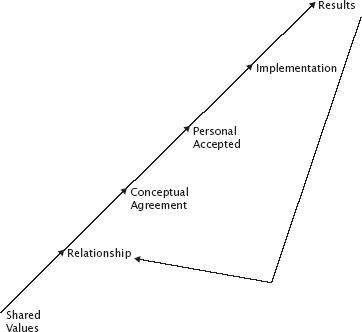
The principle from the earlier chapters is what carries the day here: conceptual agreement with a true, economic buyer about objectives, measures of success, and the value of achieving those objectives for the organization and the buyer personally. As you can see in Figure 4.1, the proposal is submitted after a lead is qualified, a buyer is found, a relationship is established, and conceptual agreement is obtained. That can be a tough wait for many consultants, but it’s the royal road (and even expressway) to high-value proposals being accepted 80 percent of the time or better.
FIGURE 4.1 The consulting business model
This approach also eliminates the need for personally presenting the proposal, for “dog and pony” shows, and for facing most committees. We’ll talk more about that in the next chapter. You’ve seen here, if you’ve completed the few exercises, how readily this sequence can be applied to your own business. So the key point from here is your own discipline and talent, and we turn to those two vital factors now.
Notes
1. The least expensive option must still meet all the project objectives or you’re being unethical. The idea is to build value above and beyond the minimum stated in the larger options.
2. You can have two options or seven, but I’ve found three to provide the best assortment of easy choice and differentiation for the buyer to quickly consider.
3. Noncompete would also go here, but these should be rare and very expensive. See my books Million Dollar Consulting (McGraw-Hill) and Value-Based Fees ( John Wiley & Sons).
4. For example, the buyer finds out that divestiture is in the works, or I find out that three vice presidents have their resumes on the street.