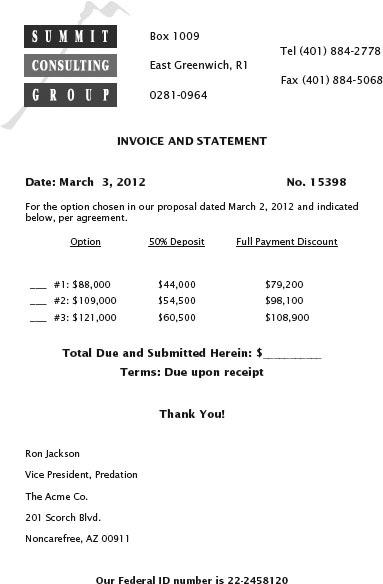
I’m a devotee of the television phenomenon American Idol. One of the most hackneyed and trite critiques of the singers offered by the judges—especially Randy Jackson, who’s become known for it—is “pitchy.” In singing, this means that one is out of the proper tonal range, which can be caused by not hearing yourself, or by nerves, or simply by singing too loudly (which often results from the first two conditions).
You can also be too “pitchy” in your proposal, and it may seem counterintuitive to many of you that this is such a “low key,” explanatory document. So first I’ll reiterate: A proposal is a summation, not an exploration, and not a negotiation. This is not a debating document, thus it needn’t make points about why the buyer should pursue this. We already know that from prior discussions. This is rather about how the buyer should do this (hence, the options I insist upon presenting).
The more you provide a “take it or leave it” approach, the more you’re faced with a “hard sell.” An auto showroom with a single model is going to have some hard- pressed salespeople, but one with 20 models has salespeople who say, “If you’re looking for better mileage, just step over here,” or “If it’s something sportier that makes sense, let’s walk out onto the lot.”
Under the best of conditions, a binary decision (do it or don’t do it) will give you a 50/50 chance. I’m not commenting on how well you’ve set it up, merely that there are two possible outcomes (despite the fact that the decision may be made immediately or delayed). With three options, however, you have no, yes, yes, and yes. You now have four possible outcomes, of which three are favorable, even though they differ in degree. (A project with the lowest option is far superior to no project at all.)
As options increase, however, the advantage disappears. Again, this may sound counterintuitive, but consider this: With the advent of the proliferation of invest- ment and retirement vehicles in an increasingly turbulent and unpredictable global economy, fewer people actually decide on even attractive alternatives and simply allow their money to sit in low (e.g., 1 percent or less) savings accounts. People walking into television stores find themselves faced with flat-screen, different sizes, 3-D, projection, home theater, surround sound, digital light processing, liquid crystal display, rear projection, and so on. And as a result, they often leave the store without deciding, whereas a decade ago the choice was simple and immediately made.
What’s needed isn’t a “pitch” but a set of optimal choices all focused on a yes of some kind. My experience concludes that this is three, but you may deem four or two your preference. My analysis looks like this:
| Option | Percentage of Times Chosen |
| ¹ | ¹⁵% |
| ² | ⁶⁰% |
| ³ | ²⁵% |
As they say in the TV ads, “under actual conditions your results may vary”! How- ever, these are the results of my own work and thousands of people who have mentored with me. This means that when a proposal is accepted, a quarter of the time the top and most expensive option is selected, and 85 percent of the time one of the top two is selected. That is a huge increase in your annual income because, if you don’t provide options but rather a single choice, that fee is usually somewhere between Options 1 and 2.
You’d be leaving (and maybe have already left) a great deal of money on the table.
In my experience, about 80 percent of value-based proposals—following a trusting relationship and conceptual agreement with an economic buyer—are accepted. Some of my mentees have reported acceptance consistently in the 90 percent range. But let’s remain conservative.
If your average proposal options are for $50,000, $70,000, and $90,000 and you submit two per month, that’s 24 proposals a year, of which 19 would be accepted. Of the 19, three would produce $150,000 (Option 1); 11 would produce $770,000 (Option 2); and five would produce $450,000 (Option 3). That’s a total of $1,370,000 without a single proposal’s option in six figures, yet many of you do and should be bidding six figures for a great deal of your work.
If you were providing the single option, between the points I mentioned is usu- ally the case (between Options 1 and 2), that amount would have been $60,000 times 19 projects, or $1,140,000, which represents a quarter million dollars left on the table. However, what’s not included in my calculations is that the single-option, take-it-or-leave-it proposal would not close at a rate of 80 percent. Let’s be kind and say that your closing rate is better than 50/50—call it 65 percent. That means 16 proposals close at $60,000 each, which is $960,000, or $410,000 less than the approach with three options and a higher close rate, which is a 30 percent decline in potential income.
Over the course of five years, that grows to about $2 million. If your proposals tend to be less than the average or more than the average above, simply adjust the figures accordingly. But the fact is that you are leaving money on the table each year, which you will never be able to recover. It’s gone. And it was all bottom-line profit. Over a decade that’s the difference between comfortable retirement and forced work; between being able to take prudent risk and having to be archly conservative; between philanthropy and penuriousness.
Try this out, just to personalize the impact, by using your last full year’s results:

Now apply my averages, assuming that you had an option 15 percent below your average fee (1), 15 percent above it (2), and 25 percent above it (3). Apply the percentages above to your close rate and the options that would have been accepted:
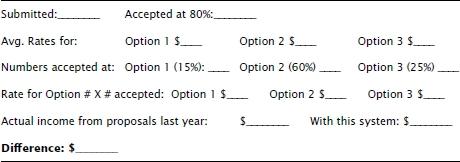
What differences do you see? Is it worth thinking about following the simple, disciplined system, and worrying less about pitch and more about process? How much money did you leave on the table last year?
Three golden rules:
7. Options escalate business dramatically.
8. If you don’t ask, you don’t get.
9. You are past the point of return in terms of negotiating.