The basic question to ask ourselves here is, “How would you know it if you tripped over it?”
There is far too much going on in terms of “feeling confident” or “clarifying” or “believing.” But you don’t know that those are not proper indicators. You wouldn’t know them if you tripped over them. (The only way you know that I’m more confident is that I ask you fewer questions, confront buyers with better rebuttals, speak up forcefully at meetings, and so forth.)
The measures of success will underscore the direct role that your contributions have played in reaching the objectives.
There can be more than one metric for a given objective:
Objective: Increase repute in the community.
Measures:
Increased, positive coverage in local media.
Local service club bestows accolades and awards.
Higher levels of local, highly qualified job candidates.
Glossary
Metrics are indicators of progress or success, which anyone can use to determine that key goals have been reached. They reside in observed behavior and/or evidence in the environment.
Some of the questions you can ask include:
How will you know we’ve accomplished your intent?
How, specifically, will the operation be different when we’re done?
How will you measure this?
What indicators will you use to assess our progress?
Who or what will report on our results (against the objectives)?
Do you already have measures in place that you intend to apply?
What is the rate of return (on sales, investment, etc.) that you seek?
How will we know how the public, employees, and/or customers perceive it?
Each time we talk, what standard will tell us we’re progressing?
How would you know it if you tripped over it?
Some metrics are anecdotal, not scientific. That’s okay, as long as you and the buyer agree on who is doing the measuring and how. For example, a divisional general manager sought greater team collaboration with fewer turf battles. When I asked how he’d know this was accomplished, he told me, “I won’t be seeing warring factions every day in my office for whom I have to serve as referee.”
That was good enough for me and for him.
Metrics are vital during the project so that there are early indications of anyone falling behind. That way you can alert your buyer, who has the real clout and authority, that some attitudes and behaviors require changing. “You and I agreed that a key metric was that all five service areas embraced the new technology by April 1, but as of March 15, the call center has not had one person attend any meetings and the manager has not returned calls. You need to change his attitude about this.”
A professor at the University of Wisconsin posited four levels of measurement in 1959:
1. Reactions of learners. 2. Increased knowledge of learners. 3. Behavioral change of learners. 4. Results of the behavioral changes.
HR people still speak about this as if it’s the Holy Grail more than a half-century later, and training magazines quote it as scripture. Unfortunately, it was superficial and academic in 1959, and it still is today. The only measure that matters is improved results—an improved client condition, in this case represented by objectives met and validated by key metrics. Those metrics are, in turn, based on empirical evidence in the environment that can be readily identified.
We tend to “whack” bad behaviors, but that only lasts as long as the whacker has a larger stick and is present. We tend to try to sway attitudes through normative pressure (“be one of the in crowd”), but such entreaties are inconsistent and opinion is fickle.
Only through addressing enlightened self-interest can we prompt belief and attitude changes that will be reflected in behavior changes, which produce new results. Therefore, most projects will include elements on achieving commitment, and not merely compliance (whack), and will be measured by an improved resultant client condition.
Try not to choose metrics (or objectives) that specify a level of performance, for example, a 3 percent margin improvement or six new customers per month. In- stead, create movement in the right direction: Maximize the margins as measured by the profit per customer improving, and maximize new customers per sales- person as measured by additional signed contracts monthly.
Note that metrics and objectives may sometimes overlap and resemble each other. You may have an objective of “12 new accounts,” but I’d rather see “improvement in number of new accounts” as measured by monthly registrations. There are too many variables outside of your control to commit to specific numbers. The key is to arrive at a range in the objectives step that pleases the buyer (conceptual agreement) and to take the conservative end of that range.
Sometimes, “success” is years away, for example, “create a European operation within the next five years.” Your contribution may only be for a portion of that time. But your metrics will cover the elements essential during your tenure—hiring five European account managers, translating materials into the six major languages, and so forth.
The most difficult part of conceptual agreement for most consultants is establishing value. That’s because they believe that the objectives constitute the value— and they probably will, if we left it at that.
But what I’ve learned is that there is a multiplicity of value emerging from most individual objectives. The more we cajole the buyer into agreeing as to what they are and the impact on the buyer personally and the organizations professionally, the higher fees we can justify in terms of return on investment (ROI).
Here’s a single, stereotypical objective that most people would also say is the value derived: Increase profit.
However, potential value from reaching the objective of increased profit includes:
Pay higher dividends to investors.
Invest in business expansion.
Increase bonuses to retain top talent.
Be more competitive in hiring.
Pay down debt.
Improve stock price.
You get the idea. By prompting and provoking the buyer, you can derive a great deal of value from each objective. And it’s the value that will be used to justify the fees you charge, not the objectives.
Questions to ask to generate value statements include:
What will these results mean for your organization?
How would you assess the actual return (ROI, ROA, ROS, ROE, etc.)?
What would be the extent of the improvement (or correction)?
How will these results impact the bottom line?
What are the annualized savings (first year might be deceptive)?
What is the intangible impact (on repute, safety, comfort, etc.)?
How would you, personally, be better off or better supported?
What is the scope of the impact (on customers, employees, vendors)?
How important is this compared to your overall responsibilities?
What if this fails?
The proposal’s ultimate fees will be based on these relationships, if understood by the buyer in this preparation stage:
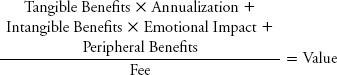
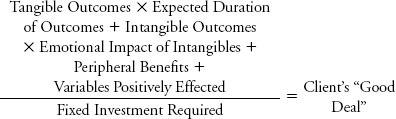
The tangible benefits (increased profit, decreased downtime) times the years the benefits will accrue and grow; plus the intangible benefits (be seen as a leader, dis- card unpleasant work) times their emotional impact; plus the peripheral benefits (easier to attract talent, better media treatment); over your fee, equals the value or ROI for the client.
A relatively few objectives can yield dozens of value statements, especially when you consider professional, personal, and peripheral, the three Ps of value. The higher these are in the buyer’s eyes and with the buyer’s concurrence, the higher your fee can be while still generating significant value.
Glossary
Value is the degree of positive impact personally, professionally, and peripherally that objectives that are met generate. It is the soul of the project, the reason that major investments can be readily justified.
Commodities, such as training programs or coaching days, don’t afford as much value because they are about time and materials and are easily compared to others’ prices. But true projects are never commodities and never comparable (which is why you should generally avoid RFPs, as discussed earlier).
Buyers, especially highly assertive and fast-moving senior people, tend to think in terms of tasks being accomplished and goals being reached. You have to “slow them down” a bit so that you can remind them and gain agreement on the results of those tasks that help to reach those goals. The intangible benefits are especially important, because circumstances such as increased safety, reduced stress, greater comfort, and increased aesthetics can be highly powerful drivers and highly regarded value. (This is why architects undercharge—they focus on the building extension rather than the improved quality of life for the family.)
Value, like beauty, may be in the eye of the beholder, but it’s nonetheless discussable and mutually appreciated. This final step in conceptual agreement is an integral part in preparing the client for an acceptable proposal and is absolutely vital, yet often rushed through or completely ignored.
Here is a summary of the key elements before we move on to ensuing that these approaches reach the right eyes and ears:
Never provide a proposal for a gatekeeper or intermediary, even if that person promises to “sell” it for you. That person won’t have your passion and will fold under pressure. He or she has more to lose than you do.
Forge a trusting relationship first, so that the buyer is comfortable sharing facts, opinions, needs, and desires. Invest as much time as needed to develop that bond.
Clearly understand and differentiate among objectives, metrics, and value. Focus on the multiple value and impact that any one objective may represent.
Reaffirm each item in these three areas with the buyer. Ensure that you have true conceptual agreement prior to creating any proposal.
Never discuss fees at this point. The key is what the buyer’s improved conditions will be. The fees and subsequent ROI will come later. If you are talking about fees or price at this point, you’ve lost control of the discussion.
Notes
1. Along with failing to build a trusting relationship; failing to provide options; failing to establish definitive next steps; and failing to charge high enough fees. All can be remedied with this book!
2. For details on this highest quality of all trusting mechanisms and referrals, see my book Million Dollar Referrals (McGraw-Hill, 2011).
3. With apologies to Jim Collins and his fine book, too many companies blindly want to embrace the mantra and not the meaning.
The best way to traverse gate keeper land is to treat gatekeepers with respect but at arm’s-length distance. The last thing in the world you need is to be seen as a peer of the intermediary. That will doom you no less than the Death Star from Star Wars in terms of habitable life in that prospect.
Consequently, you must learn to accept rejection and reject acceptance. We all know about the former. This is the marketing business and many people say no. (The best hitters in baseball, even on steroids, only hit about three out of every 10 times at bat. That’s a 70 percent failure rate.) So we inure ourselves to this or we drink heavily.
However, we don’t fully appreciate rejecting acceptance. Low-level people can feel important by interacting with outsiders directly, and so in that context you are raw meat for the relationship predators. Keep your distance. Work with gatekeepers to the extent that they can help you with the express lane to the buyer.
I call this “mutual, enlightened self-interest” because everyone wins.
If the gatekeeper chooses to accompany you to the buyer—introducing you and vouching for you—that’s wonderful, because he or she will get credit for your brilliance and you will probably wind up collaborating on parts of the project implementation.
But if the gatekeeper prefers to send you along by yourself, staying out of the line of fire, that is also fine. Your retirement plan, merit increases, coveted parking space, and daily affiliation needs are not vested in that prospect. You can afford to take the flak where the gatekeeper may be gun-shy, and understandably so.
What you can’t allow, however, is the gatekeeper to block you by not raising the gate. So trying to create a mutually beneficial advantage is the first avenue to explore.
When I first began working with Merck as a client, Art Strohmer was a human re- sources manager. He saw his job as connecting appropriate and top-quality external resources with internal areas of relevant need. Any services he purchased from me were minor, but he consistently set up six-figure projects for me with line people who had the need and the budget—the true economic buyers. (Art is retired today for many years, but we still exchange holiday cards and the occasional e-mail.)
Here are best and worst practices in terms of trying to build mutual self-interest so that a gatekeeper leads you to a buyer:
TABLE 3.1 Mutual Self-Interest Best and Worst Pracitces
Best Practices
Worst Practices
Focus on the process of the buying decision
Focus on content of the project
Brief meetings with clear agendas
Brainstorming and meals
Clarify your need to meet person with budget
Be vague about your next steps
Never offer a proposal or agreement
Provide proposal for review
Never allow to market for you internally
Assign as intermediary with buyer
Never rely on their views or interpretations
Assume they are accurate
Do not wait, create your own time frames
Rely on their “right time”
Size up your gatekeepers quickly. If they are confident and assertive, they should be ready, willing, and able to lead you to the land of the buyers. But if you find that’s not the case, then move on to the techniques in the following parts of this chapter.
Remember that enlightened self-interest doesn’t involve anything unethical or illegal. You don’t bribe gatekeepers to be introduced to the buyer. But you can find common ground where the gatekeeper sees your introduction to the buyer as a huge personal gain:
You represent a key resource that the gatekeeper found.
The gatekeeper gets the credit for taking the initiative.
A favorite priority of the buyer will be addressed.
Case Study: International Paper
Many years ago, two of us were assigned the client-service role by our consulting firm for a major client, International Paper, in Georgia. This was the kind of plant at the time that you could smell for miles down wind, and where the vegetation for three miles had a chemical coating, and cars in the parking lot were rusting in front of your eyes.
My partner, Ronnie, and I were never able to expand the sale past the gate-keeper we had inherited, a training guy named Don. But Don was superb at getting us to buy him free meals during our visits.
One day, just to break the tedium, Ronnie and I bet on how many free meals Don would mooch from us over two days on-site. The bet was $50, and Ron had nine meals while I had eight.
As Don drove us back to the airport at the end of the second day, we had had eight meals, so at least I had won $50. But suddenly Don said, “You two have at least 90 minutes to spare, and there’s a McDonald’s with a drive-through over there, why don’t we give it a try?”
Out of nowhere I said, “A drive-through isn’t a meal!”
Ronnie replied, “I guess if you chew it and digest it, it must be a meal.”
And that’s how we never got to the economic buyer and I lost $50.
Someone will have to be the champion of the internal resources.
There may be company-wide publicity and acclaim.
A promotion could hinge on the project’s success.
The gatekeeper can learn your methodology.
The gatekeeper has done this before, so there is precedent.
If the intermediary decides to be part of the meeting with the buyer, acknowledge his or her help to this point but run the meeting using your agenda and intent. Remember that some buyers might not want to disclose everything in front of a subordinate, and your goal is to establish a trusting relationship with the buyer, so ultimately you’ll want to meet one-on-one. Keep the gatekeeper apprised of the general direction and issues, so that he or she feels included.
If the intermediary decides not to participate in the initial meeting with the buyer, then make sure that he or she provides a solid introduction in person, by phone, or by e-mail (in that order or preference), and again pay that person the respect of being apprised of the progress.
Sometimes the other party just isn’t that enlightened despite your best efforts. In this case, you need to invoke some guile, or artistry, to ease your way on down the road.
If the first technique works about 50 percent of the time, this one works about 25 percent of the time. You need to make an unrebuttable excuse to meet the true buyer.
My favorite is this: “Ethically, as you can imagine, in order to provide a proposal for any project I must speak to the person whose fiduciary responsibility includes evaluating the return on their budgetary investment. I must hear from his or her lips what expectations they have to ensure they are not being unreasonable or underestimating the return. Once that’s established, I’m happy to work with you on the implementation of whatever project emerges.”
Picture a “comma” after “ethically” when you say this. The statement truly gives people cause for pause. Here are some likely follow-up statements.
“But no other consultant has asked us to do this.”
“Frankly, I’m shocked that you’d consider any consultant who doesn’t want to fulfill this ethical obligation, and that’s why you need me.”
Or:
“Sandy Jones is very busy and has tasked¹ me to evaluate resources.”
“I’m very busy, too, and my intent is to evaluate whether Ms. Jones and I can work as partners on this project.”
Or:
“I can tell you everything you need to know and then take your proposal to Sandy Jones.”
“My experience over the years is that the buyer always has objectives that others aren’t privy to and/or that we end up developing together. If this project is under- taken, and Ms. Jones feels she’s been misinformed or the direction isn’t consistent, she’s going to react poorly to you, not to me. It’s not my retirement plan that’s vested here.”
You may feel that these are strong statements and they are, but you have nothing to lose when the gatekeeper keeps sitting on the gate. You should always point out: “We have three options before us. The two of us can go to Ms. Jones as a team, which is fine with me. However, if there is the chance of any backlash, I’m happy to go alone and take the hit, after your introduction. The third option is your going alone, and that’s not on the table because it’s unfair of me to expect you to do my marketing for me.” (Which of course they won’t do very well or passionately in any case.)
This is useful to remember when you’re faced a few times a year with the rubric: “The committee makes the decision, and I have to present to them.” Very, very few committees decide. The members usually recommend to the person who formed it, who may be a part of it or may not be. So you’re still better off trying to find the true buyer. But the same guile can be applied: “The committee will ask you questions that you won’t be able to answer, so why don’t we simply arrange for me to appear in front of the committee with you?”
This may all seem as if they are merely alternate appeals to self-interest, but they are “after the fact.” That is, they are used when the gatekeeper refuses original appeals to self-interest, which are positive (look good, take credit). These art forms are really based on fear (you’ll be asked questions you can’t answer, what if the buyer is unhappy with the project) and propriety (there is an ethical necessity).
The points you make with this language are perfectly valid. I’m not talking about “guile” in the sense of trickery or persiflage. I’m simply suggesting that you can find a side door to the fortress when the drawbridge is up and the moat seems active with large reptiles.
Bear in mind that for years consultants have educated gatekeepers incorrectly and have bestowed on them pseudo-power—the power of means over ends, which is commonly known as bureaucracy. You have to overcome that by introducing new learning and new facts.
The point is that only a true, economic buyer can provide the relationship, conceptual agreement, and approval to create the partnership you need.
Any proposal that does not go to an economic buyer is pointless. Even if accepted, it will be changed, altered, and often ignored by underlings, minions, and functionaries. If you’ve arrived at this point, where a representative from a legitimate prospect is communicating with you, then don’t give up the ship by allowing low-level people on board who promise to pilot the craft into the harbor.
You’ll wind up on the rocks.
Here are the key points to bring to bear when a gatekeeper is not amenable to self-interest to introduce you to the buyer:
Ethics: It’s a professional responsibility, and one of mutual respect.
Precedent: What’s probably been the case in the past is no longer appropriate.
Fear: What if something goes wrong after you take responsibility for vetting and accepting the proposal?
Ignorance: All buyers have both personal and professional objectives they likely have not shared with subordinates.
Partnership: You are evaluating the organization as a client, so there is a reciprocity here. (Most consultants walk in as supplicants rather than potential partners.)
Speed: If you want to get this done then I must talk to the person who can approve it instantly.
Clout: Inevitably, the buyer will have to champion this at the outset and perhaps through the implementation. That has to begin now.
Credibility: This project cannot be seen as a human resources or training program or it will not receive proper support from line management. (If they don’t believe that, firmly pull their heads out of the sand.)
Sometimes both enlightenment and guile fail. A human resources manager told me that I’d work through her or not at all. For me, that’s an easy choice. There are people who are threatened, turf-defenders, insecure, envious, confused, and just malicious. Unfortunately, you find them more often among gatekeepers than true buyers. But that makes sense, because real buyers have real power.
So when there is no side door to the fortress and the gators are swimming by, you may want to try to blow a hole in the works. You’ll be successful only about 10 percent of the time, but that’s still better than the zero you’ll wind up with by submitting proposals to low-level people. See Figure 3.1.
FIGURE 3.1 Circumventing gatekeepers
This is a last resort, but because you’re not going to get this business anyway, you really have no downside. The worst thing you can do is waste time developing a relationship and submitting a proposal to someone who can say no but can’t say yes.
Now, what do I mean by “blowing up” the gatekeeper? I mean that you should feel free to pursue the buyer directly, because you may well know who he or she is by now or you can readily find out. You should cease to worry about the gate- keeper’s feelings or directions.
Many people become alarmed at this point that the gatekeeper will undermine the ensuing project if you are successful finding and partnering with the economic buyer. Let me assure you that no subordinate is going to overtly undermine a superior’s project, and your relationship with the buyer will be strong enough so that you can easily point to any such interference and have it corrected.
The language you can use with the gatekeeper can be something like these statements (not questions):
Since I’ve explained my need to meet with the buyer and you’ve been unwilling or unable to create an introduction, I’m going to attempt that on my own. I’ll mention our earlier discussions and the fact that you’ve been truly helpful.
I have some other avenues I can pursue with the buyer (you can use a name here, of course), and I’m going to try some of them. Do you want me to mention our discussions or not?
I’m sorry, but my policy and experience in creating successful outcomes demands that I see the buyer, and we have an impasse here. I respect your position, but I’m going to have to take other steps.
A Digression
I realize that my stance here is somewhat harsh. After all, most of you can point to people in human resources, training, or learning and development who have helped you and perhaps even managed to buy from you with their own budget. But to quote Damon Runyon, “The race is not always to the swift nor the battle to the strong, but that’s the way to bet.”
If you find a hundred dollars when you’re walking to work, you can count yourself lucky, but I doubt you’d quit your job to support your family by searching for money in the street. There are always exceptions, but they prove the rule. I’m interested in your well-being and in your capacity to feed your family. I don’t care if the human resources profession takes exception or dislikes me.
You cannot succeed in this business by catering to and dealing with low-level people unless it’s to work with them to quickly introduce you to legitimate economic buyers. If you don’t believe that, then you’re wasting your time and money in this profession.
At this point, you find the buyer by:
Asking others you may have met for an introduction.
Sending a note (see below).
Arranging to meet at an event where you know that he or she will be present.
I prefer a hard-copy personal note to e-mail, because it stands out more in a crowd these days. Here is an example of such a note. You do not want to criticize the gatekeeper, nor do you want to make a “pitch.” Remember, you simply want to gain a meeting with the decision maker. That is your next, small, “yes.”
Dear Mr. Watson,
I’ve been meeting with Randy Chase, who has asked for a proposal regarding my services to help with your expansion plans into new markets. Randy has explained what’s needed, and, at this point, I believe I can fulfill those needs.
However, it’s become apparent that you are the person with fiduciary responsibility, and it’s unethical for me to provide a proposal without hearing from you directly about your objectives, expectations, and desired outcomes. We can accomplish that in a brief visit, and I’ll be in your area several times over the next month.
I’ll call on Friday at 10 a.m. to set something up that’s mutually convenient and will enable me to generate an accurate proposal with detailed ROI based on your inputs and information. If that date and time are not good for you, please suggest another or contact me at the number on this letter head.
Looking forward to meeting you. Sincerely,
When you call, and you get a secretary or voice mail, say, “This is Joyce Randall and I’m calling as promised,” and nothing more. My suggestion is to call three times, and then write a final note expressing your disappointment that you were unable to meet.
Never burn your bridges, but don’t spend excess time trying to make this hap- pen. It works about 10 percent of the time, so it’s worth some limited effort. Don’t copy the gatekeeper, by the way. You’re flying at a higher altitude now.
In many cases, consultants reach the economic buyer but quickly find themselves out in the cold draft of the hallway again. They reach the summit, but then fall off.
The reason is that, instead of attempting to develop a relationship with the buyer, the consultant is too scared, too subordinated, too insecure, and doesn’t establish a peer connection. So the buyer says something like, “I’m not sure we can use your help or not, but why not talk to my HR director who knows more about this than I do, and see what she says?” And the consultant trots down to HR, hearing the “clunk” of the gates of the cathedral closing forever behind.
The buyer says these things for the following reasons:
You are talking about deliverables, not results, and the buyer isn’t going to make decisions about commodities.
You talk in jargon, which the buyer identifies as the unique vernacular of HR.
The buyer legitimately believes that the HR people can provide advice and you do nothing to dissuade or counter that erroneous belief.
The buyer is unimpressed with your language, approach, or look, and this is the easiest way to get you out of the office quickly.
All of this can be avoided, but you’ll have to “consultant up.” (I’m attempting gender neutrality here.) Here are your steps.
1. Focus on building the relationship. Don’t launch into a “pitch.” Never bring visual aids. Adjust to the buyer’s style.
2. Don’t feel as if this is a final exam. If the buyer says, “Well, what can you do for us?,” say, “I don’t know, why don’t we discuss your current challenges and priorities?”
3. Discuss “what” but not “how.” The former will stimulate interaction about key concerns but stop short of offering solutions, free consulting, or opportunity for the buyer to say, “That won’t work here.”
4. Provide value immediately. For example, tell the buyer, “In my experience there are three keys to retention of top talent. Are you using all three to your maximum ability here?” Or provide a diagnostic and ask which of three circles or four quadrants (or whatever) the buyer’s organization occupies, and whether it needs to maintain that position or change.
5. Stress that these are strategic issues not suited for subordinates, whose orientation is tactical.
6. Point out that whenever you suggest major change, people will resist it,unsure of their role, so their feedback is often more self-serving than organizationally oriented.
7. Indicate that HR people are often resentful because they are upset that they didn’t think of your intervention first, or hadn’t done it successfully themselves, or weren’t chosen this time.
In the worst case, here is the language to use:
I’m happy to interview whomever you like. I’ve found that what I hear is often different or antithetical to what you and I discuss, so let’s agree on a date for us to get back together once I see your people. How is next Thursday at 10?
This combination of preventive and contingent action should keep you safe from delegation.
However, there are times when “legitimate” delegation will be requested. The buyer may sincerely want you to talk to some senior people or front line people whom he or she believes can help in framing the proposal. In that case, agree to the steps (provided they are not laborious, lengthy, or quasi-consulting work) but absolutely insist on the debrief period so that you can finalize a true conceptualized agreement with the buyer.
But the overarching issue here is that consultants allow themselves to be delegated. Focus on these causes not from the buyer’s perspective, but from your own ability to reconcile them.
Low self-esteem: You feel that you don’t deserve to be there, that you’re not the equal of the buyer, that you’re an impostor. Therefore, you take whatever measures are necessary not to “divulge” who you really are, which means you accept virtually any buyer suggestion or direction.
Fear of losing business: Even experienced, successful consultants seem to think that they desperately need every piece of business and can’t afford to lose any “sale,” no matter how many concessions and compromises they have to make. This is seldom true, but these subordinate behaviors are what put you in that fearful position of not having enough business.
A love affair with methodology: You are so passionate about the techniques and approaches you’ve developed that your default position is to dive into it and discuss it from the inside out. Nothing, with the possible exception of vacation photos, bores others more. Focus on the other party’s results, not your inputs. Poor business acumen: If you can’t talk about ROI, margins, EBITDA, and valuation, then you can’t speak “executive.” You must acquaint yourself and become conversant in the language of the executive suite. (Stop using terms such as C-Level, which is a term used by lower level people, for example.)
Failure to be “in the moment”: Buyers can go in many directions, and you can’t stick with a script or choreography. You have to listen, understand why the buyer is going in a certain direction, and work to return to the port of call you have in mind. That may take a while. Listen for comments, which you can lever- age to make your points and cement the relationship.
Failure to set an agenda: Here’s a great opening line: “I know your time, like my time, is precious. I’d like to cover three things today and I’m sure you have some key issues, as well. Why don’t we agree on those and use our time accordingly?” This immediately makes you a peer, setting the agenda, and enables you to direct the conversation to your best interests. Many promising meetings simply run out of time because the consultant doesn’t properly man- age the time. You can always come back, but the longer things take, the more bad things can happen. Thus, it’s best to try to obtain a decent time frame (60–90 minutes) that is uninterrupted so that you can attempt to establish the proper relationship and trust, and gain conceptual agreement during that period.
Before we enter the architecture of the proposal, let’s focus for a bit on ensuring that we garner and maintain the support we need. To this point, we’ve avoided or circumvented gatekeepers and achieved conceptual agreement with the economic buyer, based on the trusting relationship we’ve created.
Prior to creating the proposal, discuss with the buyer these five issues:
1. What are the accountabilities and roles the buyer accepts?
There must be a key person within the client who can shake loose bottle- necks and champion the right behavior. That should be the buyer (and can also be additional people). Does the buyer understand and commit to those duties, particularly at the outset of the project? The buyer has to walk the talk (demonstrate desired behaviors) as well as talk the walk (communicate progress and accomplishment).
2. Are there any barriers that haven’t been discussed yet?
Sometimes the normal course of discussion does not include potentially formidable barriers, such as entrenched department heads, competing projects, technology change, and so forth. What can the buyer foresee that the two of you should be planning to prevent or mitigate at the outset?
3. Who are the key influencers?
There are people who can informally lend weight and momentum to projects and who should be co-opted early. These may be sales leaders, union officials, popular managers, and so forth. Identify who they are with the buyer, and make plans to involve them in steering committees, important meetings, and so on. Show them how their self-interest will be served and how they’ll get credit for progress.
4. Where are the likely early victories?
Where are the likely best places to consider success? These might be tied in to the key influencers, but they might involve high-performing groups, the top-selling products and services, or particularly attractive markets and geographies. Start with small victories whenever possible to build the momentum.
5. What’s on the radar?
You’ll see a line in Proposal I in the next chapter that talks about you and the buyer informing each other of any events or issues that arise that may materially affect success. Now is the time to make the initial request. I’ve worked on projects where the buyer knew a divestiture was coming but didn’t tell anyone, including me!
Case Study in Resistance
When Hewlett-Packard was still making most of its profit from, of all things, printer ink, the head of the printer operation was a law unto himself. No matter what his peers agreed to, he would often choose to go his own way, confident that he wouldn’t be discomfited because he was providing most of the company’s bottom line.
Similar dynamics exist in many organizations, albeit to smaller extents. You can just acknowledge them, you have to figure out how the buyer intends to deal with them.
These final questions and checkpoints are an important transition to the proposal itself. The responses and discussion enable you to determine what the buy- er’s and your accountabilities should be, what time frames make the most sense, what options may be most appealing, and so forth.
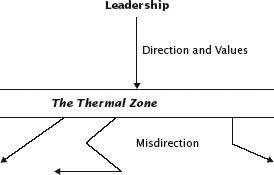
In every organization there is a layer—I call it the “thermal zone” (Figure 3.2)—which refracts and redirects things, just as happens in water. That layer com- prises key middle managers who really run the day-to-day operation, and whose commitment, not mere compliance, is needed for the success of any project.
FIGURE 3.2 The thermal zone
Therefore, it’s best to recognize both them and the circumstances in which they work so that your project isn’t refracted out of existence.
Note 1. One of HR’s and training’s favorite non verbs.
There are nine key components in the proposal “architecture” that I’ve introduced and supported globally over the past 25 years. In this chapter are the latest iterations and examples.
1. Situation Appraisal
What: The situation appraisal is a one- or two-paragraph description of why you and the buyer are discussing the project.
Why: The intent is to begin on familiar ground with the premise of the project clear and for the buyer to being nodding “Yes, that’s correct.”
How: State what the improvement desired is and why it’s important to the buyer and/or the organization.
Example Here’s a poor situation appraisal, yet it exemplifies so many of the openings to poor proposals:
The Acme Company is a provider of financial services located in Cheyenne, which has been in business for 30 years and has a capitalized market value of $800 million. The Acme buyer knows this! It’s nothing novel or new or related to the project. It’s irrelevant.
Here’s an excellent situation statement:
The Acme Company has traditionally attracted the best and brightest talent because of its excellent brand and relationships with top schools. However, recent bad publicity over poor financial decisions, the removal of the CEO, and loss of key contacts in top schools have made it imperative to launch an aggressive plan to acquire the best talent in the industry, both at entry and senior levels.
That situation appraisal explains exactly why you’ve been talking, why the project is urgent, and what the general goals are.
Take a project you’re considering, have under way, or have completed, and try writing your own situation appraisal below:
2. Objectives
The next three elements—objectives, metrics, and value—are taken directly from the conceptual agreement elements achieved with the buyer. I prefer to state them as bullet points and not narrative, because they are clearer and more concise.
What: An objective is a business outcome or result that is to be achieved.
Why: These are the “improved client conditions” that generate value and, ultimately, ROI.
How: State the objectives gained during the conceptual agreement phase, trying not to use specific numbers (e.g., “five new hires,” but rather direction, e.g. “maximum new hires”).
Example
(continuing with our current example) The objectives for this project include:
Reconstruct positive relationships so that we are endorsed by top schools.
Attract seasoned veterans who see our firm as a “step-up” in prestige.
Avoid disrupting or threatening current staff.
Reassure clients and prospects that top talent is present at Acme.
You will be the leading edge and leader in financial recruitment.
Take a project you’re considering, have under way, or have completed, and try writing your own objectives below:
What: These are the measures of success indicating progress and/or completion.
Why: You and the buyer will use these to guide decisions during the project and to validate your involvement in making the difference.
How: These are taken from conceptual agreement and stated with bullet points, making sure that there is manifest evidence (indicators) for the objectives.
Example
The measures of success for the project will include:
A minimum of six schools on the top 24 list invite you to recruit on campus.
Unsolicited resumes are received from top people at competi- tors.
Unsolicited contacts are made by search firms to provide top tal- ent.
Your involuntary attrition rate falls below industry averages.
Clients renew at pre-incident rates and new clients are acquired above industry averages.
The media create positive stories about your talent success.
Take a project you’re considering, have under way, or have completed, and try writing your own metrics below:
4. Value
What: This is the impact on the organization and the buyer for meeting the objectives, as measured by the metrics.
Why: These statements justify the fee by enumerating the ROI and impact.
How: Again in bullet point form, noting that there can be several value statements for any single objective.
Example
The value and impact of achieving the above objectives include:
Less cost of attracting talent, estimated by you at about 15–25 percent.
Less current turnover, estimated now at about $400,000 per year.
Less client turnover, estimated now at $3 million in lost commis- sions annually.
New business that should add a minimum of $3 million in com- missions.
Word-of-mouth goodwill for both the company’s products and its jobs.
You being seen as a leading-edge figure in financial recruiting.
Enhanced media and community relationships.
Note that value is both organizational and professional, and both tangible and intangible, as well as peripheral. Again, the formula we are using is:
Take a project you’re considering, have under way, or have completed, and try writing your own value statements below:
5. Methodology and Options
Always try to provide options for clients. This changes the psychology from “Should I do this?” to “How should I do this?”, which increases your chances for success at least fourfold. Don’t go too deeply into methodology (e.g., “focus groups,” not “six focus groups in four locations”).
What: These are the alternatives that the buyer may select from to reach the objectives, the various roads to the destination. However, some routes provide more value than others, even though the least of them will fulfill the objectives.
Why: To escalate the buyer’s decision to add more value and consequently higher fees because of higher ROI. You are adding to the value “above the line” in Figure 3.1, allowing you to increase the fee “below the line,” which still in- creases resultant value.
How: Meet the objectives with the first option, then provide even more value and differentiation in ensuing options.
Example
Option 1, Strategic: We will interview top administrators at your top 24 schools and develop a plan for creating new and strong ties. We will run focus groups comprising current clients to establish the best of your existing services and determine which new ones would be most desirable. We will launch a media campaign of delighted clients, new services, and feature existing top talent. We will create an advisory board of top search firm leadership.
Option 2, Tactical: In addition to Option 1, we will create a monthly, electronic client and prospect newsletter. We will create speaking engagements for the new CEO in front of campus and search audiences. We will monitor current employees for any signs of disaffection of top talent, including observations and personal interviews.
Option 3, Execution: In addition to Options 1 and 2, we will work with your senior management team to develop them in perpetuating this work themselves after our departure. We will create an annual conference of “best practices in talent management in the financial services industry” hosted by your firm. We will revisit once a quarter for the ensuing year to fine-tune and to help you to manage the results.
Note that you can call these options anything you like, including simply “Options 1, 2, and 3.” You can also mix and match my particular interventions to suit, as your client and your own taste will differ from my example. But, in theory at least, the differences applicable to any alternative should make sense in the context of that alternative, understanding that prior alternatives are already inclusive. Options are not “add-ons,” nor are they based on more volume (e.g., interview at 40 schools instead of 24). They are qualitatively better, not merely quantitatively larger.
You want to avoid a “take it or leave it” single alternative whenever possible, which should be always.
Take a project you’re considering, have under way, or have completed, and try writing your own methodology and options below:
6. Timing
What: This is an estimate and preferably a range of the duration of each of the options barring unforeseen circumstances.
Why: The client deserves to know the extent of your presences and possible disruptions, and you deserve to have a disengagement date set to avoid any possibility of “scope creep” (the buyer requesting that you stick around beyond the objectives being accomplished at no extra fee).
How: State in duration of days, not calendar dates, the estimated time required.
Example
For Option 1, we estimate a 45- to 60-day time frame. For Option 2, we estimate 60 to 90 days. For Option 3, we estimate 90 to 120 days, with four quarterly visits in the following 12 months.
These time frames assume that you and we experience no unforeseen delays or postponements. I’m prepared to begin within one week of your acceptance of this proposal.
7. Joint Accountabilities
This is one of the most overlooked elements in a proposal. If you concur that you’re entering into a partnership with your buyer, then it’s only logical that you should each have (and share) accountabilities for success. The project is not something you “do” to the buyer. It’s a joint undertaking.
What: These are the responsibilities that you are each in the best position to support individually or that you can best do jointly, and constitute the key areas underlying the success of the project.
Why: By specifying these in the proposal, the buyer is also signing off on his or her personal responsibility and committing to acting in a certain manner, while also being clear on your commitment to critical areas.
How: List those that are unique to the buyer, those that are unique to you, and those that you’ll share.
Example
Your accountabilities will include:
Providing me with access to all key people internally, in colleges, and among your media access.
Sharing financial details of costs of turnover, loss of customers, acquisition costs, and so forth.
Free access for me to roam the offices, including security passes, access cards, a private office, and intranet access.
Providing your personal contact numbers and addresses, weekly debriefs by phone or in person, and responding to my inquiries and requests within 24 hours.
Honoring the intellectual property and trademarked material I provide for your use.
My accountabilities will include:
Signing nondisclosure and confidentiality documents.
Responding to your questions and requests within 90 minutes during Eastern U.S. business hours (put your own service standard in this space).
Conducting all interviews, focus groups, observations, external interactions personally and with respect for minimizing disruption and concern.
Meeting all deadlines agreed on and immediately reporting any threats to our progress.
We both will be accountable for:
Immediately informing the other of any new developments that might materially affect the success of this project.
Take a project you’re considering, have under way, or have completed, and try writing equivalent accountabilities for you and the buyer below:
8. Terms and Conditions
This is my favorite part of the proposal! This is the first time—the first time—that the buyer will see the fees. That may be contrary to everything you’ve ever heard, learned, or practiced, but hear me out. You want the buyer to be nodding assertively and positively throughout this proposal that these are the issues dis- cussed (in conceptual agreement), the options that are valuable and make sense, and that it’s time to get started. You want that positive sentiment and momentum to carry right into the fees section.
What: These are the fees, reimbursements, and terms of payment for the project described herein.
Why: The buyer has now understood the value of the options and can make a reasoned judgment about ROI (return on investment—see Figure 3.1). With value-based fees, there is never a time-based element or meter running, simply a project fee with substantial return.
How: Simply state the fees, reimbursements, and terms, without too much narrative and without confusion. Take into account in your fees the elements in Figure 3.1 from conceptual agreement and the value stated herein.
Example
The fee for Option 1, Strategic, is $176,000. The fee for Option 2, Tactical, is $211,000. The fee for Option 3, Execution, is $267,000.
Terms: 50 percent on acceptance of this proposal, and 50 percent 60 days after commencement of work. Alternatively, you may avail yourself of a 10 percent discount with payment in full on acceptance. (NOTE! Some organizations have internal policies stipulating that all discounts must be accepted.)
Expense Reimbursements: We charge expenses as actually accrued and bill at the conclusion of each month. Payment is due upon presentation of our invoice. We charge for reasonable travel, living, and related expenses. We do not charge for administrative support, courier, postage, phone, and so forth.
This project is noncancelable for any reason. You may postpone and reschedule with our approval without penalty so long as you maintain the existing payment schedule. The quality of our work is guaranteed, and if our work is not consistent with the quality expressed in the accountabilities section, we will refund your full fee.
Important Notes:
The terms are aggressive and I suggest that you always request 50 percent as a deposit, with the balance due in short order, not over the course of the project.
This is as good a time as any to point out that you never want this proposal to go to the legal department, hence, avoid legalese and “boiler- plate” such as “third parties shall hold harmless. . .”
Specify what your expense policy is and never “nickel and dime” (like lawyers do when they charge you for photocopies).
Never cite “10 days net” or “30 days net,” but rather, “due on presentation” or “on receipt.” In worst case, they’ll take 30 days but not 60.
Try to provide a minimum 10:1 return on the client’s fee in terms of the value expressed. At these levels, it doesn’t matter if Option 1 is $164,000 or $181,000. It doesn’t matter. However, ensure that there is sufficient “distance” among options.
Take a project you’re considering, have under way, or have completed, and try writing your terms and conditions below:
Case Study: The Insurance Merger
I was hired for the cultural aspects of a huge insurance merger in New York City. The fee was $250,000. I received $125,000 promptly and began work, though my buyer, the executive vice president, never returned a signed copy of the proposal. Sixty days later, I received my second $125,000 on schedule. I completed the project well ahead of deadline in four months, and still had no signed contract.
When I asked the delighted buyer, he told me, “I have authority to sign checks up to $150,000, but I can’t sign legal contracts over $100,000 without legal’s review. So I took the path of least resistance, figuring you’d be happier with the money and no signed contract than the other way around.” That explains a sentence you’ll see in the final segment of the proposal architecture, further on!
9. Acceptance
To steer clear of the legal minefields my proposals are also acceptance vehicles. Thus, after the buyer has read through, agreed to most of what he or she has previously agreed to, and seen attractive options, an immediate decision can be made.
What: The formal and contractual decision is indicated to go forward with the desired option.
Why: Proposals are summations, not explorations. It’s important to allow the buyer the opportunity to make an immediate commitment.
How: Include the brief wording and signatory provisions at the conclusion.
Example
Your signature below indicates the acceptance of the option checked and your agreement with all provisions and terms specified in this proposal.
Alternatively, your deposit or full payment and indication of an option will also constitute that acceptance allowing us to begin the project together.
We accept (please check)
__ Option 1 __ Option 2 __ Option 3
and agree to the terms and conditions as specified. We are providing a __ 50 percent deposit or __ full payment less a 10 percent professional discount.
For Acme, Inc.:
For Summit Consulting Group, Inc.:
______________
___________________________
Wile E. Coyote
Alan Weiss, PhD President,
Vice President
Predation
Date: March 2, 2012
I’m not going to provide a practice space with this one because you merely use the template above, substituting as necessary.
I send two copies of my proposals in hard copy even if the buyer has requested an electronic version, and I sign all copies before sending them. I don’t see the need to have the buyer sign, then I countersign, then I return a copy again. I want speed, not bureaucracy, and since all of this is predicated on a trusting relationship with the buyer, and I’m dealing only with the buyer, there is no danger in signing and sending it along. I use FedEx all the time.
The buyer typically signs one and returns one, or signs one “electronically.” But see the case study above where I never did receive the signed contract. I will work on a “telephone handshake,” or even an e-mail one, though I prefer a signed document, because:
Buyers change.
Others may eventually want to review it.
It indicates commitment not just to payment terms, but to outcomes, time frames, accountabilities, and so forth.
If the project is delayed per the allowance in the proposal, it’s more important than ever to have documentation for starting up again.
Lawyers sometimes appear unexpectedly when you open the cellar door by mistake.
The architecture, as I’m calling it, is in these nine clear steps:
1. Situation appraisal
2. Objectives
3. Metrics
4. Value
5. Methodology and options
6. Timing
7. Joint accountabilities
8. Terms and conditions
9. Acceptance
Contrast this to the semi-bound, quasi-legal monstrosities you’ve seen in so many instances, which provide the unfortunate opportunity for the buyer to quite legitimately claim that he or she requires help from legal, finance, HR, implementers, stakeholders, colleagues, and so on. The more you say, the more you leave yourself open to be second-guessed or discussed.
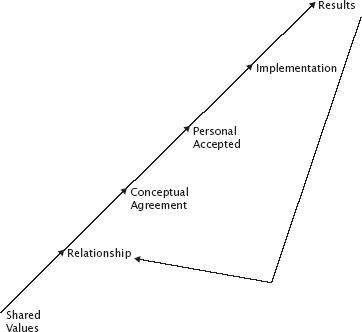
The principle from the earlier chapters is what carries the day here: conceptual agreement with a true, economic buyer about objectives, measures of success, and the value of achieving those objectives for the organization and the buyer personally. As you can see in Figure 4.1, the proposal is submitted after a lead is qualified, a buyer is found, a relationship is established, and conceptual agreement is obtained. That can be a tough wait for many consultants, but it’s the royal road (and even expressway) to high-value proposals being accepted 80 percent of the time or better.
FIGURE 4.1 The consulting business model
This approach also eliminates the need for personally presenting the proposal, for “dog and pony” shows, and for facing most committees. We’ll talk more about that in the next chapter. You’ve seen here, if you’ve completed the few exercises, how readily this sequence can be applied to your own business. So the key point from here is your own discipline and talent, and we turn to those two vital factors now.
Notes
1. The least expensive option must still meet all the project objectives or you’re being unethical. The idea is to build value above and beyond the minimum stated in the larger options.
2. You can have two options or seven, but I’ve found three to provide the best assortment of easy choice and differentiation for the buyer to quickly consider.
3. Noncompete would also go here, but these should be rare and very expensive. See my books Million Dollar Consulting (McGraw-Hill) and Value-Based Fees ( John Wiley & Sons).
4. For example, the buyer finds out that divestiture is in the works, or I find out that three vice presidents have their resumes on the street.
I promise my proposals within 24 hours in almost all cases. (Taking an international flight might prohibit this, but not always.) I can write it on the flight then e- mail it from my laptop or iPad on landing. Since I’d rarely schedule a flight like that the same day as a major meeting, it’s rarely ever been a problem, and it’s the kind of problem I love if I do have it!
Speed is of the essence. Too many bad things can happen the longer you wait to submit your proposal:
A client priority radically shifts.
Unexpected internal and external events intervene.
The buyer becomes ill or is reassigned or has personal problems.
A subordinate decides to resist because it’s threatening.
Legal and finance and HR get wind of it, and stick their noses in.
Across-the-board cuts are made.
You get the idea. Absence does not make the heart grow fonder; it makes people forget. You want to ride the wave of the positives you’ve created: trust, conceptual agreement, value, excitement. Consequently, you want to instantiate the discussions, ideas, concepts, agreements, and related matters in a formalized way as soon as you possibly can.
I’m suggesting that as soon as you possibly can is the next business day.
Since my proposal “architecture” is really a template, I suggest that you modify it within reason for your needs (e.g., you may want to include something about intellectual property if it worries you, but never include resumes for you and your staff), and then simply “plug in” the appropriate content in each of the nine areas.
Once you do that, you can read it through for flow and logic, and then finalize it. As I mentioned in the prior chapter, send two executed copies by FedEx to your buyer’s personal attention, and send an electronic copy only if requested.
Glossary
Instantiate: To convert intangibles into pragmatic, clear examples for action and next steps. Digression: Electronic Proposals I realize some people request and prefer these, and I’m no Luddite. I’m working as a coauthor right now on a book tentatively titled Web Dreams. Having said that, here are my reservations about electronically submitted proposals:
Digression: Electronic Proposals
I realize some people request and prefer these, and I’m no Luddite. I’m working as a coauthor right now on a book tentatively titled Web Dreams. Having said that, here are my reservations about electronically submitted proposals:
The formatting is easily scrambled, and small errors can make major differences, as with decimal points, months, and so on.
They are unsecure, and a secretary or assistant may regularly intercept e-mail (they are less likely to open a personal FedEx), and they may talk to friends in legal or HR.
E-mail with attachments is often blocked or redirected for security reasons.
It’s far too easy to include someone else’s e-mail by accident, either at your end or the client’s end.
You lose the richness of your letterhead, presentation folder, and so forth.
For those reasons, I’ll send hard copy no matter what. I’m not using FedEx as a generic here, either. I use Federal Express because it has by far the best service, highest reliability, and easiest tracking. (I remember the DHL guy who would appear in a little van, smoking a cigarette to deliver to me. I don’t want his cousin delivering to my clients.)
The proper sequence then, looks something like this:
1. Conclude your conceptual agreement meeting in person with a summary and definitive next steps (see the final segment in this chapter).
2. Write the proposal immediately—if you’re back in the office that day, fine, otherwise write it in your travels. Consider allowing time to write it in the city you’re visiting before taking the first flight home. Treat yourself to a good meal and celebrate.
3. Review it for accuracy (it helps to have someone else read it for typos) and send it via FedEx. Track the progress. E-mail the client that it’s en route, and include the client’s e-mail address in the FedEx options for notification for “sent,” “exceptions,”¹ and “received.” This way, if the buyer should tell you later that it wasn’t received, you can specify exactly who signed for it and when. (This has happened to me because internal mail operations don’t necessarily assign the best and the brightest there.)
4. Contact the client as established in the next two days.
Three golden rules:
1. Write the proposal rapidly and completely at your first opportunity.
2. Get it to the client by the fastest means, which may include FedEx and electronics.
3. Enable the client and yourself to follow up on its progress. Before we move on, consider this: The speed and responsiveness demonstrated by your proposal submission is a clear and vivid indication of the speed and responsiveness the client can expect of you during the ensuing project. That is no small matter, no small example to set, and is seldom unnoticed. If you can provide a substantial proposal succinctly and rapidly, the chances are you can fulfill your project obligations in the same manner.
The proposal is the curtain being raised on the project. It’s an opportunity for the “audience” to understand what’s to follow, and become engaged and absorbed early. In the theater, they often talk about “the front of the house,” so that people have a positive experience arriving and the curtain can go up on time.
This is your “front of the house.” The important thing is for you to arrive on time! Get the place cleaned up, usher your buyer into the right seat, adjust the lighting, create the right mood, and sell the popcorn!
The word above is “re-creation,” as in formulating again, not what goes on in a rec room! By “re-creation” I mean that you should be faithfully recreating the conceptual agreement reached with the economic buyer.
This means that you shouldn’t be including everything that happens to be stored and accessible on your computer. You should be providing the “bare-bones” essential to keep the buyer on the straight and narrow trail.
Case Study: Heft versus Gravitas
I had received a call from a buyer at a previous client, now at a new firm, to meet with him and submit a proposal for a project. It was a different kind of firm from his prior one, so I believed that I should convince him of my qualifications for that type of business, despite our previous relationship and conceptual agreement achieved during our meeting.
When I called as promised a few days after the proposal submission, he said, “Alan, I’m sorry, but that ‘core dump’ you did of every visual you’ve ever created was distracting and leads me to believe you may not be comfortable with this particular type of intervention. Maybe next time.” There never was a “next time.”
Here’s what you don’t want to include in the proposal package and why. Don’t even think about it, assuming, of course, that you have conceptual agreement with a buyer in place. If not, then don’t just refrain from what’s below, refrain from sending a proposal altogether.
Resumes: These are used to get jobs, not to supply credentials for proposals, especially when you’ve already met with the buyer. And resumes for your staff are pointless. If the buyer trusts you, shouldn’t the buyer trust your judgment about your associates and colleagues?
Promotional materials: That horse left the barn just before the cows came home. Why on earth attempt to support your credibility now, after successful buyer interactions?
Deliverables: HR is famous for requesting “deliverables” because HR people seem incapable of thinking about outcomes. Whatever tasks or interventions you’ll be performing can be lightly covered in the “options and methodology” section of the proposal.
Charts and graphs: These are seldom useful at this juncture because you already have agreement, and they can tend to cause reservations if they are misunderstood or are shared with others who have not been privy to the prior conversations.
Gifts or incentives: Don’t even suggest that there is some lagniappe involved, even a brochure to a college the buyer’s daughter is considering. The only incentive should be the early payment discount, which profits the entire organization.
Glossary
Cover letter: The introduction to the proposal that contains certain promises, agreements, and expectations that accompany and are inherent in the proposal.
If those are items that should not be included—which is why 2.5 pages is usually totally sufficient—what else should be included?
Put the proposal in your best presentation folder along with a cover letter. Here is a sample cover letter.
March 3, 2012 Wile E. Coyote Vice President, Predation Acme Co., Inc. 85 Canyon Dr. Notsocarefree, AZ 88901
Dear Wile,
As promised, I’ve enclosed two copies of the proposal reflecting our agreements reached yesterday in your office. I’ve forwarded an electronic version as well this morning.
Please choose the option you prefer, the payment terms you prefer, and return one of the copies I’ve already signed via the FedEx envelope enclosed. I’ve also enclosed an invoice in different varieties in case this helps in the process.
I’m prepared to begin within a week of your acceptance, as discussed.
Please note that this proposal is copyrighted and contains my intellectual property. It may not be shared with anyone outside of your organization for any reason without my express approval.
I’ll call you Friday at 10 a.m. as agreed, if I don’t hear from you prior, to see which choices you’ve made. If you’d like to begin immediately with a telephone “handshake,” I’m happy to accommodate you.
Thanks for the opportunity to work with you on this important project.
Sincerely,
Alan Weiss, PhD P
resident
Note that you’re stressing that this may not be shown to competitors, the exact date and time of your follow-up, there is a FedEx envelope with your account number enclosed, and there are invoices to expedite the initial payments.
You’ve also allowed for an immediate start on the basis of a phone call. When the client does accept, either with a signature or a call, try to begin right away, on- site. This “pours cement” on the agreement. Even if you have other client engagements, you can always work in a brief visit to make some observations and con- duct some interviews.
Let’s explore why you don’t need more pitch and promotion, just to ensure that you’re comfortable. So forget all the resumes and jive. But make sure that cover letter is firmly attached and writ large!
Three golden rules:
4. Leave out as much as you can. 5. Ensure that the hard copy looks great. 6. Don’t mistake the proposal for promotion.