Counterintuitive: No Pitch or Promotion

I’m a devotee of the television phenomenon American Idol. One of the most hackneyed and trite critiques of the singers offered by the judges—especially Randy Jackson, who’s become known for it—is “pitchy.” In singing, this means that one is out of the proper tonal range, which can be caused by not hearing yourself, or by nerves, or simply by singing too loudly (which often results from the first two conditions).

You can also be too “pitchy” in your proposal, and it may seem counterintuitive to many of you that this is such a “low key,” explanatory document. So first I’ll reiterate: A proposal is a summation, not an exploration, and not a negotiation. This is not a debating document, thus it needn’t make points about why the buyer should pursue this. We already know that from prior discussions. This is rather about how the buyer should do this (hence, the options I insist upon presenting).

The more you provide a “take it or leave it” approach, the more you’re faced with a “hard sell.” An auto showroom with a single model is going to have some hard- pressed salespeople, but one with 20 models has salespeople who say, “If you’re looking for better mileage, just step over here,” or “If it’s something sportier that makes sense, let’s walk out onto the lot.” 

Under the best of conditions, a binary decision (do it or don’t do it) will give you a 50/50 chance. I’m not commenting on how well you’ve set it up, merely that there are two possible outcomes (despite the fact that the decision may be made immediately or delayed). With three options, however, you have no, yes, yes, and yes. You now have four possible outcomes, of which three are favorable, even though they differ in degree. (A project with the lowest option is far superior to no project at all.) 

As options increase, however, the advantage disappears. Again, this may sound counterintuitive, but consider this: With the advent of the proliferation of invest- ment and retirement vehicles in an increasingly turbulent and unpredictable global economy, fewer people actually decide on even attractive alternatives and simply allow their money to sit in low (e.g., 1 percent or less) savings accounts. People walking into television stores find themselves faced with flat-screen, different sizes, 3-D, projection, home theater, surround sound, digital light processing, liquid crystal display, rear projection, and so on. And as a result, they often leave the store without deciding, whereas a decade ago the choice was simple and immediately made. 

What’s needed isn’t a “pitch” but a set of optimal choices all focused on a yes of some kind. My experience concludes that this is three, but you may deem four or two your preference. My analysis looks like this:

Option  Percentage of Times Chosen 
¹  ¹⁵% 
²  ⁶⁰% 
³  ²⁵% 

As they say in the TV ads, “under actual conditions your results may vary”! How- ever, these are the results of my own work and thousands of people who have mentored with me. This means that when a proposal is accepted, a quarter of the time the top and most expensive option is selected, and 85 percent of the time one of the top two is selected. That is a huge increase in your annual income because, if you don’t provide options but rather a single choice, that fee is usually somewhere between Options 1 and 2.

You’d be leaving (and maybe have already left) a great deal of money on the table. 

In my experience, about 80 percent of value-based proposals—following a trusting relationship and conceptual agreement with an economic buyer—are accepted. Some of my mentees have reported acceptance consistently in the 90 percent range. But let’s remain conservative. 

If your average proposal options are for $50,000, $70,000, and $90,000 and you submit two per month, that’s 24 proposals a year, of which 19 would be accepted. Of the 19, three would produce $150,000 (Option 1); 11 would produce $770,000 (Option 2); and five would produce $450,000 (Option 3). That’s a total of $1,370,000 without a single proposal’s option in six figures, yet many of you do and should be bidding six figures for a great deal of your work. 

If you were providing the single option, between the points I mentioned is usu- ally the case (between Options 1 and 2), that amount would have been $60,000 times 19 projects, or $1,140,000, which represents a quarter million dollars left on the table. However, what’s not included in my calculations is that the single-option, take-it-or-leave-it proposal would not close at a rate of 80 percent. Let’s be kind and say that your closing rate is better than 50/50—call it 65 percent. That means 16 proposals close at $60,000 each, which is $960,000, or $410,000 less than the approach with three options and a higher close rate, which is a 30 percent decline in potential income.

Over the course of five years, that grows to about $2 million. If your proposals tend to be less than the average or more than the average above, simply adjust the figures accordingly. But the fact is that you are leaving money on the table each year, which you will never be able to recover. It’s gone. And it was all bottom-line profit. Over a decade that’s the difference between comfortable retirement and forced work; between being able to take prudent risk and having to be archly conservative; between philanthropy and penuriousness.

Try this out, just to personalize the impact, by using your last full year’s results: 

Now apply my averages, assuming that you had an option 15 percent below your average fee (1), 15 percent above it (2), and 25 percent above it (3). Apply the percentages above to your close rate and the options that would have been accepted: 
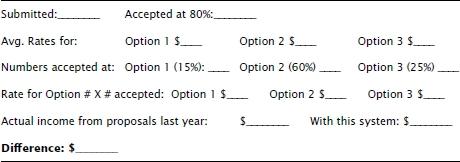
What differences do you see? Is it worth thinking about following the simple, disciplined system, and worrying less about pitch and more about process? How much money did you leave on the table last year? 

Three golden rules: 

7. Options escalate business dramatically.
8. If you don’t ask, you don’t get.
9. You are past the point of return in terms of negotiating.


To Be or Not to Be (In Person)

It’s a bad idea to deliver a completed proposal in person. 

I know that flies in the face of what you’ve been told, what you do, and even a positive experience or two you’ve had, but it’s an overwhelmingly bad idea. 

Now I guess you’re going to want to know why. 

  • Timing: This delays receipt and acceptance. You have to produce a convenient date for you and the buyer, which could take a week or a month. If something emerges in the interim or during that meeting requiring an adjustment, then the delay becomes even longer.

  • Temperature: You allow the process to cool down considerably. The next day (which is why I’ve advocated speed and FedEx or electronics) the buyer is still enthused, very conversant, and convinced. As the days grow long you reach the December of the (northern hemisphere) year: cool and icy conditions.

  • Intermezzo: Restaurants often provide an intermezzo, or palate cleaner, between courses, to remove prior tastes. You don’t want that course served here. Too many interferences can surface that neither you nor the buyer had anticipated (or had anticipated as much less of an issue) the longer you take to get there. 

  • Crowds: There is at least an odds-on chance that, because you’re coming back to present the proposal, the buyer will invite in (or others will inveigle in) random colleagues and subordinates, who may well pose objections and resistance the buyer had underestimated. It’s unlikely that the buyer would invite this cabal to review a written proposal received the next day after your meeting.

  • Production: It’s often assumed that the presentation of a proposal requires PowerPoint, handouts, models, and at least three trained seals. Why are you there with merely a 2.5-page proposal that is totally clear and crisp?

  • Questions: As long as you’re there, the buyer is going to utilize the time to explore every nook and cranny. There will be minor questions that become major pains, semicolons that require more than a short pause, and suggestions for amendments and redaction. 

  • Negotiation: It’s much tougher in person than on the phone for most consultants to steel themselves to reject requests for fee compromise. When the buyer says, “I love Option 3, but the price is a tad high,” on the phone you can reply, “That’s why we have Option two!” But sitting on a couch, drinking coffee, with the buyer smiling and winking, how steeled are you going to be? After all, if this isn’t a negotiating document, then why have you returned in person to discuss it at all?

And there is the rub. 

Once you show up, especially after more than a couple of days—and it’s often more than a month in many instances, given travel and other priorities for both parties—the dynamics have changed. There are new priorities, views from precincts not reporting in previously, less intimate familiarity with the details, less fervor about and belief in the ROI. 

Your proposal is copyrighted, and you’ve stipulated within it that it’s not to be shown to anyone outside of the organization—thereby preventing, one hopes, the sharing of contents with competing consultants. But on top of all of that, you have a trusting relationship with the buyer. 

Therefore, your written proposal should be sufficient for you to place before the buyer without the potential negatives of setting up and conducting a personal meeting for discussion and acceptance. And don’t forget this: 

  • Returns: Any changes, additions, or deletions agreed on in a personal meeting must be changed, usually through more than a hand notation but rather with a new, altered proposal, which will take more of your time to create and return and have accepted. And the buyer just may suggest that you return in person for a “final” discussion with the amendments.

Digression About Trust 

When a buyer says, “Great proposal, it’s made it to the short list,” or “We’re now looking only at you and one other firm,” or “Someone else is 25 percent less expensive making it a harder choice for me,” you do not have a trusting relationship with the buyer. 

The relationship you develop, coupled with conceptual agreement with its inherent ROI, should place you in a completely different category from competitors. Hence, the time required to develop that relationship actually results in faster, higher quality business. 

If I—as an economic buyer—trust you and believe in the goals we’ve mutually established, then someone else’s lower price isn’t going to be even a vague issue. Don’t rush the proposal creation, but do rush its delivery. 

  • Expense: The client isn’t going to be paying your expenses in 98 percent of these excursions, so that you may be spending thousands, which reduce the margin of the project by increasing acquisition costs considerably. The idea is to reduce acquisitions costs! (And if you aren’t successful in obtaining the project—which in best cases will be at least 20 percent of the time—you’re incurring tens of thousands in unnecessary reductions to your bottom line annually.)

So, to be or not to be?
Not.

Near the end of this famous Shakespearean soliloquy, Hamlet observes:

With this regard their currents turn awry,
And lose the name of action.

You don’t want to “lose the name of action.” You’re going to accelerate the process (or at least maintain the current velocity) ironically by staying away. Educate the client about this near the end of your conceptual agreement meeting. “If we’re agreed, I’ll summarize this in a brief proposal, get it to you tomorrow, and call you Friday at 10 for your choice of options and terms. There’s no need to take up any more of your time until then.” 

So let’s turn to Friday at 10, when you do need to “show up.” 

Two golden rules: 

10. You’re most influential when you’re not there with the proposal.
11. Don’t fix things that are working just fine.

Definitive Dates and Times

A discipline that’s key to our professional lives is especially salient in terms of proposals. I call them “sedulous next steps,” or SNS. 

Nowhere is a definitive future, agreed-upon action more important than in developing, documenting, and delivering proposals. It’s rather useless to promise a proposal quickly and then take your time following up. Speed and milestones are as important as detail and description. 

Before you leave the buyer and after the conceptual agreement, you should use language such as this: 

I’ll have this on your desk before 10:30 on Thursday. Are you available Friday after- noon at 2 to chat by phone so that I can find out your choices? 

If not, what time is best on Monday? Would you prefer I call your cell phone or office number? 

If you have a conceptual agreement based on a trusting relationship, you should not receive a response such as: 

  • I’ll get back to you when I can next week.
  • Call me in about two weeks.
  • I’ll need to have some of my people review what you send.
  • Take your time, there is no rush here.
  • Why don’t you schedule another meeting and bring it by?

All of these are “stop” signs requiring that you return, like Groundhog Day, to an earlier part of the conversation and reestablish (or establish for the first time) a trusting relationship, value, a sense of urgency, and definitive next steps. A failure to do this is why so many consultants complain to me that, “I can’t understand it, the buyer won’t return my calls despite our productive meeting.” 

Productive for whom? 

Here is a typical schedule you can follow and even place in your briefcase to refer to during your visit: 

Step  When 
¹. Establish conceptual agreement  During meeting with economic buyer after trust is established ³ 
². Reconfirm conceptual agreement  Prior to end of meeting 
³. Set time and date for buyer to expect proposal  Prior to end of meeting 
⁴. Set time and date for follow-up after  proposal is received  Prior to end of meeting

⁵. Set contingency time and date in case follow-up is missed  Prior to end of meeting 

Thus: 

I’ll have this on your desk before 10:30 on Thursday. Are you available Friday after- noon at 2 to chat by phone so that I can find out your choices? 

If not, what time is best on Monday? Would you prefer I call your cell phone or office number? In case something occurs that we don’t anticipate and we miss that call, how is Monday morning before the day begins, say at 8:45? how is Monday morning before the day begins, say at 8:45? 

We’ve covered why the buyer might not be responsive when you don’t create SNS (e.g., the buyer just wants you to be gone and really hasn’t felt a trusting relationship grow). But why would the buyer not respond if you do have a trusting relationship and tight conceptual agreement?

Glossary 

SNS: Sedulous next steps are those vital connections between you and the buyer, which maintain momentum and minimize time duration. They are important throughout the marketing and delivery relationships, but absolutely critical in the proposal stage. 

Personal concerns have arisen that trump all else •Illness •Emergency assignment •Company emergency (e.g., lawsuit) •Interference and interruption by others/shifting priorities •“Cools off” to the value after you leave •Learns new, pertinent information that’s discouraging •Misses or misplaces your call/forgets 

For these and allied reasons, I’ve been suggesting the following preventive and contingent actions: 

•Take your time to gain trust and test that trust, for example, is the buyer sharing with you and seeking advice? •Reconfirm everything on the spot, while you’re there. •Set definitive next times and dates. •Set contingency times and dates. •Request a cell phone number and/or personal e-mail. •Ask while together, “Are there any obstacles you can conceive which might delay your acceptance of my proposal that we haven’t yet  discussed?”⁴ •Move quickly—as quickly as you can. This is enhanced by our very brief and pithy proposal format. •Ask the buyer’s secretary or assistant if anything is preventing a return call if the original and contingency aren’t made. •Don’t assume the buyer is damaged or dishonest or uninterested. •These judgments will adversely affect your behavior. •Make three calls, and then write a hard copy letter. We’ll talk about this contingency more a bit later. 

Understand for now that time is money in the sense that the faster you are, the more you’ll make. But let’s look at adverse events that occur despite your best plans. 

One golden rule: 

12. Get there firstest with the mostest and measure it with your calendar.

Notes 

1. This enables the buyer and you to be told that FedEx had a mechanical problem or a storm cancelled the flight. 

2. Which is not in person, and which I discuss later in the chapter. 

3. This may take more than one meeting in certain circumstances, so be sure to schedule the next meeting while you’re there.

4. If the buyer says, “Yes, I haven’t seen your fees!” respond, “That’s true, and you’ll see fees, options, and ROI in detail tomorrow!” 

How and When to Follow Up

As we’ve discussed, you follow up quickly on an agreed-upon date at an agreed upon time. If you reach voice mail or an assistant, you simply say, “I’m calling as promised.” If you have a trusting relationship, the buyer should have you on the calendar and take your call. If the buyer has encountered an unavoidable conflict, then the buyer should call you back promptly. 

That’s the best of all possible worlds, a Candidian outcome. Your inquiry should then be an assumptive closing statement, such as: 

Which option have you decided to implement?
Which payment option do you prefer?

If for any reason you have not set a definitive time and date with the buyer, then my advice is to contact the buyer 24 hours after receipt of the proposal. If you’re using FedEx you can track that and actually see who signed for it and when (anticipating the possible reaction, “Did we get it?”). Always do this by phone, never e- mail. Consultants are afraid to use the phone, I think because the possible rejection is starker than by e-mail. Get rid of that mind-set. Pick up the phone and call. 

My general rule for any unreturned communications is three tries and a letter. That means that after three calls, you send a hard copy letter (avoid getting lost in e-mail) and say the following: 

I’m sorry we couldn’t make contact. I’m here if you need me, but I certainly don’t want to hound you. After three attempts, I’m respecting your privacy but am happy to continue when you’re ready. 

When people don’t get back to you it’s not because they’re busy, it’s because they’re rude and unprofessional. (This is much more common at lower levels and within HR than with executives, by the way, who have no need to create artificial power in this manner by being non responsive.) It’s passive/aggressive behavior that is detestable, so don’t throw good time and money after bad. However, you needn’t burn bridges. My two lines above are polite and leave the bridge intact. 

It’s always a good idea to cultivate a relationship with the buyer’s secretary, assistant, or key subordinate during your visits if possible. You can then call them and say: 

I need your advice. Is she in town and, if so, what’s the best time to reach her? Can you put me on her calendar? 

The old bromide works well here: Call early in the morning or after hours. Many buyers are at their desk by 8 and still there at 6, with their line open because their assistant isn’t there and they may be expecting calls (though not yours!). 

If the buyer does take the call as planned, and responds, “Option 2, we’ll send the 50 percent deposit tomorrow, when can you start?” then simply move forward. You may say: 

Thank you, I’m looking forward to our partnership. Will you use the invoice and FedEx envelope I enclosed, or will you need something else? (Some firms need to give you an accounts payable number or require proof of malpractice insurance coverage, and so forth.) While I have you on the phone, let’s get everything squared away. How is Tuesday morning to start? Can you and I meet for 30 minutes? 

If at some later time, accounts payable or a similar function has someone contact you to inform you that the provisions of your proposal are out of policy, or that they intend to pay you 60 days, net, or that you’ll have to jump through other hoops, simply go back to your buyer and emphasize the terms and conditions that were accepted in your proposal. Don’t argue with bureaucrats, that’s all they have to do. Let your buyer do the heavy lifting. 

Some firms (especially overseas) will want to wire funds. Make sure that they have your international routing (SWIFT) number, your account name and number, your bank’s name and address, and a management contact at the bank. In my experience, wired funds take from 3 to 10 days to reach your account once initiated by the client. 

Do not accept foreign currency checks, no checks in U.S. funds drawn on a non- U.S. bank. The bank will return it, via normal mail, to get their exchange and will charge you a fee for taking so long to do it. U.S. funds must be drawn on a U.S. bank. Most foreign banks have U.S. counterpart relationships.

Case Study: Purchasing Problem 

After I had reached a deal with Tom, the general manager, I was to start in two weeks. In the interim, Peggy called me from purchasing to inform me that Tom “wasn’t authorized” to conduct negotiations with “vendors.” “I’m a consultant, not a vendor,” I pointed out. 

“You’re a vendor to me,” she sniffed. Then she told me that I was to provide an hourly rate, and if it was more than 10 times higher than the average of the last six consultants who worked there, I would have to lower it. “You’ll do that or you won’t work here,” she said. 

“Good-bye,” I said. 

I called Tom and he told me he had heard about such things, and that he’d take care of it. He had Peggy fired.

I have no remorse. Her job was to support the line executives, not to play traffic cop. I realized that arguing with her was a losing proposition, and that I had no intention of losing in the end. 

Accept credit cards when the client requests it. The fees you’ll have to pay (generally from 2 to 3.5 percent) are a cost of doing business. On a $30,000 fee, that’s about $900, which is worth it to get the money in your account quickly. 

In most cases, you’ll get through to your buyer and he or she will choose an option to proceed. Life being what it is, other things can occur. So let’s take a look at what you can reasonably anticipate getting in the way and how to cope. 

What to Anticipate and How to Cope

I mentioned earlier that my “hit rate” with this process is about 80 percent, though some people in my Mentor Program report upward of 90 percent. In any case, that means that about 60 percent of the time I simply get a yes, 20 percent I have to cope with “issues,” and 20 percent I simply don’t get the business.

Bad things happen to good people like you and often me. You can anticipate some and cope with them or even resolve them. 1. The client loves an Option 3 facet but cannot approve expenditures above Option 2.

In this case, technically there is another buyer just for Option 3, because you’ve exceeded your buyer’s grant of authority with it. But it makes no sense to try to move to that more senior person when your buyer is ready to proceed. Nor does it make sense here to cavalierly say (as I often do suggest to those buyers who have the money but want to see if they can get a “deal”), “Well, that’s why we have Option 2.” 

You can’t just grant Option 3 at Option 2 fees because the next question is, “How low will you go?” Perhaps to Option 1 prices? 

But what you can do is to move things around. Suggest that you can move one facet from 3 to 2 at a slightly higher price or, if possible in the context of your options, take some things out of 2, move something from 3 in, and simply charge the Option 2 fee. It helps to be flexible in these cases if you believe your buyer simply doesn’t have the ability to invest more. But you must show that you’re removing something, not just lowering the fee. 

2. The client can’t approve a check over a certain amount even though the buyer has a budget for more than the total amount. 

It’s often the case that the buyer has a $500,000 budget, for example, but can’t approve checks over $150,000 without another officer’s approval or a committee review. That can be deadly, because people without any interest in or appreciation of the project will feel it their earthly calling to question the amount being invested. 

The best way to cope with this is to suggest that the buyer authorize more than one check at his or her grant of authority until the full amount is paid. This may re- quire that you change the terms of payment or that time frames be extended or work protocols shifted. You’ll find a case study earlier in the book where this exact issue arose and was handled in this manner. 

You do not want your proposals going to the legal department or to executives who have not participated in the process. So suggest this alternative to your buyer. (Many will suggest it to you.) 

3. Your buyer says something to others that threatens the project. 

Rehearse with your buyer if for any reason other high-level people need to be apprised of the work that’s to come prior to the proposal being signed. I’m not talking about further approvals, which means that you haven’t been speaking to the real buyer. But often there are executive councils or senior committees of which your buyer is a member and on a regular basis they inform each other of changes in their operations so that others can copy best practices or adjust to new ones (which is actually a pretty good idea). 

But your client should not mention details of the proposal, merely the results expected of a new initiative. Ideally, the buyer shouldn’t even mention you. But coach the buyer: For example, tell the buyer asked about the cost to simply say the proposal hasn’t been reviewed yet although it should clearly be well within budget. This will help you avoid an inadvertent creation of some other interested but unhelpful parties. 

4. The buyer gets cold feet. 

This is the reason that I urge you to act speedily and with all due haste. You want to strike while the buyer is still warm in the glow of your agreement. But, stuff happens. 

The causes can be legion, and we’ll deal with legitimate, last-minute objections below. They can include an unexpected event, a random comment by a superior, fear expressed by a subordinate, even a misunderstanding by you or the buyer that emerges when the buyer sees everything in writing. 

Case Study: The Careless Comment 

One of my Mentor Program Members in a European country had the equivalent of a $2 million project approved by the COO, who had budget and responsibility for such things. However, before it was signed, a board meeting was scheduled and the executive had to appear and report on new developments. He invited my colleague to observe the meeting as a courtesy. 

This particular board included two members of the union, per the contract. At the conclusion of the COO’s report, another board member casually asked what the price was, and the COO told him. The two union members immediately came to attention and suggested strongly that the matter be studied, given the immensity of the fee. The chair had no choice but to agree. 

My colleague was told two days later that the project was dead. For all of his preparation, he had never rehearsed with his buyer what to say if asked about the fee.

Follow up your proposal quickly. If you sense any hesitancy, confront it at the time, not later. In other words, if the buyer says, “I looked it over and things seem just as we agreed, but I’d like to. . .” then ask immediately why he or she feels it necessary to talk to others, to take a few more days, to compare it to the strategic plan, and so forth—whatever it is that finishes that sentence above. Don’t hesitate.

Before you leave the buyer with conceptual agreement attained, always ask, “Is there anything you can think of that would be an obstacle to us working together once you see the proposal and the investment levels provide for dramatic return?”

Try to ferret out what you can at that point. But if you encounter this when you make your follow-up call, confront it: “I’m not sure why that would help in any way, and I’m concerned that you may see obstacles that we hadn’t discussed. Please tell me what, specifically, gives you cause for pause at this point?”

Don’t be afraid to do this. The longer the buyer takes, the more bad things can happen. The faster the decision, the faster the best thing happens.

Overcoming Last-Minute Objections

There are legitimate objections that arise at the last moment, along with not so legitimate ones. There really are no objections you haven’t heard before, so it’s negligent not to be ready for all of them. You may not win every battle, but you should give a good fight. 

Last-minute objections fall into these four categories: 

1. Genuine misunderstandings.
2. Legitimate intervening events.
3. Resistance encountered from others.
4. Illegitimate fears.

1. Genuine Misunderstandings 

The buyer may have said that sales could be improved by 15 percent, but the client meant over two years and you thought it was over a single year. Hence, the returns may seem overly optimistic in your proposal. Or you may have said that your company would run all focus groups (meaning subcontractors or employees you routinely utilize) but the buyer thought that you, personally, would conduct them all. These things happen in all business meetings and there is no malice or incompetence involved (unless they repeatedly happen to you). 

The cure here is to ask the buyer what would make him or her happy, and see if you can accommodate that. Compromises are fine. You want to try to avoid lowering fees. For example, lowering the return to the first two years rather than the first year is not so debilitating, and may mean a 14:1 return on investment the first year instead of 20:1, which is still impressive. And it may be possible for you to agree to do half the focus groups or personally conduct interviews or convince the client that your people are better at focus groups than you are, which is why you have them conduct the sessions. No harm done. 

Take the responsibility for all misunderstandings, whether your fault or not, and try to preserve your fees by offering compromises or showing the buyer that there’s nothing to fear. 

2. Legitimate Intervening Events 

A company plant blows up. (It’s happened to me.) The buyer’s boss is fired, or re- placed, or leaves on extended disability. There is a purchase or divestiture announced. A company employee is kidnapped overseas. There is a major technology crash. A competitor gains a huge leap. 

These things happen regularly, so the odds are that they will happen in between the submission of your proposal and its acceptance at some points in your career. 

Be prepared. 

My recommendations: 

  • If you hear through other channels, phone your buyer immediately. If your buyer tells you, then suggest that you immediately confront the issue. 

  • My favored alternative is to suggest that the causes and reasons for the project haven’t actually been changed by anything that has transpired. So there really is no good reason to stop, just as there is no reason for the organization to suddenly stop doing business. 

  • If the change is too severe for the project to persevere, suggest to the client that you reorient your work within the budget of the first proposal (and options) to help with the issue at hand. The buyer has designated time, money, and you, so why not capitalize on those resources to at- tack the new challenge? 

  • If the first two don’t work, force the buyer to agree to a specific date to talk again to review the status. Remind the buyer that the current terms and conditions are good for 90 days only. (Some consultants actually put time deadlines in their proposals. I don’t because I want to encourage clients to act immediately and not believe they have a 90 day window.)

3. Resistance Encountered From Others 

On many occasions, others will know of the pending project and proposal. Monies may have been budgeted, people’s opinions sought, a gaggle of consultants brought in, and so forth. Some of those people want to undermine proposals be- cause they are threatened by the intervention. 

The best preventive action for this is to apprise your buyer in advance of this likelihood. (This is especially important if you’re asked to chat with subordinates by the client.) Tell the buyer that people tend to be threatened or offended that they aren’t called to take the lead internally on such projects. 

If the resistance still arises, suggest to the client that there are two options:

1. Co-opt the resistance. The buyer can talk to those involved and ensure them a role (and credit) in the implementation aspect.

2. Overwhelm the resistance. Tell them it’s a fait accompli and they had better get used to it, because they’re all expected to float on this boat.

Finally, point out that the decision is strategic, appropriate for the buyer, but not for people who are the tacticians and implementers. Sometimes tough decisions are required to effect the greatest positive change. 

4. Illegitimate Fears 

Your buyer and those around him may fear the following:

  • The unknown
  • Failure
  • Embarrassment
  • Bruised egos
  • Significant change
  • Going “public” with a new initiative
  • Risk
  • Fear itself

Fears aren’t uncommon, but these I call “illegitimate” because they really shouldn’t derail a significant buyer oriented toward improving his or her operation. The recipe for dealing with this is simple: Isolate the actual fear from my list above (it’s not all of these, after all); then ask what is the worst that can happen; demonstrate that you have preventive actions in place as well as contingencies; and point out that any new venture entails some degree of acceptable risk.

So if embarrassment is the issue, demonstrate that continued performance at the current level without any visible attempts at improvement is much more embarrassing, and that even modest improvement would look very good, and that the two of you are prepared to handle whatever arises through additional training or a slower pace (the benefit of value-based fees).

It’s darkest just before the dawn. 

Overcoming Legitimate Obstacles

There are legitimate obstacles that arise even at this late juncture, which is why “hit rates” aren’t even higher with this system. But you can maximize your rate of acceptance if you prepare for the common causes of last-minute interference. 

Obstacle 1: The buyer is called away. 

There have been more occasions than I thought possible in the realm of probability where my buyer has suddenly “vanished.” There’s an emergency in Puerto Rico and the buyer must rush to San Juan. There’s a sudden vacancy in the executive ranks, which the buyer must fill. There’s a potential client defection and the buyer must hurry to shore up the relationship.

Personally, the buyer is called away by illness in the family, a birth, a death, an accident, and so forth. 

You certainly don’t want to intrude in a moment of grief or even celebration, but you do want to be resolute on lesser business issues that suddenly impose them- selves. Consequently, here’s what to do when you achieve conceptual agreement in person and before you begin to write the proposal. 

  • Inform the client that sometimes either of you can be suddenly co-opted.

  • Suggest that you therefore exchange private cell phone numbers and e-mail addresses if you already haven’t.

  • Agree that a backup plan will be to talk in the evening or on a weekend should a sudden unforeseen issue arise.

Then follow up quickly as I’ve recommended throughout the book before bad things begin to happen to good people who wait. 

Obstacle 2: The buyer’s boss becomes involved. 

In large organizations, most of your quite legitimate buyers will have quite legitimate superiors. (In small businesses, you’ll find the owner often “reports” to a spouse.) Even though the superior need not provide approval or budget, there are times when your buyer may deem it politically correct to mention the project. 

This becomes a problem because none of the underlying value has been established with the superior, and you have no relationship or credibility with the superior. In larger projects, the buyer’s boss may reasonably say, “That’s a substantial in- vestment. Are you sure it’s the best approach?” And with that simple, reasonable question, the buyer may say, “I do, but if you have other ideas. . .” out of a sense of primal survival need. 

In the light of such a possibility: 

  • Ask the buyer if any of his or her superiors need to be apprised or involved prior to sending the proposal. Offer to meet with them at any time.

  • Suggest to the buyer that the contents of the proposal are heavily dependent on the intimate understanding and collaboration achieved by the two of you, and others may not appreciate the value and ROI but merely look at price.

  • Ask if there is anything at all you can do to help with internal acceptance if that’s an issue.

  • After the fact, urge the buyer to introduce you to any inquiring parties because “It’s unfair for you to market my abilities and approaches, and I can’t allow you to be in such an awkward position.”

Obstacle 3: The buyer and/or you have erred. 

Sometimes the buyer has believed that some assumptions are facts (i.e., turnover rates or average sales amounts). Sometimes you will be in error on your projections (the percentage increase in sales expected will be only in two areas, not all five). These errors are discovered after the buyer reads the actual proposal, which is really why you’ve submitted it and the buyer is reading it! 

At this point it may seem obvious to merely correct the errors and resubmit the proposal, and that is what you would do. However, you may be doing so with far less value than originally estimated and therefore less ROI, consequently too high a fee. So here are ways to avoid those unpleasantries in case their ugly heads arise: 

  • Always maximize the value statements from any one objective. Example: The simple objective to increase profits could generate impact (value) including increased investor attraction, better retention of top talent, higher investment in R&D, and larger bonuses.

  • Stress that you’re taking the low end of the range of possible value, or cutting estimates in half. Be very conservative, to demonstrate that there is the potential for much more.

  • Maximize the number of objectives in the proposal, which may include revenue, profit, stress reduction, higher visibility, more productivity, less cost, and so on.

  • Ensure that you have three solid options, the least of which provides strong value.

  • Stress in objectives and value the personal, emotional impact that will be achieved for the buyer. 

In providing for these elements, you can go back to the buyer after errors are  discovered and point out that there is still huge value and ROI; that a lesser option may now make sense; that the errors are inconsequential; and so forth. You don’t want to have to rewrite your proposal but merely have the buyer see that the return may be 12:1 instead of 17:1, or that the emotional gains are still quite present, and that there’s no point in making any revisions. 

“Bad” things can happen, often suddenly, but their simple occurrence shouldn’t be cause for despair or to give up the ship. Some, as you can see, are preventable if you take the right actions early. Others can be dealt with on a contingent basis if they do occur. But the key is that there are things to do, actions to put in place that can minimize this not infrequent stalling point. 

It’s a shame to have proceeded this far only to let anything less than a natural disaster get in the way of the value you’re capable of delivering to your client. Hence, it’s incumbent on you to deal with the rapids that sometimes abruptly appear downstream. 

Creating a Signature (or Something Else)

The point of all this planning and preparation is to get a signature on the bottom line of the proposal (my ninth category, “Acceptance”), because my proposal for- mat includes the buyer’s acceptance and there is no legal contract beyond this document (we’ll talk about legal documents and departments in the next chapter). 

So how will that happen? 

The most basic and fastest route is for the buyer to choose the desired option, sign and date one copy of the proposal, and return it. This is why the two copies I send are both executed by me. I don’t want the buyer to sign, then return it for me to sign, then return it to the buyer again. Too much time, too much potential for bad things to happen to good people who wait. I also include a FedEx letter envelope already addressed to me by using my account, and an invoice that can be used for any of the options and/or for full payment discount and “normal” 50 per- cent deposit.

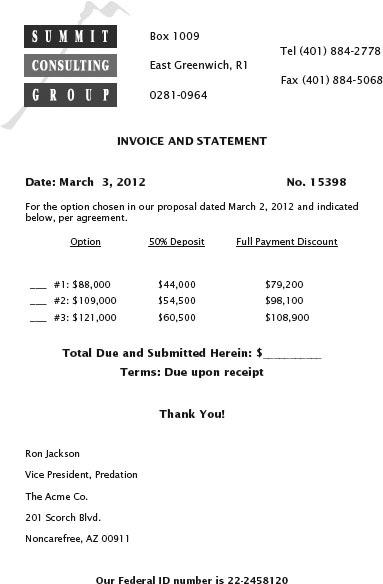
The invoice would look like the one shown in Figure 6.1. You’ll note that this can be hard copy or electronic, and I send them in both forms. My federal ID numberis on the invoice because many company payment departments demand it, and I don’t want them to have to contact me (usually in 30 days!). Also, it’s called “Invoice and Statement” because some firms demand one or the other, so I’m covering all bets with a single document. 

FIGURE 6.1 Invoice and Statement 

Specify the funds if you’re billing a nondomestic firm or wire instructions. You may also provide directions for wire transfer or credit card payments, depending on the situation. I tend not to provide these unless the client has re- quested them, because credit card payments entail interest charges on your part (3 percent on $121,000 is $3,640, for example, and wire transfers also result in a bank charge to you; both modes require up to a week before the deposit clears). If the client needs these alternative payment devices I’ll do it, but I’d rather not. As it is, checks take a few days to clear and checks not drawn on a domestic bank involve long delays and exchange charges.

Thus, ideally, the buyer signs the proposal copy that will be returned, chooses the option and payment terms, fills in the invoice, has a check issued, inserts the three items in your FedEx envelope, and you have it all the next day. 

Sometimes, however, it’s not so easy. 

If the buyer says, as often happens, “I want to begin, but the check cycle here is 60 days,” you don’t have an inconvenience, you have a problem. First, any buyer can have a “manual check” drawn, which is simply a computer check that pops out immediately. That’s because “60 days” means that your invoice is sitting on some- one’s desk in procurement or accounts payable for 59 days. 

So you reply, “If that’s the best we can do, I’ll plan to start in two months.” A deal is a deal, and if you’ve managed to “consultant up” and be a peer of the buyer to this point, don’t cave now. You’re partners, not buyer/seller. The buyer will usu- ally say, “Let me make a call.” 

Attack any issues like this as partners: How do we resolve this? 

Having said that, there are times when you want to begin immediately so the hastening of a signature or reasonable facsimile is important. 

For example, the buyer may well call you or respond when you call the buyer a day or so later, “I love this, Option 2 it is, and we have a rare chance to involve all of my country managers at once because they’re here this Friday for a conference. Can you come in to meet them and get acquainted? It will help tremendously when you have to talk across long distances later.” 

The answer to this is, “Of course,” as long as your schedule actually permits it. I call this “pouring cement on the sale,” because once you’re on-site working there is virtually never a retreat on the buyer’s part. You simply add, “The proposal calls for payment on commencement, and this is quicker than either of us anticipated, but I’m happy to help. Can you expedite the payment?” 

A “telephone handshake” is always good enough for me. If the buyer says, “Go,” I start moving. Don’t forget that the Acceptance aspect of the proposal says, in effect, “your payment is as good as your signature.” So if you get the check, simply ascertain which option, which you should readily tell by the amount, and get cracking. 

The beauty of a true economic buyer with a trusting relationship is that his or her word is golden. So start mining. Otherwise, you’re going to meet the lawyers.  

Notes 

1. You don’t negotiate terms if you can help it, but there is the option for full pay- ment on acceptance and a 10 percent discount. 

2. For those interested, of the 80 percent accepted, Option 1 is taken 25 percent of the time, Option 2 about 25 percent, and Option 3 about 50 percent.

3. If you can’t make it, ask about Thursday or even Saturday. These people wouldn’t be brought together for a single day, and your buyer may have simply chosen the best time for his or her schedule, but it probably could be altered.

Dealing With the Legal Department

Dick Butcher makes the famous comment captured in this chapter title in Henry VI, and it’s almost always misconstrued. Shakespeare was saying that we need them to keep us honest and killing them is like killing the messenger. (Of course, that was half a millennium ago.)

My point is that companies have legal departments for good reason, both preventive (keep us out of trouble) and contingent (get us out of trouble). With those charters, most legal departments are fiercely conservative, to the point that they wouldn’t even advise opening the doors if that could be avoided. After all, if you allow customers in, bad things can happen that are impossible if they’re not here at all.

Thus, lawyers are not exactly the apple of legal pursuits. 

When you must deal with the legal department, do so with caution but also in harmony. The worst thing that can happen is a dozen attorneys, paid to be conservative and without much else to do, will focus solely on you and your project. Like the Internal Revenue Service and an audit, once they take you on they will spend $50,000 to recover $5,000, because they must justify their efforts somehow. So don’t thumb your nose at them.

The worst part isn’t so much fee changes, because it’s someone else’s budget. They’re much more concerned about protection and contingencies, and those deliberations and negotiations can last months—often more months than your buyer is willing to wait, or more months than the issue will stay alive, or more months than you have available to feed your family.

There are several occasions where you’ll be told the legal department must be involved: 

  • It is a rigid company policy.
  • All vendors’ proposals must be vetted.
  • The buyer is uneasy signing the proposal without support.
  • Your proposal is in legal terms.
  • There are exceptions to corporate policy being requested.

I think you know where I’m going with this: Where you can avoid it, do so. Don’t couch your proposal in legal terms (“third parties shall hold harmless”) and get rid of the “boilerplate.” We’ll talk more about that in the next section. Let’s focus here on when you really can’t avoid it. 

Ask your buyer what causes the attorneys to react poorly, or what they may require that’s missing. Find out if there are examples of proposals successfully  submitted and approved without delay. (Don’t forget, you’re about to write the proposal and already have conceptual agreement.) 

Ask if there is a specific lawyer who will receive the proposal and whether it makes sense to give that person a call. If so, ask directly what you can do to make the job easier and to comply ahead of time. Talk through anything out of the ordinary (you don’t have a separate contract, simply the proposal, for example). Note anything extra required: proof of your errors and omission insurance, proof of in corporation, possession of liability insurance, proof that you are a business within your country, nondisclosure forms, and so forth. Assemble these and provide them with the proposal to prevent delays.

Exchange personal contact information so that questions not involving internal issues can bypass the buyer and go directly to you, greatly reducing the time involved. Find out if the lawyer is working on a wide variety of cases and, if so, what your priority is. (I found out once that the attorney was leaving for a two-week vacation the next day and if the file wasn’t forwarded that day for reassignment, it would sit on her desk for the two weeks she was away and the additional week it would take her to sort things out post-return!) 

In a smaller firm, there may be a single general counsel and if the buyer is the owner there may be little needed other than a request to “make this happen.” But in larger firms, there are scores of attorneys, not all expert in these kinds of consulting projects, many of whom may treat you and the proposal and just another vendor contract as if you’re paving the parking lot or selling pencils. 

The most serious problem, however, may be the fee basis. Lawyers are notoriously time-based, so they may insist on seeing your hourly rates. Don’t comply with this. The point is that the buyer, whose budget is involved, is the one who is deciding about the investment and consequent value, and that’s not within the purview of the legal department. (Ironically, it’s usually HR people demanding hourly rates with the ferocity of a piranha, which is why you should stay out of that river.) 

Prepare your buyers for this, because you can compromise on that one. If they “back your fee” into hours they estimate, it will come out as $2,500 an hour or some absurd number, which will cause the entire machine to read “tilt.” They will not understand hourly based billing, but fortunately, that’s not a burden anyone should place on them. 

Prepare your buyer about that contingency. 

Those are the best practices for dealing with the legal empire. The primary  problem in delay, and that can be fatal—you don’t have a signed agreement yet. It’s far better to avoid this particular obstacle course, and fortunately you can do that if you’re careful and agile. Toward that end, not that you’ve seen what may await you, I’ve assembled the following preventive actions. 

How to Avoid the Legal Department

The ideal that you must have come to realize at this point is to avoid the legal beagles. Fortunately, there are steps that you can take and that have been effective for me about 98 percent of the time over 30 years. In fact, the only time I’ve been unsuccessful in avoiding the lawyers is when there is a tough corporate policy demanding it, and even then I’ve sometimes evaded the seemingly inevitable (see the case study earlier about the buyer who could write checks but not sign agreements). 

The avoidance part is in your hands, and here are the basics: 

1. Don’t use your lawyer. 

In the next segment we will discuss when to consult with your own attorney but never start from that corner. If you use your attorney he or she will naturally be as conservative in your favor as the client’s legal force would be on its turf, and you’ll wind up with a transmogrified proposal that looks like a declaration of war on Lichtenstein. Your lawyers will be trying to protect you. Let me assure you that’s not what will happen. They will sink the agreement just as assuredly as if you took a torpedo amidship. So don’t make that call at the start. 

2. Avoid “boilerplate.” 

I provide proposal examples online as part of this book’s Appendix. These are meant to give you examples of the approach, just as the details earlier in the book have. They are templates. But you’ll notice that they contain no legal phrases, perse. Nowhere does it say “third parties shall hold harm- less” or “any disputes will be settled by courts in the state of North Dakota.” Once you insert this stuff you might as well have placed a salami in your suitcase amid all those sniffing beagles at customs when you return from overseas. You’re toast. (Well, you can’t bring toast in, either, as I think about it.)

3. Make the proposal a continuation of the conversation. 

The proposal, as we’ve established, is a summation, not an exploration or a negotiation. Keep your language conversational. You can see in my examples phrases such as “You will be accountable for . . .” and “I will be ac- countable for. . . .” It doesn’t say “Accountabilities established and agreed, the violation of which constitute rupturing the terms herein. . . .” If you write in the same manner as you’ve spoken, there shouldn’t be any tropism toward the legal library.

4. Forewarn your buyer. 

After achieving conceptual agreement but before leaving the buyer’s office, discuss the legal implications in this manner: 

I’ve found that we can begin rapidly if you and I can do so on a handshake, but occasionally the legal department becomes involved. Is there a way we can avoid what is inevitably a significant delay? 

The buyer might set you straight and say, “Oh, I work with legal all the time and if I say I need something back in 24 hours, I get it.” That’s great, then ask, “Is there anything that we’ve discussed to this point that might give them cause for pause, or any standard issues they tend to look askance at?”¹ Put a plan together that will try to avoid the legal quagmire, or at least expedite a path through it if it comes to that.

1. Don’t include penalties. 

I’ve always detested penalty clauses because they are inconsistent with a solid, trusting buyer relationship. They typically stipulate that interest will be added if fees are late beyond a certain point, or that extensions in the timing caused by the client’s scheduling problems may result in additional fees. Once you insert these kinds of caveats, the buyer has little choice but to solicit a legal opinion. After all, it’s the buyer’s signature going on the document, and it’s one thing to commit one’s budget but another to commit the company to possible expenditures that can’t be rationally avoided. (The buyer can’t absolutely control accounts payable or some other department’s cooperation in most cases.) Besides, if this is a trusting relationship, then you should trust the buyer to meet commitments without threats. 

2. Provide reasonable assurances. 

You have some strong leverage in the proposal in your favor, most particularly the terms of payment, which are minimally 50 percent on acceptance and might be 100 percent on acceptance minus a 10 percent discount. (Remember that some firms’ rules call for the automatic acceptance of discounts.) With that kind of money being paid—probably unprecedented with prior consultants unless they’ve read my work—the client will rest better with some “protection” or quid pro quo. That’s why I recommend statements in the proposal such as: 

We guarantee the quality of our work and performance of the accountabilities listed above. If that quality is deemed insufficient, or accountabilities are not met, and we cannot correct the deficiency within a reasonable time period, we will refund all fees paid. 

That may seem too open an interpretation to you, but it’s only an option for the buyer, it’s already based on a trusting relationship, and you’re not guaranteeing results (which would be unethical) but rather your standard of performance. This gives the buyer something to rely on in exchange for rather aggressive fees and terms. (I’ve had one client in 30 years, early in my career, ask for and get his fee back, because I over promised and dealt with people whom I mistakenly thought would be committed to the work. My fault. Like being hanged in the morning, this marvelously focuses your attention.) 

3. Be prepared to deal with issues about you

I’ve actually been asked on rare occasion, “What happens if you die?”! (I’ve usually responded, “I don’t know, but I do believe in heaven.”) A buyer will sometimes raise an issue about a solo practice that wouldn’t be asked of McKinsey & Co. Don’t stammer and waver. You don’t want the buyer to get a legal opinion. Mention that you’re in great health, there are others who may cover for you as you would for them (the real issue is sickness and disability, not death), and that in the worst case you hold the client funds in escrow and they are easily accessed and re- turned. You may note the longevity of your company and the types of clients with whom you’ve dealt. You want this to be a casual conversation, not nine paragraphs of legal literature. 

Now, what happens if, despite it all, you need to consult with your own lawyer?