How to Assertively Pursue Renewals

Retainers should never be by the month, as explained earlier. There simply is insufficient time to show your worth, because the client may not need your advice monthly, especially the first month, and monthly fees are too easy to simply stop. 

Thus, quarterly is the minimum I suggest and six months to a year are quite common. Multiyear deals are somewhat more difficult because of budgeting requirements and internal rules. 

So the question becomes: How do you assure renewals at the conclusion of the term? Here are some of my suggestions: 

1. Summarize the value over the period. 

Nearing the end of the retainer period, summarize for the buyer the issues you were consulted about, your advice, and the outcome. These are virtual case studies: the situation, intervention, and resolution. The buyer may have become so accustomed to your help that the depth of the outcomes is forgotten or simply assumed. You know the Hollywood sequence: 

  • Who’s Audrey Smith?
  • Get me someone good to play the role.
  • Get me that Audrey Smith who played the role.
  • Get me Audrey Smith.
  • Get me an Audrey Smith type.
  • Get me a young Audrey Smith.
  • Who’s Audrey Smith?

Keep your worth in front of the buyer by summarizing progress, especially nearing the end of the retainer term. 

2. Agree that the retainer can be favorably renewed in advance. 

If you have a retainer running from January through June, offer the option of advising you of an intent to renew in May in return for a 10 percent reduction in the fee. However, if the buyer waits, say until May or later, then the full fee will be due again. 

As cited earlier, many firms require that any discount be taken advantage of in projects that are undertaken. This offer provides a benefit for the buyer and a huge benefit to you. 

3. Keep the client apprised of the ending date. 

Many clients honestly lose track, don’t renew, and then call you three weeks later for help, putting you in the awkward position of providing it possibly free, or having to ask for money before providing it. 

Drop a note or mention during a phone call: “Just a reminder, our retainer arrangement will end on June 30, which is three weeks away.” 

4. Watch for critical activities. 

The client will probably need your help more if there are critical activities approaching, such as new product introductions, reorganizations, new technology, and regulatory reviews. Tell your client: “I know that the regulators will be here during August and our agreement expires in June. Do you want to continue it to cover that next period, which you’ve said is always chaotic?” 

5. Listen for the buyer to give you an opening. 

The buyer may well say, “In September, we’re going to have to talk more frequently about the divestiture,” or “I’m going to need your help for the October board meeting.” At these points you say, “Happy to work with you on it, should we talk about extending the term of the retainer to include that period?” 

The more the buyer relies on you the more comfortable the relationship becomes, but that means that the buyer may not recognize that renewals are looming. Don’t allow yourself to become a “friend,” and feel uncomfortable asking for repeat business. 

It’s not the quantity of time—the amount of calls or e-mails or meetings that create value for the buyer in retainers, but the quality and impact of the advice, along with: 

Responsiveness: These clients deserve to be top priority for return calls and e-mail response, preferably within a couple of hours. 

  • Flexibility: You have to use your judgment to respond to client need. I once flew to Pittsburgh on a weekend to facilitate an emergency meeting for Calgon. It wasn’t part of the deal, but it needed to be done.

  • Accessibility: Your client should have your business, home, and cell phone numbers, as well as a private e-mail address. There are times when unusual circumstances dictate quick and direct contact.

  • Prescription: Retainers are not good vehicles to try to gain some kind of consensus with the client and/or the client’s colleagues, nor is it a time to play therapist and ask, “Well, how do you feel about that?” Give an opinion with clarity, rationale, and succinctly.

  • Ego control: Don’t become upset if the client doesn’t heed your advice, or doesn’t call during an important event, or tells you flat out something won’t work. You’re an advisor, not a Magic 8 Ball meant to be taken at face value all the time.

Case Study: Calgon 

I had been working on projects with Calgon and the president asked about the best way to work together for the next year, so I suggested a year’s retainer at $10,000 per month, with payments quarterly, but with a $20,000 discount if $100,000 were paid on January 2. We also agreed that we would mutually evaluate renewing the arrangement under the same terms in November. 

We did that for three years, until one November the president said, “Alan, we’re not going to do the $100,000.” I started to desperately review what I might have done wrong or how I may have become complacent. Then he continued: “Make it $130,000, you’ve been more valuable than you think.” 

If you follow these guidelines and heed this advice, you’ll find that your hard- won retainer will stand a far better chance of being renewed. Most consultants do not work with clients for more than a couple of years, at most. That’s because they engage in purely project work, with no retainers. 

How to Stimulate More Retainers

I’ve been stressing that retainers are more likely as a result of top-flight project work with existing clients, but they may also arise from direct business with a new client because you have a position of thought leadership, outstanding intellectual property, high visibility, commercially published books, and so on.

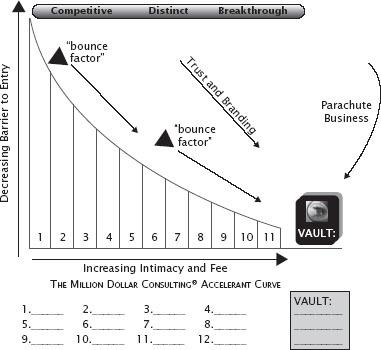
I’ve represented this in the Million Dollar Consulting® Accelerant Curve in Figure 9.1 

FIGURE 9.1 The accelerant curve 

You can see that a progression of work with clients can help speed them down the curve, from areas of low barrier to entry (business with you), aided by “bounce factors” (e.g., models specially created for the client), that end up in your “vault,” which comprises such things as licensing and retainers. Counterintuitively, perhaps, as fees increase and the intimacy of the relationship increases (bottom axis) labor intensity decreases.

That “vault” contains breakthrough work and singular value that only you can provide to certain clients. Although it attracts people who have come down the accelerant curve, it also attracts what I’ve chosen to call “parachute business,” which is new business from non clients, which can go directly to retainers. 

If you observe people who are the acknowledged leaders in their field—Marshall Goldsmith in coaching, Jeff Gitomer in sales, Walt Mossberg in technology, Marcus Buckingham in personal development, me in solo consulting—you’ll find that people are quite prepared to initiate a retainer relationship to have access to those respected “smarts.” 

Thus, achieving that type of “star status” no matter how small or grand your field will greatly encourage direct retainer business from new sources. 

But what if you’ve not yet attained those heights? 

Here are other ways to try to stimulate more retainers: 

1. Let the prospects know the option is available. 

Too often you’re focused solely on your project work. If you look at the Accelerant Curve, you’re featuring or speaking about only a few options in the middle. Make sure that your prospective buyers understand you offer retainers and the utility and value of them by: 

  • Stating in your casual conversation with prospects that “While I was on retainer with . . .” as a part of your language.

  • Insert the same kind of statements in your formal speaking events, such as, “Here’s why I love retainer work—I found myself being called at midnight. . . .”

  • Write some white papers, newsletter articles, and blog postings that mention your retainer exploits.

2. Suggest it as an immediate option. 

Remember the bank executive in the case study who told me he needs smart people hanging around? I was lucky he felt that way at the time. You should try to mention that there are several options for working together, one of which is a retainer. 

3. Acquire specific testimonials. 

Among your video and print testimonials should be clients who expressly mention the power of having you on retainer and how that relationship created tremendous value. 

4. Use a retainer as an extension of value in proposals. 

In your top option in the proposal, add a retainer to the project, with the hope that this aspect would be continued as a pure retainer in the future. 

I thought this would be a good place to provide a sample proposal specifically for retainer work only. 

Sample Retainer Proposal Proposal for Marlin Perkins, CEO, the Acme Company 

Situation Appraisal 

You’ve asked me to serve as a resource on retainer to help in an advisory capacity by phone, e-mail, and an occasional meeting with your board preparation, retention issues, difficult customer situations, and related matters. 

People Involved 

I will be the sole resource from Summit Consulting Group, Inc. providing the responses and advice to you and your COO, Jim Perkins. Any additions to the two of you will require an amended proposal. 

Scope 

The two of you have unlimited access to me from 9 to 5 U.S. Central Time during the week by e-mail and phone. If not immediately available, I will re- turn all phone calls within 90 minutes or, if at the end of the day, first thing the following morning. All e-mail will be responded to within 24 hours and usually much faster. We may have regularly scheduled calls at times we both agree on for whatever duration is needed. You may also contact me in emergency or critical situations beyond these provisions. Finally, we will personally meet if and when we both determine that such meetings would be critical to the resolution of high-priority company issues. Any additions to this scope will require an amended proposal. 

Duration and Timing 

This proposal covers the 12-month period from March 1, 2012, to February 28, 2013. We will discuss an extension in December 2012 if warranted. 

Terms and Conditions 

The fee for this retainer is $10,000 per month, payable by quarters at the beginning of each 90-day period (e.g., $30,000 due March 1, 2012). It is noncancelable for any reason, including your not contacting me for given periods, and payments are to be made on all due dates as scheduled. The retainer may not be postponed, delayed, or otherwise rescheduled. 

We offer you a courtesy discount of 10 percent if the entire retainer is paid at commencement: $118,000 due on March 1, 2012. 

Expenses will include only travel expenses should both be decided that a meeting is required, and will be billed as actually incurred. Expense reimbursement is due on presentation of our invoice. 

Joint Accountabilities 

Your accountabilities will include: 

  • Providing me with access to you and your COO, including per- sonal contact information.

  • Sharing financial details of costs of turnover, loss of customers, acquisition costs, and so forth, as needed.

  • Responding quickly to my requests for information.

  • Reasonable lead time when discussing urgent matters whenever possible.

My accountabilities will include: 

  • Signing nondisclosure and confidentiality documents.

  • Responding to your questions and requests as stipulated above. We both will be accountable for:

  • Immediately informing the other of any new developments, which might materially affect the success of this project.

For example, the buyer finds out that divestiture is in the works, or I find out that three vice presidents have their resumes on the street.

Objectives, measures, and value are not included. You should include Joint Accountabilities as in our earlier example, and finally acceptance. 

I don’t allow postponements with retainers because you might be in a position of an eternal retainer in such a case. Here, you must hold fast to the agreed on duration. 

These retainer proposals are more like signed agreements—short, to the point, and easy. They simply stipulate the Who?/What?/When? dimensions and clarify that any alterations will result in an amended proposal.

Note that I don’t usually include options here. My feeling is that a retainer is a retainer is a retainer, and providing differing durations or activities during it is simply distracting. 

You may find yourself simultaneously delivering projects during the retainer. That’s fine, it happens, and you simply create the traditional proposal for the project work (and there, of course, you can and should have options). But be careful: If you agree to a retainer and then agree to or suggest project work within it, you are going to lose your shirt as well as your house. There is no retainer large enough to cover the appropriate fees from the value of multiple projects.

So let me conclude this chapter by reemphasizing: 

1. Project work involves a clear intervention, with a beginning, middle, and end, oriented to produce certain results, the value of which provide a dramatic return on your fee. You are the interventionist, even if you’re using client resources, to ensure that the project moves forward. You actively intervene with as many client resources as are required for the objectives to be met. You are highly proactive with the client. 

2. Retainer work is a relationship in which the buyer purchases the right to have access to your smarts under limited conditions, which include people who have access, the degree of your responsiveness, and the duration of the arrangement. You are reactive to the client’s needs. Almost all of the work is by phone and e-mail—remote. 

If you keep these fundamental and significant differences in mind at all times, you’ll have a great career—and submit successful proposals—for both project and retainer work with existing and new clients. 

Finally, let’s look at what to do when bad things happen to good proposals.

What to Do With Requests for Delays Based on Time and Money

There are times when the buyer will respond with the request for a delay. The requests are usually about time and money, in that it’s not the right time, or there’s another budget cycle approaching, or that there may be too much disruption at the moment. If you simply accept these requests in good faith, you will be doomed. 

Here are my tricks of the trade for counteracting these not-infrequent requests: 

1. Find out what’s changed. 

If nothing has changed, then the buyer wouldn’t be asking for the delay. After all, you probably (should have) already asked if there were any obstacles not discussed after conceptual agreement but prior to writing the proposal. 

So something had to have changed, or the buyer wasn’t being candid with you before. Find out if it’s a legitimate obstacle, such as a budget abruptly reduced or a new responsibility added, or if it’s a chimera. If nothing has changed, then it’s just an excuse.

If there is new information or concern, work with the buyer to overcome it. Any delay in your project will probably doom it. My estimation is that 90 percent of proposals that are delayed after submission are never accepted at all. Make these arguments: 

  • There is no time like the present. The project’s advantages and value will be even more important in a tougher environment or with the threat of disruption. 

  • You’ve seen this before. You can adapt and you can help the buyer to adapt to the new circumstances as the project goes forward. 

  • The budget will be lost if it’s not used. The buyer clearly had funds he or she was willing to invest. Those funds might well be removed or redirected if not invested in this project now. 

  • Offer to meet the buyer’s boss if that would be helpful and is possible. 

  • Offer to reorient your efforts and the project to incorporate and/or address the new priority and new issues. You’re a valued resource, the buyer has a new need, money has been allocated—you can get a running start. 

2. Find out if it’s an excuse. 

The buyer will sometimes offer a lack of money or time as an excuse. Here is what might have transpired and what you can do about it: 

  • Subordinates have learned of the project and are terrified. In this case, tell the buyer that lower level people are always discomfited when there is a threat to the “nest,” but that you’ll be happy to place a few of them on a steering committee to give them formal input. 

  • Someone else has learned of the cost and has objected, without under- standing the value or ROI. Offer to explain to the offended party or to provide the buyer with the language and rationale to handle the objective. 

  • As in my case study, your buyer may be “big hat, no cattle” and be intimidated about actually approving the work. In this case, don’t throw good money after bad. Some people are just afraid. 

3. There is a legitimate cause for pause. 

The buyer may be undergoing a personal setback in terms of a family problem, illness, or finances; the organization may have added responsibilities to the buyer, demanding that the buyer travel somewhere, or actually frozen all budgets. These events happen all too often. 

Try to establish the best time to pick up the discussion again. If the matter is personal and you know that, provide some breathing space and simply keep in touch with the buyer’s assistants until you’re told that things have stabilized and he or she is attending to work again. If it’s organizational, work with the buyer to choose definitive review dates and times to assess next steps. 

Legitimate delays aren’t always fatal, though they are most of the time. Try to “stay in the game” with frequent contact and review of status. Remind the buyer that the terms in the proposal are not eternal, and that your availability and your fees may change abruptly. 

Case Study: The Hospital CEO 

I was introduced to the CEO of a major hospital group who needed coaching, because he wasn’t getting along with a key subordinate and also had problems with his boss, the board chair. We agreed to meet in person, and he flew in on the company’s private jet. I picked him up in my Bentley convertible, and he told me he had a similar model. 

We spent two hours at my house and, as a result, I FedExed a proposal after taking him back to the airport and the private jet. 

My top option was a $45,000-a-month coaching relationship, with less expensive Options 1 and 2. After a week, he finally returned my messages, and said that Option 3 was clearly the only one that made sense, but he could never justify the cost. He was afraid of what his disruptive subordinate might say to his prickly chairman of the board.

“But your jet trip to see me cost you that much,” I pointed out. 

“Yes, but no one really knows the purpose of that trip.” 

So the Bentley-driving, million-dollar CEO had to opt out because he was afraid of what others might think. Of course, he could have funded this himself, but that was apparently unthinkable. You can’t win them all. 

But most of all, remember that time and money are not resources, but are rather priorities. So don’t fall victim to a wait until resources are forthcoming. Instead, build a case that you and your project represent a larger priority than those to which money and time are currently being invested. This is what can dramatically shorten your process and best overcome this objection. 

If you’re a large enough priority, resources will flow to you nonetheless. Continually demonstrate your importance to your buyer, the organization, and the results that were specified in the proposal. All good things do not come to people who wait. 

They come to people who make their case. 

What to Do If Rejected

We all experience “defeat.” The best hitters in baseball are successful only about a third of the time. The best soccer players might score once every other game. The important thing is to get up to bat and to be in the game. You can’t hit if you don’t swing, and you can’t score if you’re on the bench. 

Moreover, success is a matter of small amounts. The horse that wins its race by a nose gets the same purse and prize it would have received if it had won by six lengths. First is first, it’s not measured by degree. And that first place finish is worth about 10 times the prizes awarded to the second-place horse. But the winner didn’t have to train 10 times as hard, have 10 times the investment, or run 10 times faster. 

It just had to win by a nose. 

On the golf tours, the first-place prize is often in the millions, and tends to dwarf the prizes for second through 10th places. But do you have any idea of the difference in strokes per round between the winner of tour events and the 10th-place finishers? How many strokes difference, per round, do you think it takes to be first rather than 10th? 

Less than one stroke per round, that’s how many. 

My point is that there is a razor-thin line of demarcation between winning a proposal and it being rejected, and that you can turn things in your favor by following my system and processes to enhance your odds. (I’m actually writing this segment in Las Vegas at the Bellagio Resort, and the smart thing to do in the casino is to play games least in the house’s favor and most in your favor. Blackjack is good, roulette is not.)

No matter how well we play the game, we sometimes lose. An unattributed quote that I particularly like: 

You win some, you lose some, and some get rained out. But you have to suit up for them all. 

So what happens when you’re rejected? Here are the absolutely critical factors you need to consider to avoid thinking and acting as if it’s a disaster: 

1. Don’t take it personally

Let me put that another way: Don’t take it personally! This isn’t about you, or your worth, or your beliefs. Don’t generalize from a specific, as in, “My proposal was rejected after all this work and time, I must not be cut out for this work.” Use the points below to extract worth and value and improve. 

2. Find out why. 

Ask your buyer if he or she could help educate you so that you can improve in the future. Don’t be defensive, and never accept, “Oh, it wasn’t you and it was close, it could have gone either way,” from someone trying not to hurt your feelings. That doesn’t help your learning. Ask this critical question, “What is the one thing I could have done differently that might have resulted in my getting the project?” Find out if it’s something you said, or didn’t include, or misquoted, or failed to understand. Then make sure that doesn’t happen again. If you find you’re getting the same feedback after several failed proposals, then you’re just not listening. 

3. Ask for future consideration. 

You’ve built a fine relationship and reached the “finals” of this event. Why throw all of this away just because you didn’t win this particular race? Ask the buyer if he or she would consider you for similar work in the future. They may well be quite happy to do so. 

Case Study: Barbara’s Timing 

I was mentoring Barbara, who sent me three proposals that had been rejected over the course of two months. Each had some common problems, such as insufficient expressed value and poor options to choose among. “What should I do?” she whined. “I just don’t seem to be able to master this!” 

“I’d suggest you send me the proposal before you submit it, not after it is rejected.” 

She did that, and closed her very next deal for $80,000. Never try to fix what you can prevent in the first place. 

4. Ask for permission to stay in touch. 

Another way of extending the relationship is through periodic contact. (How else would Point 3 above really work?) So ask if it’s agreeable to: 

  • Put them on your mailing or newsletter lists. 

  • Check in with them after the current project is under way. (Sometimes an alternative resource fails quickly, and the client has to scramble to re- cover the situation. You could serve as the “relief pitcher.”) 

  • Have them consider you as a sounding board on occasion if they need some assistance from an objective source. (A little “free consulting” might get you back in the door.) 

5. Ask for referrals. 

This sounds completely crazy, I know, but I’ve discovered a fascinating dynamic: You’ve established a strong relationship with a buyer, who may feel a bit guilty in not selecting you. This request provides some expiation and atonement. The buyer will often say, “You’d be just right for a colleague in marketing,” or, “I know they’re looking for help in R&D, call Moe Adams. . . .” It can’t hurt, and it often results in a high-quality lead. 

All of these steps assume a solid and trusting relationship with an economic buyer who happened to choose another resource for the work. That means that your opportunity to ask these questions and suggest these actions will be successful, because phone calls will be returned (don’t use e-mail, for the reasons we’ve discussed earlier—make this as personal as you can—and in person is best because the buyer will be even more eager to be conciliatory). 

Learn from your defeats, it’s what they study in West Point. If you’re not failing, then you’re not trying. But if you’re making the same mistakes over and over, then you’re on a treadmill to doom. 

Hop off that track and land on your feet. 

How to Improve Your Proposals Constantly

You’ll learn from your victories and defeats what you can do better the next time. My proposals have become stronger, not by changing the format—which I’ve found to be consistently effective for my purposes—but from the content I insert into the template. ‘

By way of both summary and best practices, here are 12 keys for continual improvement: 

  1. Ensure that you are talking only to an economic buyer.
  2. Establish a trusting relationship, no matter how long that takes.¹
  3. Gain conceptual agreement on objectives—results to be achieved.
  4. Gain conceptual agreement on metrics—progress indicators.
  5. Gain conceptual agreement on value—impact of the results.
  6. Review and ascertain if there are any obstacles to proceeding.
  7. Create a proposal with options or increasing value and fee.
  8. Ensure that you demonstrate an impressive ROI.
  9. Get the proposal in front of the buyer quickly.
  10. Establish definitive next steps, times, dates.
  11. Follow up as agreed on to find buyer’s decision.
  12. Implement as rapidly as you can to “pour cement.”

Like a golfer who has to perfect tee shots, bunker shots, putts, course management, and so forth, you need to improve in each area until you are unconsciously competent in each. If these are the 12 steps to proposal acceptance, and you can master each and handle objections at a point in the sequence, then your success ratio will probably be well above 80 percent. 

You may need to adjust your proposals and their format in view of: 

•RFPs
•Retainers
•Legal departments
•Client requests and requirements

One of the greatest “threats” is in proposals that have insufficient fees in terms of the value being offered. 

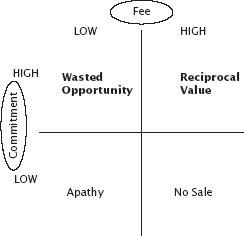
When your fees are high and the buyer’s commitment is low, you have no sale. When the buyer’s commitment is low and your fees are low, you have apathy. When fees are low but commitment is high you have a wasted opportunity. Only when both commitment and fees are high do you create reciprocal value. (See Figure 10.1.)

FIGURE 10.1 Fee and commitment relationship 

The upper left shows where consultants frequently and habitually leave money on the table. They have a committed buyer and the potential to provide great value, but their fees are too low. That is money that is never recoverable. The entire point of the proposal process is to try to place yourself in a position of providing value in options that represent appropriate fees for the value in any given option.

You may find that in your markets your proposals need extra dimensions. Clients might want to know how many people will be used on the project. Or they might need to know who owns “work product.” I wouldn’t normally include such issues but I would be happy to include them for a particular client who has a good reason for asking. 

When your proposals are rejected, make it a top priority to find out why. It’s seldom the luck of the draw or the result of some committee. There’s something you could have done a better job with, and it’s usually involving the buyer. Too many consultants don’t “run through the tape” but rather let up at the finish line. That is, they ask the buyer a few questions but not enough questions. They get information but not the most important information. They unearth some value but not the maximum value that the buyer would derive. There’s a tendency to say, “Whew!” after the buyer answers a question that prompts the consultants to want to get it over with, rather than seeing an opportunity for further questioning and mining still more value. 

The format is easy; it’s the content that makes the difference. 

Thus, the constant improvement of your proposals will be based on your ability to secure the highest possible content from your buyer. The time you spend in the buyer’s office, asking questions and pursuing potential value, constitutes the most crucial aspect of creating a winning proposal. 


How to Maximize Your Successes and Fees

There is an interesting phenomenon that accrues with success: The more successful you are, the more successful you become. Or as my father used to say from our lower class status watching those better off: “Them that has, gets.” 

As your proposals create high rates of acceptance, start to experiment with your approaches. After all, you’re now playing with “house money.” There is no time to try new things (and possibly fail in a good cause) as from a position of strength. 

Some examples: 

Assess which options are usually selected. If it’s usually Option 2, how can you make your Option 3 more compelling? If it’s usually Option 3, then you may be charging enough for that alternative. If it’s usually Option 1, then you might be putting far too much value in your first option, making the next two seem inappropriately expensive for too little additional value. 

  • Evaluate how many current and past clients have chosen a retainer option with you. If the number is only three to four per year, perhaps you’re not aggressive enough in presenting the option. Or perhaps you haven’t provided enough additional value for the buyer to want you to be around even after the current project is completed. 

  • Find out how many clients have chosen to pay the full fee in advance with the discount you’re offering. If very few, then perhaps you haven’t made the alternative sufficiently visible, or the discount is too small. If nearly everyone, perhaps the discount is too large. 

  • Assess how many of your proposals and the projects they represented led to repeat business and extended work (not retainers, but more projects). Investigate why this didn’t happen even more often. Were you not providing sufficient ideas and incentives to continue with you, or did the buyer see you in too narrow a role, not suited for other things? Were you not meeting new buyers during your time on-site? 

Let me dispel a myth at this point: It is entirely possible and, in fact, desirable, to market while you are delivering a project. The old rubric that “you can’t deliver and market at the same time” is an excuse thrown up by people who don’t know how to market! 

Case Study: My Surprise at Merck 

George was an international development manager at one of my largest clients, Merck, and he was my most significant single buyer, purchasing about $250,000 of consulting work per year through single proposals. He would take the 10 percent discount, and pay me $225,000 in early January, because Merck was on a calendar year as their fiscal year. 

I was asking my buyers at the time why they chose the discount so that I could determine if I was at the right rate or not. When I got to George, I received quite a shock. 

“Oh, I don’t care about the size of the discount, or the discount at all,” he said, smiling. “I pay your full fee in advance because that way no one can cancel my project.” 

Talk about how stupid I was two weeks ago! It was in George’s self-interest to pay me early because the inevitable “tremors” with a large company caused budgets to shift, but you can’t shift a budget that’s already been spent! I immediately added this to my list of reasons to pay me in advance—it’s in your self-interest! 

While you’re on-site, you’ll find ample opportunity to meet colleagues of the buyer who are buyers themselves. You’ll also meet lower level people who would gladly introduce you to their boss. There is nothing illegal, immoral, or unethical about meeting these people and investigating whether a relationship is possible. 

Your mind-set has to be: I have tremendous value to provide, and I’d be remiss if I didn’t offer it to these other people as long as I’m here. 

The worst thing that happens is that nothing happens. But the criminal thing that happens is that you don’t even try. I’m not advocating that you visit the client each day with PowerPoint slides and order forms. But I am urging you to seek out and create relationships with additional buyers, which I call “lateral marketing.” 

Quite a few of the people I’ve mentored and helped with proposals have been told by their clients that the proposal they submitted “made all the difference” at selection time. They’ve entrepreneurially suggested that perhaps their clients’ own sales forces would benefit from adapting similar aspects in their own approach to customers. So in many cases, they’ve turned the proposal itself into an item of value for the client with appropriate compensation. 

The overall format can be readily adjusted for non monetary purposes that still represent success for you in other areas. The sequence of establishing trusting relationships and identifying objectives, measures, value, and joint accountabilities is useful in gaining influence, persuading others, and creating consensus. The approach is useful on boards, committees, task forces, and so forth. The person applying the approach will usually be seen as at least the informal leader. 

Options, of course, are applicable across a wide range of business and personal issues, and help to create compromise, defuse hostility, and move others from “Should I?” to “How should I?” You can provide your kids with alternatives, or your boss, or your significant other, or yourself. You can ask others to provide additional options to gain further inclusion.

The main consideration, perhaps, is to continually examine your fees. As your acceptance rates increase, place upward pressure on your fees (no one else will do this for you). You’re always better off with a few high-priced proposals than a plethora of low-priced ones, even if the eventual total dollars are the same. The client is concerned about value. Provide all the value you can, so that you needn’t be concerned about fee, because the client sees huge ROI. 

When to Stop Writing Proposals

Never, assuming you continue to work in professional services. 

But there are times when proposal writing is far less important or actually dysfunctional. 

For example, there are many types of work you can choose to do on a “hand- shake” or brief email exchange after you’re successful, well known, and have long- term relationships with buyers. Sometimes a proposal becomes “overkill” or even insulting to long-term buyers. 

Here are five occasions when you can stop writing certain kinds of proposals. 

1. When the project is very short term. In this case the buyer wants you to come in for a day to brief some key people on how best to deal with a hostile client, or to provide a day of coaching for a key executive. Just cite a price and do it. 

2. When the project is identical to one in the recent past. For example, conduct a strategy review for Unit B the same way you did for Unit A about a month ago. 

3. When it’s a discrete task or deliverable: Provide a template for the steps all of our managers must adhere to in order to legally and ethically terminate a management-level employee.

4. Almost all retainers. 

5. Singular “assignment events,” such as speaking for a half-day as a part of a conference. 

In these and related assignments you’d actually be shooting yourself in the foot if you subjected yourself and your buyer to the rigor of a full-blown proposal. A real or verbal handshake is usually fine in these instances. You can always document whatever you need to in a simple letter or email. 

Ironically, you should create proposals for most pro bono work, because you want a record of what was agreed on to prevent scope creep in a situation where you’re not getting paid to begin with, and you want documentation of your success because a testimonial and references are going to be your key dividends.

Remember that buyers change and conditions change, and no handshake will trump a changed board policy or the transfer and replacement of your buyer. We’ve talked about the utility of accompanying a dreadful RFP with your own proposal. 

I continue to use my proposal template today for all major client work and all major coaching work. As a rule of thumb, any potential project involving more than $35,000 or so should have a written proposal. Both you and the client deserve that protection. Remember that one of the benefits of a proposal that we spoke of early in the book is that neither party can unilaterally change it. Thus, this is a fundamental good-faith agreement between you and your buyer in a trusting relationship, which no legal team should be able to tear asunder.

The size of the proposal’s project and its scope are not relevant to the size of the proposal itself—about 2.5 pages—so this simple document will ensure success and protect you while requiring very little labor investment to create and to track. 

In summarizing this book, I’d like you to always bear in mind that if you leave $100,000 on the table each year—that could be as little as four proposals under- charged by $25,0000 each—you will lose $100,000 that will never, ever be recovered. That’s a million dollars in 10 years, total profit less taxes, that you’ll never see again. If you’re leaving more than $100,000 on the table and/or for more years, you could easily be losing millions of dollars that are vital to your family, life, and business.

I’ve heard from thousands of people who read my former book on the subject that they couldn’t believe that they “almost immediately gained $45,000 per proposal,” or “raised the hit rate to 85 percent from under 50 percent,” or “reduced time on each project by at least a third.” These methodical proposals can save you time and make you money. Ignore them at your own peril. 

Above all, this is a relationship business, grounded on the trust generated between you and your economic buyer. Don’t be distracted. What’s your value, who can write a check for it, and how do you find or attract those buyers? You do that consistently and you’ll provide great value to your clients and continuing wealth for yourself and your loved ones. Don’t stray from that path. That’s my proposal to you. 

Note 

1. Within reason—several meetings are reasonable, but two years is not.