Utilizing Your Own Attorney

There are attorneys and there are attorneys. I’ll tell you right now who you do not want:

  • Any family member.
  • Anyone who’s giving you a “break.”
  • Anyone who is just starting out.
  • Anyone whose expertise is not in professional services and contract law.

That’s probably insufficient. I was speaking to a group of consultants and one actually proclaimed, “My husband is an attorney, and he’s assured me that I do not need to incorporate or carry malpractice insurance, both are wastes of money. What do you say to that?” 

What I said was to get a new attorney and a new husband, but I doubt that she did either. 

So the first thing I need to make absolutely clear is that the attorney who closed on your house for you, or did the title search, or wrote your wills, or represented you in an auto accident, is probably not the right person for this. His or her firm may be appropriate, if they have multiple attorneys in different practices, and it’s always good to stay in one place if you can. But I have attorneys for contract, trademark, estate planning, and litigation—all different people in two different firms.

Ideally, your attorney should be adept at both contract work and the working of personal services firms. Thus, a seasoned attorney who has a private practice with one or two others and specializes in this area would be ideal, but they are hard to find because, by definition, they can’t specialize to that degree as independents and still make money (just as with consultants). 

The time to consult your qualified attorney specifically about the proposal process is at these junctures: 

  • If you do not use my kind of template, but invent your own format and wording, you should pass it by your lawyer not to have it rewritten in legal terms but to ensure that you haven’t inadvertently shot yourself in the foot. Remember that you don’t have to accept all the attorney’s suggestions, but you should responsibly be aware of any potential risks the attorney unearths. You may have accidentally implied that your proposal can be applied to other areas at no extra cost, for example.

  • When the client comes back to you with legal questions or the client’s own attorneys’ wording in lieu of your own in the proposal or on a separate document. This is particularly important in terms of non disclosure and/or non compete clauses.

A nondisclosure agreement merely demands that you will not reveal proprietary client information to anyone else. It’s reasonable and many clients request it, though the wording can vary widely. These are usually mandatory when requested, but innocuous. 

A non compete is far different. These agreements request that you refuse to work with organizations similar to the client—most likely, competitors—for varying periods of time. When you are asked to conform to this request, you should charge more in your proposal at every option level, because the client is removing a portion of your market for which you deserve compensation. Here you must ascertain the time frame, exactly which firms would be included (nothing vague, such as “anyone deemed to be a competitor”), and which of your services. You might charge a premium, for example, of $25,000 not to work with two competitors with a certain offering for a year, or $250,000 to never work with them in any area.

You’ll need your attorney’s advice to make any adjustments in the agreement, because the client’s lawyers will have structured this to their maximum benefit and to your maximum detriment. And this is something that your buyer really can’t help with. 

Another critical area is “work product.” Generally, you take out the intellectual property that you arrived with, the client keeps what was theirs to begin with, and you jointly own what was created during the project. However, the client will often demand that all “work product” created during the engagement be strictly theirs (so that it can’t be used with competitors, a version of a non compete), and may even try to insist that they own your original intellectual property to apply as they wish. This last provision would effectively make your client a competitor, if they offered, say, your strategy approach to a third party.

This is why you need a careful legal review and opinion on such matters. I’ve seen consultants essentially “frozen” out of a vibrant market and/or surrendered their intellectual property for what they thought was a nice project but which in actuality ruined them. 

As a rule of thumb, whenever your client returns an amended or additional document to you with words not your own, run it by your attorney. You aren’t compelled to follow the advice, but you should know all your options. I noted earlier that the 32 pages from the Federal Reserve attorneys didn’t really change anything, but that’s a rarity. Most of the time they are stacking the deck for the home team. 

You’ll also want to be sure that you’re not getting into unnecessary arguments. When Hewlett-Packard, for example, requests a copy of in-force errors and omissions insurance, that’s reasonable and you should simply comply. But when some other firms request that you make changes to your liability insurance coverage for the duration of your work with them, that’s both unreasonable and unnecessary and you should know that you don’t have to comply. In many cases, a legal department will try to obtain an advantage, knowing they won’t press the issue if there is resistance, but there’s nothing to lose in trying. 

Therefore: Consult your attorney once with your proposal template just to make sure there are no glaring problems, but don’t feel obligated to follow all of the ad- vice. Consult your attorney whenever you receive a legal form, advisory, or request from the client’s attorneys, even if it’s by way of your buyer. Then you make the decision about what’s reasonable and not (our next segment deals with compromise). Make sure that your attorney understands your type of business and your type of firm. 

But be master of your own fate. Attorneys aren’t adept in the consulting profession. In fact, almost all of them are still charging by the hour. 

Effective and Ineffective Compromise

Compromise is something you can live with, not something you would die for. 

There are times when irresistible forces meet immovable objects. When something “gives” in such circumstances, it usually means someone has won and someone else has lost. Not good in terms of acquiring clients! 

Thus, I suggest that you prepare yourself for the negotiable and nonnegotiable. And for that we need a brief digression. 

You and the client each have objectives for a project, some of which are mutual and some of which are partisan. That’s all fine and well. You both want the project objectives to be met and successful, for example, but you might want to be paid in advance and the buyer might want to pay you at the conclusion. You’re both merely looking out for what you perceive as your own best interests. 

Such personal objectives fall into two categories: must and want. 

A “must” has these characteristics: 

  • Mandatory for your success.
  • Measurable, so you know it when you see it (or don’t see it).
  • Reasonable, in that you’re not asking for the moon.

A “want” is a desirable outcome or expectation that, while appealing, isn’t crucial to your success and without which having obtained success is still possible and reasonable. 

In negotiating, you never want to compromise on a “must,” which is why they are usually few and far between, but vital nonetheless. You can sacrifice “wants” but usually with some commensurate sacrifice or concession on the other party’s part. These dynamics are obtained in conflict resolution, persuasion, negotiation, and so forth. And that’s why they’re important here.

One “must” that you never negotiate is your fee. Don’t forget—we’ve established that the proposal is not a negotiating document or opportunity. So when is it appropriate to change fees, when you meet stiff resistance?

Glossary 

Objective: A result desired, either an improved condition and/or a minimized use of resources. Achieving the most possible with limited use of scarce resources is a highly desirable condition for objectives.

Must: An objective that is crucial for your success, without which you will have failed.

Want: A desire that you hope to achieve, but which you can fail to achieve but still be successful in the larger framework.

  • The client simply chooses a lesser option. Option 3 may be attractive, but if there is simply no budget, well, that’s why we have an Option 2.

  • The client makes quid pro quo concessions. That is, you remove value to justify the lowering of a fee. This may mean that you don’t include the international people or don’t provide quarterly visits, and so on. (Most buyers love to try to reduce fees, but detest losing value, so this technique is highly effective.)

  • There is an alternative offer of value to you. The client offers introductions to a trade association, which is chock-full of your prospects, or offers to film an event for free, or offers bartered services that are attractive (don’t forget that these are taxable).

So, to preserve fee integrity, never lower your fee on any option without one of the conditions above prevailing. 

What you can negotiate and compromise on are your terms. That’s why I recommend such maximally attractive terms for you at the outset: 50 percent in advance and 50 percent in 45 days, no matter what the duration of the project or its size. The client (and the attorneys) may react poorly to that, or they may have some problem with the overall fee and you can use this to mollify them.

You can always “retreat” to 25 percent on acceptance (that’s not “commencement” but “acceptance”), 25 percent in 45 days and 25 percent in 90 days (assuming it’s more than a three-month project). I would advise to never accept less than a 25 percent down payment, and never accept monthly payments (excluding retainers, and even there you should be paid quarterly at the beginning of the quarter). Never, ever agree to payment “upon completion.” You’ll find in those circumstances that things are never complete, and if your buyer changes or conditions change substantially, you’ll never collect that final payment.

Keep your payments maximized toward the front end, starting heavily in your favor so that compromise is still quite good for you. 

Be careful about compromise on timing. You don’t want to have the project “hanging out there” and suddenly being requested when you’re committed to three others. So explain when you’re ready to begin under “timing” and when the client agrees to go forward to solidify the calendar start dates. 

Feel free to compromise on the small stuff. You may have anticipated 20 people in certain groups, for instance, but if the client wants 30 don’t look at it as a 50 per- cent increase, because you’re billing based on value, not head count. If the client requests the following, be big about it:

  • Extra debriefing days.
  • Larger class enrollment.
  • Additional copies of materials.
  • Discussions with key subordinates or superiors.
  • Your presence at certain internal meetings.

But don’t agree to the following: 

  • Additional work beyond the proposal (“scope creep”). 

  • Transfer of your intellectual property without compensation (e.g., in licensed form). 

  • Running more events (focus groups, meetings, and so on) than you deem are necessary for quality and communication.

  • Presence at irrelevant gatherings (customer social events, unnecessary meals).

If you’re prepared for what’s in the realm of compromise and what isn’t, you won’t be caught suddenly saying “Of course” in response to a request that’s going to seriously cost you. Never default to the position that if you don’t do something you’ll lose the project. There are worse things.

Like losing your shirt. 

The Golden Handshake

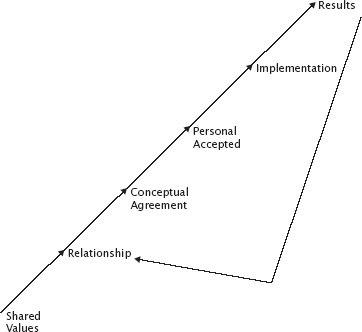
The transactions discussed here are based on a strong and trusting relationship, so it’s safe to make some assumptions based on the sequence shown in Figure 7.1. 

FIGURE 7.1 A simple business sequence 

Shared values about business (e.g., whether downsizing is proper, the role of outsourcing, honesty with investors) can lead to trusting relationships. On that basis, conceptual agreement about objectives, measures, and value is possible, after which a proposal with options can be submitted with high probabilities of acceptance. Once a project is implemented, the results serve to reinforce the original relationship.

Succeeding steps are built on original trust and the increased trust that ensues from working together as partners and peers. This is why I emphasize here (and in all of my work) that positioning yourself as a peer, partner, and trusted advisor is so critical to success. Once your own demeanor, response, insecurity, language, and other factors place you in a subordinated position, as they say in Vegas at the craps tables, “all bets are off.”

With that basis established, the “golden handshake” is the potential to begin a client based on the buyer’s word and nothing more. That handshake may be physical, but it’s just as likely to be by phone or even e-mail. I talked earlier about “pouring cement on the sale,” meaning to show up as soon as possible after the proposal is accepted to demonstrate work has begun, and/or to do so even earlier. This is the result of the golden handshake. 

When you have a trusting relationship and the buyer says something like, “It will take me a week to sign and return your proposal and generate a check, but there’s an ideal opportunity this week to meet with my entire team in one place, can you do that?” it’s time to spring into action. That’s a highly responsive, reactive action that will help to “guarantee” the buyer’s acceptance—you’ll be on-site, visible, involved, representing your partner, and so forth. It’s not impossible, but highly unlikely you’ll be told that you can’t go forward after that debut performance. 

However, there are also proactive means to enforce the handshake. The buyer may say, “We’re a ‘go,’ I just have to physically sign the documents when I return from London next week, but I wanted to alert you that we’re accepting Option 2 and want you to put aside the time.” 

To which you should respond, “That’s wonderful, why don’t I begin some of the initial interviews now to hit the ground running? May I call your assistant and obtain some of the contact information, and let’s you and I schedule a meeting for the day after you return.” 

In this case, you’re suggesting the opening act, which is hard to say no to because it’s basically noninvasive. Note the options. The buyer could say, “I need to talk to my people first, so hold off on the interviews, but let’s schedule that day together.” Or conversely, “I’ll be submerged for a few days, but do start the inter- views and let’s schedule the meeting for a week later, when I can also give you the signed proposal and check.” The more options you provide to begin, the more likely the handshake will be accepted.

In all of my experience, I’ve never had a contract reneged on or even changed once the buyer and I have agreed to initial actions even before the proposal is signed and a check generated. That’s why I call this “golden.” Pragmatically, you need to show up and begin. 

Not only haven’t I ever lost such work, but I’ve “saved” the contracts when intervening elements would have undone them. Natural disasters, deaths, terminations, competitive moves, market plunges, and other uncontrollable events would have at the least forestalled several of my contracts if I hadn’t shown up and begun work. 

You can’t beat being present. This can taper off as your project moves forward and your labor intensity declines as planned, but it helps to be there early and often if you can, prior to the formalization of the contract. The longer you wait for any- thing, the more bad things can happen.

I’ve tried to illustrate in this chapter that it’s wise to try to avoid the legal department altogether. That means not provoking the legal hornet’s nest by poking it with your own lawyers and/or legalese. Once it becomes inevitable, work with them or your buyer to minimize concerns and conservative frenzy. Under certain conditions, do consult your own attorney, but ensure that the resource you use is well versed in your type of business and concerns. 

You’ll have to compromise at times, but if you are clear about and prepared to protect your individual “musts” and trade away “wants” (maintain the fee, change the terms slightly if you need to) you’ll still have a great project and the client will feel that you’ve met halfway—even if it’s really your side of the field. 

Let’s move now to a not uncommon but nonetheless dreadful aspect of proposals—when they’re actually requested, which can be the worst thing in the world for your business interests.  

Notes 

1. These principles work well with procurement and accounts payable, as well. For example, with this question, the buyer might point out that payments cannot be made in two different fiscal years, and you’ll want to know that at this point.

2. Which leads to more business and referral business, the “second sale” made at the time of the first sale. For a detailed explanation, see my book Million Dollar Referrals from McGraw-Hill (2011).

The Beauties of Being a Sole-Source Provider

An RFP is a “request for proposal.” It is most commonly used by government agencies, but you’ll also find them applied in nonprofits and some for profit entities. They are a blight on the crop. 

These are usually issued by low-level people who have an arbitrary alternative in mind. They’ll issue an RFP for a “two-day retreat for team building.” And they’ll have criteria that match the worst of the want ads: “The successful bidder will have 10 years of team building experience with nonprofit arts groups.” That experience may be desultory and with arts groups that collapsed—no matter. These are input driven monstrosities. The questions will include such things as: “How many people will work on the project, will they commute or require travel, will they spend an entire day on-site, and will they eat bread crusts or cut them off if they dine in the cafeteria?” 

Thankfully, there is hope. The FAR Act (Federal Acquisitions Regulation) states that even government purchasers in the United States may choose vendors based on value and not solely price (but you’re still a vendor). But a great many agencies and other organizations still prize RFPs as a way to fairly evaluate suppliers. This may work for people who pave parking lots or sell plants for the hallways, but not, unfortunately, consultants. 

The best way to circumvent RFPs and render them irrelevant is to be a “sole- source” provider. Such a provider is exempt from competitive requirements be- cause of a uniqueness not found among competitors, rendering competitive proposals moot. 

For example, Jim Collins wrote Good to Great, Michael Hammer wrote Re-engineering, and I wrote Million Dollar Consulting. We are unique in having written those books and the attendant intellectual property. Hence, we are “sole sources” and may be hired directly by the interested party, despite rules for competitive proposals in other circumstances. This applies to books, intellectual property, models, experiences, accomplishments, and so forth. An organization can hire you directly if you can justify that you’re the only one of your kind. That’s surprisingly easy to do, and far superior to the RFP morass.

Case Study: The Navy and Me 

Many RFPs are still in hard copy and require painstaking attention to the requirements. For about a year, the Navy sent me RFPs for a variety of projects. I ignored every one. It would have cost me more to try to compete for them than the project was worth. 

Finally, the Navy sent me an inquiry. They wanted to know why I wasn’t responding to their RFPs. And would I please fill out my response in triplicate and send it back! 

One of the advantages of developing intellectual property and writing commercially published books is that you can stand out in the crowd. 

If you’re approached by an organization that wants you to compete in the RFP process, your immediate position should be that you can be considered a sole source alternative. Are you arranging your body of work to support such an assertion? 

Figure 8.1 is a simple graphic. 

FIGURE 8.1 Sole-source material 

It depicts a hiring and delivery of results process. There’s nothing earthshaking, but if this were your property with appropriate supporting material you could make a case for sole source. It doesn’t have to be elaborate or unprecedented. It just has to be yours in a configuration that’s distinct and yours. Protection such as copy- rights, service marks, trademarks, and registration further your claims.

RFPs can appear to be manna from the skies, offers that just descend on you. But they are mostly time wasters and chimeras. Even if you’re successful in your  bidding, you’ll find that costs (fees) are fixed and unattractive. 

My advice is to refrain from responding to most RFPs unless you can easily make the case that you are a sole-source provider and the prospect readily agrees to that. In the rest of this chapter, I outline how you can deal with these random events if you insist. But my warning early on is that these are tedious and futile endeavors unless you can put yourself in some advantageous position.

The worst part is that these RFPs are almost always generated by low-level people who use all the wrong criteria in evaluating the applicants. They are not buyers, and will merely cull the applicants to present a feasible group to the real buyer. There are no relationships possible, and the purchase might as well be made from a catalog. 

Fortunately, these are rare. If you find yourself in a market where they predominate, such as state government, I’d find an alternative market. You simply can’t gain sufficient or valuable enough business responding to conventional RFPs, because neither the volume nor the quality (high fee) is attainable. But there are ways to circumvent this process, and we’ll take a look at them further on. Don’t feel as if you’re restricted to a conventional RFP response. If you can’t prove that you’re a sole-source provider, there are other options available. At least make the attempt to take these poor propositions to turn them into more valuable proposals. 

I’ve never met anyone, in 25 years in this business, who has a viable and lucrative consulting practice based on a preponderance of RFPs. You can look at them as Really Foolish Positions. 

How to Massage RFPs so That They Look Like You

Another method of dealing with RFPs is to make them into bespoke offerings! (I rarely get to use that wonderful word in a sentence!) 

Some buyers will love you but they’re forced to use a competitive bidding system because of strict organizational rules. In this case, have the buyer (not some lower level committee) “design” the RFP around you. Even if you don’t qualify for “sole-source” purchasing, this is the equivalent. 

The RFP in this case can list criteria such as: 

  • Worked for extended periods in London and Sydney, where our two major overseas offices are located. 

  • Speak Spanish, where our expansion plans are highest priority. 

  • Has coached at executive level in the pharmaceutical industry. 

You get the idea. There will hardly be hundreds of people applying. That means that you can pretty much have the field to yourself. 

This approach requires a tight relationship with the true buyer, and that is often much harder in RFP situations. We talk later in the chapter about how best to at- tempt this when you receive an RFP of interest, but let’s talk here of the “front end,” before it’s even issued. 

The entire point of market gravity is to create interest in your work among economic buyers and, once contacted, to ascertain who the economic buyer really is. If you’re able to do that consistently through your speaking, publishing, networking, Internet activity, and so forth, you will meet buyers who can write a check immediately and others who must go through the competitive bidding process. 

The good news is that the bidding process must be instigated by someone, and you’ve found that someone. So when the buyer explains (or complains about or bemoans) the need to create an RFP, suggest that perhaps you can recommend some important criteria based on what the buyer has explained about needs. (Many buyers don’t need this hint, believe me.) 

The two of you can then collaborate on getting you hired. In many cases, the buyer can even create work flow that will enable your value-based fees to be readily accepted (since RFPs are notoriously based on hourly and daily rates otherwise). Even if there are a few other consultants around with similar credentials and experiences, the odds are that: 

  • They aren’t going to learn of this RFP. 

  • Even if a couple of consultants turn up, they don’t have the relationship with the buyer that you’ve established.

  • The odds are still better at one in three than one in a thousand. 

You can see how much of an advantage you’ll get from market gravity and be- spoke RFPs than you would have in just responding to the ones figuratively marked “occupant” when they hit your company mailbox! 

Some of the characteristics useful in helping the buyer “design” an RFP for you, in addition to the precise nature of the project: 

  • Language capability
  • International experience
  • Industry experience
  • Professional (acknowledged) credentials
  • Publishing (articles, columns, assuming no commercial book)
  • Education
  • Experience running companies, sales forces, start-ups, and so on

Once you begin to combine several of these you’ve narrowed the field by leaps and bounds until it’s almost the same as, “Get me James McGee.” It can be that specific. 

This approach to RFPs is what I call “preventive,” because it focuses on dealing with them before they’re issued. (So does sole source in most cases, because after an RFP is issued it seldom calls for “a book published on lean manufacturing in the construction industry” as a criterion—they are by definition more generic.) We talk about “contingent” approaches, what to do after you receive an RFP that is very generic, in the last part of this chapter. 

The case I want to make here is that RFPs are a waste of time only if you surrender to their terms and conditions, and the very nature of the beast. If you prepare yourself to deal differently before and/or after, you can achieve success with these. It’s not unusual for a series of RFPs over the years to be created just for you once you’ve done a great job with the initial project.

But you cannot take this particular preventive action with a committee, non buyers, or after the fact. Bespoke RFPs are possible only under these conditions: 

  • An economic buyer has come to you or you’ve reached one yourself, prior to any RFP being issued.

•You establish rapport and a trusting relationship with that buyer to the extent that the buyer is prepared to design an RFP that will enable you and few others to be considered. 

  • You suggest and possess the distinctive features that design the profile of the successful candidate.

  • The basis is so clear and reasonable that even a screening committee would have no hesitation at passing your name on once you’ve complied with the RFP requirements for submission. That same committee will eliminate virtually everyone else.

To place things in perspective, I’ve succeeded with this approach on a handful of occasions before I became a true sole-source provider through my range of books and unique experiences. But during that period I was never successful on any RFP for which I merely complied with submission requirements, even though I may have been superbly well qualified for the project. I suspect that most of the problem was around my fees. 

I offer this as an alternative, not a panacea, especially where you’ve met an interested buyer first who now needs to get you through the competitive bidding process. 

How to Offer Additional Value

There are times when the best way to win the bid on an RFP is to offer even more value than the prospect requested. 

Once you comply with the details requested in an RFP, always try to add additional value. The purchasers are not required in most cases to choose the lowest proposal, as if this is a highway paving project or a request for textbooks. They can identify and choose the highest value that represents the greatest return for their in- vestment. That’s where your creativity can turn the tide.

Here are factors to consider that are often either overlooked or considered implicit in an RFP that your competitors might not highlight or address:

  • Preparation work.
  • Surveys of employees, management, customers, suppliers.
  • Tests of assumptions for validity.
  • Reinforcement tools on the job.
  • Monthly “boosters” via newsletter, special website, e-mail, and so on.

Case Study: USA Today 

I had been contacted by someone I knew at the newspaper USA Today and asked to bid on an RFP. I agreed and did so, and was named one of the finalists, so I was invited to make a presentation to the inevitable committee.

About 30 people sat around a U-shaped conference table with the finalists, one by one escorted in and out as if they were Grand Jury witnesses in some organized crime ring, presenting their best arguments. I alternately felt like a criminal and a performing seal. 

Yet my contact told me I had an “inside track” from what she had seen, and wanted me to throw all of my energy into this. I did, everyone asked questions and made notes, and I left and waited. And waited. Remember, the longer it takes, the more bad things happen.

Finally, I called my contact who sheepishly told me that another firm had been chosen. “Was I just too expensive?” I asked. 

“No, the winners were more expensive than you,” she confided. 

Now I was stunned. “How could that be?” 

“Well, they offered to also train the managers of the people going through the initiative to better reinforce the results on the job.” 

“But the RFP didn’t request that!” 

“That’s why the committee liked it so much.” 

  • “Audits” at fixed periods (quarterly) to assess progress and fine-tune.
  • Post-project testing to compare to prior baselines for improvement.
  • Compilations of best practices.
  • Access to you for key people for given time periods.

You get the idea. None of these is especially labor-intensive or difficult, and most require no on-site presence at all, or only occasional visits. You can often derive these from reading the extensive background provided with most RFPs or through public meetings (see the following segment). 

You can give options in your responses to RFPs, and I urge you to do so if you’re going to pursue this route at all. The trick is to ensure that your first, lowest fee option meets all the project’s objectives. Once you’ve established this, you can build on the value in your following options. You don’t have to provide a “take it or leave it” or “make or break” proposal where the extra value you can provide is part of the basic package. This gives you two “shots” at the prize: The basic option for those evaluators who seek nothing more, and advanced options for those who would love to see additional value.

You never know what’s going to constitute a “hot button.” 

When providing “extra” value, focus on two conditions: 

1. Something of a mild surprise to the evaluators. “Interesting, we never considered that, but it’s a great idea,” is the kind of response you’re seeking here. That should set you apart from the competition. 

2. Something in your own suite, so that it’s easy for you to provide and not something that will erode your margin and keep you competitive.

Complete the RFP as you normally are requested to do, but use an “addendum” or extension to demonstrate your options and additional value being suggested. 

I suggest one more opportunity to stand out in this crowd. It doesn’t always work, but it rarely hurts, and you can use your own judgment: I often provide a copy of my own proposal format to accompany the RFP response. 

I actually tell the evaluators that, for their information and for the sake of comparison, I’ve also included a copy of my own proposal format for the project, which in effect, can serve as an executive summary. I like them to see the brevity and focus on objectives, measures, and value. And I like them to see the options in this con- text. It can often help you to stand out in a crowd.

One more key point before we move on: You’ll usually have to “distill” the conceptual agreement on your own. That is, there is no trusting relationship with a buyer in the example I’m giving here, so you will have to “create” the objectives, measures, and value as you see fit from the information provided. The probability is that it’s not presented in this manner, but rather as an arbitrary alternative, which has prompted the RFP. But the prompting occurred to produce some results, and you should infer what that is and work from there.

Even with an RFP, the evaluators are going to be better able to analyze your proposal and your worth if they can see their ROI, and the best way to do that is in our format, not theirs. So don’t be bashful about creating your own objectives, measures, and value and creating the approach that puts you in the best light. There are objectives, they just have to be unearthed from the rubble and detritus of the RFP process!

So get your mining gear and get moving. 

How to Use Public Meetings for Leverage

Most RFPs are accompanied by public meetings, at which prospective bidders can hear background and ask questions. They are almost never run by a decision maker, but rather by members of the committee responsible for issuing the RFP and vetting responses. 

The meetings are very inconvenient, in that they may be held in the home base of the entity, say, Washington, DC, and you happen to be in San Francisco or London! However, there are often company or even governmental rules mandating such a meeting, so it’s held. The assumption is also in place that large firms are going to respond, and large firms have offices in many cities and the capacity to put people on airplanes to attend the meeting. Occasionally, there is more than one meeting in more than one place. 

You can let the issuers know that you can’t attend the meeting and request copies of any handouts or a summary of any additional background provided. There may even be copies of visuals available. Sometimes you can obtain these items, sometimes not. You can also have someone else attend in your place, and they simply need to identify themselves as your representative, and not need to be an employee of your firm. This is a good reason to consider a colleague who is a member of a trade or professional association to which you belong, and a favor you can reciprocate in some manner. You can prepare this person with some questions, they can gather up materials, and provide insights on who else was there and what kinds of questions were asked.

If you can attend the meeting, I suggest that you arrive early and remain later. Talk to the organizers informally if it’s permitted. Among the information you’d like to learn would be: 

  • How important is price and how important is value? 

  • What underlying needs prompted the alternative represented by the RFP?

  • Who is the primary force behind the request (e.g., who is the real buyer)?

  • What else is going on that has bearing on the request (what additional value might be powerful)?

  • What has characterized winning bids in the past in this organization? 

  • What are the procedures after proposals have been received? 

Also try to network with other attendees. Try to understand: 

  • What type of organizations are attending the meeting and might bid? 

  • Have they worked with this organization before? 

  • What are the distinctions of working with this organization? 

  • What is their usual process after receiving proposals?

  •  Are there likely to be further attempts at negotiation? 

Listen to the questions asked in response to the information provided at the meeting, especially from those who have successfully bid in the past. These responses will give you some insights into the key buying considerations. 

If you can establish any kind of relationship with any of the client’s people, do so. There usually is no restriction on your contacting them at later points with questions or clarifications. 

Here are seven techniques that may or may not be possible and allowed, but are worth pursuing if you are intent on bidding on such projects: 

1. Find out who the actual buyer is and whether a personal meeting can be arranged.

2. Introduce yourself and do something to create an impression with as many of the committee members as possible, so that when they see your proposal they can relate to a name.

3. Find out about the “automatic rejection” issues, for example, failure to provide evidence of malpractice insurance, or failure to provide a banking reference. Often, they don’t ask you to resubmit, they simply eliminate you.

4. Find out the deadlines and time frames the group has in mind. There will be requests for your time needs, but if you can match them up to the general expectations of the committee, that will help.

5. Explore what other projects or initiatives are taking place, and their relationship to the one you’re bidding on. You might be able to suggest synergies in your proposal.

6. Make sure that you learn the buyer’s name and position, because you might want to try to bypass the process (especially if you discover that you just may be able to qualify for sole-source status).

7. Try to have a clear understanding through your formal and/or informal questioning as to what the preferences are that aren’t stated in the RFP. These may include length, appendices, charts, staff resumes, testimonials, or lack thereof. Don’t shoot yourself in the foot if you don’t have to!

Public meetings can range from very informative to the dullest couple of hours in your life. They may be run by one low-level person, or by members of the committee issuing the RFP and, in rare cases, by the ultimate decision maker. 

My advice is to avoid RFPs in general unless you can take advantage of some inside advantages, such as I described earlier in this chapter. But if you insist—or have no choice because you deal primarily with government or certain nonprofit entities—then attend those meetings that: 

  • Are reasonably inexpensive to attend.
  • Demonstrate some advantage in your presence.
  • Represent RFPs that you feel you have a good chance for success.
  • Provide a unique insight or relationship that cannot be attained merely by securing the handouts.

It always helps to know “when to hold ’em and when to fold ’em,” so I’d be doing you a disservice if I didn’t make it clear when you should take your chips and walk away from the table. 

When to Run for the Hills

This chapter on RFPs is about one-tenth of this book, and will probably be far less than that in most of your businesses and markets. I wanted to equip you with some of the top devices and approaches for maximizing your success should the proper circumstances present themselves. 

However, I want to end this chapter with the advice that you will not grow a major business by responding to RFPs. There are firms that do this frequently and well, but they are very large, have other diverse income streams, or are highly specialized to work in government, institutional, nonprofit, and similar arenas. For solo practitioners these can at best be a peripheral and rare source of income; for boutique firms, perhaps a bit more. If you’re not a sole-source provider, and can’t have “bespoke” RFPs crafted for you, then this is not a propitious marketing endeavor. 

Frequently, newer consultants will ask me about the viability and sustainability of a given market, such as education, or nonprofit, or government. I tell them that these are not pragmatic and high-potential choices. They argue back that they are passionate about them and: 

  • Know people making millions in that market.
  • Can make it work.
  • Would have the market to themselves.
  • Are better than anyone else in the market.

Sorry, no cigar, not even close. 

First, talk is cheap, and there aren’t people making millions in those markets with the exception of some very large or highly specialized firms. 

Second, passion is wonderful but not an anodyne. You can be passionate about flying, but flapping your arms and jumping off the garage will simply make you a public spectacle if you’re lucky, and a corpse if you’re not. 

Third, having 100 percent of nothing is not valuable and you wouldn’t have the entire market no matter what you think. 

Fourth, I admire the high self-esteem. 

People have long asked me how to make a lot of money. I tell them not to find a way to make a lot of money and try to become passionate about it, but rather to find something they’re passionate about and try to make a fortune doing it. That may seem to contradict what I’ve written above, but it’s highly consistent, in that what you’re passionate about also has to have a viable market and high-value need. I’m passionate about exotic cars and electric trains, but I don’t attempt to make my fortune by advising on either. These are avocations, not occupations.

Glossary 

Avocation: A hobby or pastime that provides emotional gratification and that needn’t provide income or career opportunity. Some avocations may lead to occupations. 

Occupation: A person’s usual work, job, or business that provides the financial sustenance to support a chosen lifestyle.

My point here is that RFPs are not likely to be able to sustain your occupation, in this case, consultant (or coach, facilitator, advisor, and so on). They are remote possibilities, which, on special occasions and/or at certain points in your career, may yield additional revenues and profits. They are not a fundamental marketing avenue nor source of income. 

Run for the hills when you find: 

  • Your primary pipeline is “clogged” with RFPs.
  • You are spending more than two hours a week on RFPs.
  • You actually seek them out and place yourself on lists to receive them.
  • Most of your delivery work is for RFPs.

Among the problems for you as an independent consultant or boutique firm owner are that even if you’re successful in attaining these projects, the profit margins are inevitably thin. If you’ve made a mistake in calculation, or allow scope creep or scope seep to develop, it’s not uncommon to actually lose money when delivering RFP projects.

You also will seldom receive referral work, which is the important second part of most sales when you close new business. You’re working with low-level people, rarely meet a buyer, and the process is such that the only referrals you’ll receive are to be on other RFP invitational lists, not for any direct business. 

Although electronic submissions have negated the old “fill this out in triplicate” needs (in some, but not all cases, by the way), you’ll still find these highly labor intensive to complete, with a degree of detail almost unimaginable (e.g., what will occur in the morning session from 10 to noon; where will lunch be served; provide 12 references for whom you’ve performed this exact kind of work). 

These projects invariably require—demand—that you specify exactly how much time you’ll be on-site and someone—you can bet on this—will monitor these appearances. The labor intensity is severe. If you do not provide the agreed-upon number of days—even if all other metrics are being fulfilled—the client may ask for additional time or withhold some payments. 

Payments are highly delayed. That includes initial payments, in-progress payments, and expense reimbursement. Forget about your dates, your amounts per payment, your terms. Not only will these be stipulated, but they’ll often be abrogated by the client! You can complain all you like, but you have no buyer to provide clout and no leverage with anyone. 

Projects can be delayed or even cancelled unilaterally. There is usually “boilerplate” language about this, but it doesn’t matter. You’ll be notified and expected to accept the decision. 

I paint this dismal picture deliberately, because RFPs are situationally attractive, but not regularly beneficial. They’re often the last resort of consultants who fear an empty pipeline or lack of business. But they actually can detract from marketing and business, and steal needed time from more pragmatic and profitable business alternatives. 

You’ve been apprised. RFP: Really Finicky Prospects.  

Notes 

1. I’m talking about MBA and PhD, not an alphabet of honorifics bestowed by entities such as “coaching universities,” which no buyer has ever heard of. Every time I see three or more initials I can’t readily identify, I get suspicious about credentials.

2. Note that I refrain from saying “buyer” because you’re really not dealing with one directly.

The Three Variables of a Retainer

A consulting retainer is vastly different from the typical “retainer” you might hear about from an attorney, just as Beethoven’s Fifth Symphony inspires something other than the feelings you might derive from the hokey pokey. 

Legal retainers are merely deposits, against which future hourly fees (in six minute intervals) and expenses are deducted, right down to the cost of a stamp. But consulting retainers are payments that allow a client to have access to your “smarts.” 

Glossary 

Retainer: A fee paid for a given time period allowing members of a client organization to access you as an advisor in a reactive mode.

Retainers are usually for a minimum term of a month, though I recommend a quarter (90 days) as the minimum (which I explain later in the chapter). They may involve one or a few people, but never dozens. They may involve frequent access or limited access or situational access. They are always reactive, in that the client calls you, you don’t instigate the discussions. Think of being on retainer as being a mentor to the client, not a coach (the latter of which actively intervenes).

Retainers are “insurance policies” in some respects. They constitute a safety valve, or sounding board, or contingency for the client. People hope to never have to use their fire extinguishers, but they’re comforted that they are present and that they work. You can find yourself providing one phone call a month and being held in extremely high esteem by your client. And always remember that you can maintain quite a few retainers concurrently, so that they are of high value and low labor intensity, the very definition of differentiated and successful consulting. 

They also require a different type of proposal, because there is no discrete project involved, with a beginning, middle, end; there are not objectives, metrics, or value, per se. 

Retainers are most common after a project or series of projects, because the client trusts you, you’ve performed as promised, the results are evident, and it makes sense to continue the relationship even in the absence of a specific project. Too many consultants simply disengage without having suggested a retainer to the client.

Think of yourself in an advisory role. Think of yourself as Yoda, from Star Wars! You’re a wise person who doesn’t assertively intervene, but who is there when needed, though probably somewhat less abstruse and metaphysical than the little guy. Presidents have had “kitchen cabinets,” executives often use colleagues from their social and civic networks, and all of us usually have certain people we turn to when we need advice, even though we may otherwise not speak often. In police departments, they are often called “rabbis,” and in business it’s usually someone not in your direct hierarchical chain. 

There are three elements that must be considered in a retainer relationship. 

1. Who? (Number of people.) 

It’s important to specify in the retainer proposal how many people have access. The more people, the more valuable the proposal. It may be your buyer solely, or someone your buyer designates. Or it may be your buyer and three of the buyer’s direct reports. 

Retainers are never time- or activity-based, so it’s important to keep this number small (e.g., six or fewer), and to reflect the value of allowing more people rather than fewer people. The criteria for “admitting” people would be: 

  • Who is vital to have access to your smarts for the buyer?
  • Who will share the confidential nature of the discussions?
  • Who deserves to be in a deliberately small group?

These people must be of the proper level and understanding that you’re being accessed for advice, not for interaction in a project or for “hands-on” work. 

2. How? (Scope of the retainer.) 

The second variable is the nature of the interaction. For example, will it be strictly by phone and e-mail, or also by Skype, or sometimes in person and, if the latter, at scheduled intervals or adhoc? A retainer is unlimited access—that is, without restriction as to number of interactions, but it can restrict the type of interactions. 

For example, does the client have access during Eastern U.S. business hours, where you live, or also during Western business hours, where the client is head- quartered? What about weekends and evenings? What is the response time—within three hours, or a day, or 48 hours? (My personal response time is generally 90 minutes during U.S. Eastern business hours, if we don’t agree to exceptions.) The more flexible you are, the more valuable. 

If the client has a board meeting on the first Tuesday of every month, can the buyer access you on Monday evenings to review the next day’s agenda? 

Are you expected to meet in person (expenses would be separately billed) at given times. (It’s fine to meet in person as long as the meeting remains simply advisory and not otherwise involved, e.g., conducting interviews, observing operations.) 

3. When? (The term of the arrangement.) 

As mentioned, I believe that a retainer must be in effect for a minimum of 90 days because it’s too tough to see the benefits in a mere few weeks, since you’re dependent on the client contacting you. Nor do you want monthly billing, which is too easy to simply abrogate at every hiccough that the client may suffer. 

However, in 90 days, the likelihood is such that the client would have contacted you and found worth in the agreement. Remember, it’s not the frequency but the comfort in knowing you are there as a trusted advisor, and the immediacy of your expertise and advice when a relevant issue arises, prompting the client to seek your help. 

This basic Who/How/When approach is all you need to create a retainer proposal, a sample of which appears later in this chapter, quite different from a traditional proposal. It’s unusual to begin with a new client in a retainer relationship (unless you have profound intellectual property and thought leadership), but it should be fairly common to create retainers with successful current and past clients, so you should become adept at these differing approaches to a highly lucrative business. 

The Need to Control Scope Creep and Scope Seep

With a retainer, it can be financial suicide to allow it to expand beyond the limits of the three variables cited earlier. When the client does this, either inadvertently or advertently, it’s known as “scope creep.” When you do it by accident or out of guilt, it’s called “scope seep” (a term I coined several years ago when I found consultants doing things that no one at all had ever asked them to do). 

A retainer is a “fixed-fee” project with compensation rendered in consideration for access to your intelligence and judgment, but anything that enlarges its scope or size is a direct diminution of your bottom line. You must resist this at all costs. 

Glossary 

Scope creep: A project expanding and requiring more labor, beyond the original parameters set in the conceptual agreement and in the proposal, because the consultant is unable to deny a buyer (or even non buyer) who is requesting additional work. Generally based on feelings of inferiority. 

Scope seep: Like scope creep, except initiated by the consultant out of guilt, lack of self-esteem, and other factors prompting the consultant to prove that he or she is “over delivering.” Generally based on feelings of inadequacy. 

Ironically, scope seep is the worst and more frequent hazard. It usually occurs when the consultant feels that he or she has not been accessed “enough” by the client to justify the fee. So the consultant unilaterally offers one or more of the following additions: 

  • Extend the retainer beyond the current date at no additional fee.
  • “Roll over” unused months to the future, sort of like cell phone roll-over minutes.
  • Call and write the client offering unsolicited help and opinion.
  • Ask for meetings.

This happens all the time, invariably from consultants who feel that they’re not worth anything if not being used and not being used frequently, at that. There is nothing incumbent on you to proactively offer help, because the very nature of your retainer is reactive and in response to client request. The client is paying for the comfort of knowing that you’re there if needed, not to need you every day. A great deal of this is poor business judgment, but some of it is also ego need—wanting to be wanted, which I’ll call the “Brenda Lee Plea,” trusting that a few of you will get that.

Scope creep can arise from any level of the organization, not just your buyer. When I worked with Hewlett-Packard employees, they were very concerned about “undocumented promises.” They would sign a $2 million contract with a client, and assign a large team to implement it. But during the implementation, lower level client people would ask lower level HP people for additional help, “while you’re here.” The HP people didn’t want to cause offense, so they tried to fulfill all such work or promised to do so. These “undocumented promises” wound up eroding the margins significantly because so much more time and delay were entailed. 

The resolution was to simply provide this script to HP people: “Unfortunately, I’m not able to make any changes to work agreements, but I’ll be happy to give this to my manager today for a decision.” That drove the decision to people at HP who could comfortably say no (or evaluate whether some of these requests were actually important to the project implementation). 

You are your own boss, assumedly, so referring this to the proper authorities shouldn’t take long! 

Don’t allow “guilt” about not being used and having that money “in your pocket” drive you to scope seep. The buyer is an adult, and realizes that you’re there to be accessed when he or she deems it necessary. However, not being called is not the same as not being appreciated. If you want unconditional love, get a dog. Otherwise don’t seek pats on your head from your clients. 

It is fine to suggest regular “check-in” contacts. These might occur: 

  • Prior to important buyer meetings with colleagues.
  • At designated times (e.g., every second Monday morning).
  • When certain events occur (e.g., monthly sales figures).

Although we’ve been discussing retainers as an evolution from successful project work, they can arise as the original interaction with a client, particularly if you have strong intellectual property, a commercially published book, a powerful referral from a peer, and so on. 

Retainers seldom run for more than a year, often because of internal restrictions but more often because it’s hard to make such long-term commitments. Let’s turn, then, to how to ensure that retainers are renewed. 

Case Study: The Bank “Project” 

I was introduced to a buyer at a large New York bank by a woman who worked for him, whom he trusted, and who had been impressed by some of my published work. We met in his office, where he had stressed that he only had 45 minutes before an important meeting. 

At the 30-minute mark, I realized that we were having a great conversation,  but there was nothing he apparently needed that I could supply, even though we agreed on many ideas and he was receptive to my “push back” on some of their practices. As I watched the clock tick down to the end of the meeting, I was stunned that I couldn’t come up with a next step. 

Then he said, “I’m sorry, I have to run. But this was great. Call me on Monday and we’ll work something out for you.” 

I was speechless. “Ah, work something out? Like what?” 

“Oh, I don’t know, some kind of retainer where we can call on you. I’m not sure at the moment, but I do know we need more smart people around here, and access to your smarts makes sense.” 

This is why I insist that you meet solely with true, economic buyers. They can do these things.